This page features every post I write, and is dedicated to Andrew Ho.
XVidCap is a very nice screen-capture program for Linux. I have been dabbling in it to capture video of my desktop.
Unfortunately, the binary offered by Ubuntu’s software distribution has audio disabled. I found a bug about that somewhere and added my two cents, then went and installed it manually. Then I had to reinstall it manually because the Ubuntu version had been bumped and the “newer” version replaced my audio-supporting version.
Step 1: Remove Existing xvidcap
sudo aptitude remove xvidcap
Step 2: Install XVidCap from SourceForge
http://sourceforge.net/projects/xvidcap/ — click “download now” and the rest is all point-and-click.
Step 3: Lock XVidCap Version
Ubuntu will be quietly bide its time until it can “upgrade” xvidcap to a version that doesn’t support Audio. Fortunately, you can tell it not to do that!
Open: System > Administration > Synaptic Package Manager
Search for “xvidcap”
Select the package, go to the Package menu and select “Lock Version”
(From what I can tell, sudo aptitude hold won’t actually prevent xvidcap from being “upgraded.”)
14 Comments
This is more for my own reference, because there are some broken rc scripts that don’t detach the PTY correctly, which can be really aggravating if you’re starting or stopping multiple daemons on multiple servers.
1-7:45 djh@opshost ~> cat .ssh/config
StrictHostKeyChecking no
BatchMode yes
KeepAlive yes
That KeepAlive yes is more for my interactive sessions. but here’s the real mojo:
ssh -f user@server command
I can add an & if I like . . .
Feedback Welcome
It feels like it has been longer, but at just over a month our apartment building has installed the window screens. Boy is it nice to have window screens! Of course, it would have been nicer if we had had the window screens during the really hot days of August, but I try not to gripe too much.
Of course, when the guy came by to install the window screens, he had to explain that management had instructed that screens not be installed on windows opening on to fire escapes. Since this is an idiotic request, and since I had explicitly requested window screens on those very same windows, he installed screens anyway, explaining that if the management company later insisted, he would have to remove them. I was happy to take the chance.
Later I mentioned the issue to our superintendent, who agreed that window screens do not belong next to fire escapes, and that is just one of the tragic outcomes of a city with so many complex rules governing it. I found that a bit unsettling.
Sometimes I find it hard to sleep at night, and my mind will churn with the great questions of our day, like “is there really a restriction against installing window screens on windows that open on to fire escapes in New York City?” Well, the wisdom of the Internet led me to the Rules of the City of New York, which explains in Chapter 15-10(k)(2):
Wire screens and storm windows. Wire screens are permitted on a door or window giving access to a fire-escape. Such screens may be of the rolling type, casement or of a type that slides vertically or horizontally in sections, providing that there shall be a clear unobstructed space two feet (2′) in width and two feet six inches (2′-6″) in height when the screens are opened and further provided that no such screen shall be subdivided with muntins or other dividing or separating bars into spaces less than two feet (2′) in width by two feet six inches (2′-6″) in height.
So yeah, window screens are completely legitimate. I don’t know if this contrary idea is actually with the management or some fanciful notion that has somehow been implanted into our superintendent, but should the issue need revisiting I can leverage my powers as Internet Man to defend the placement of these window screens for which I have long waited.
Feedback Welcome
From http://www.translationparty.com/#2010449:
We are stardust, we are golden, we are caught in the Devil’s bargain, and we’ve got to get ourselves back to the Garden!
ç§ãŸã¡ã¯ã‚¹ã‚¿ãƒ¼ãƒ€ã‚¹ãƒˆã«ã¯ã€é‡‘色ã®ã¯ã€æˆ‘々ã¯æ‚ªé”ã®é§†ã‘引ãã«å·»ãè¾¼ã¾ã‚Œã€ç§ãŸã¡ã¯åºã«è‡ªåˆ†è‡ªèº«ã‚’å–り戻ã™ãžï¼
We are stardust, golden, we are involved in a devil’s bargain, we’ll get back to the garden itself!
ç§ãŸã¡ã¯ã€é»„金ã®ã€æˆ‘々ã¯æ‚ªé”ã®å–引ã«é–¢ä¸Žã—ã¦ã„ã‚‹ã€ç§ã©ã‚‚ã®æ–¹ã§ã¯åºãã®ã‚‚ã®ã‚’è²·ã£ã¦ã‚ã’るスターダストï¼
We are golden, we are involved in the transactions of the devil, for us is to buy the Stardust Garden!
我々ã¯ã€æˆ‘々ã¯æ‚ªé”ã®å–引ã«é–¢ä¸Žã—ã¦ã„ã‚‹ã€ç§ãŸã¡ã¯ã€ã‚¹ã‚¿ãƒ¼ãƒ€ã‚¹ãƒˆã‚’購入ã™ã‚‹é‡‘色ã®åºã§ã™ï¼
We are, we are involved in trading the devil we are to buy a garden of golden stardust!
我々ã¯ã€æˆ‘々ã¯æˆ‘々黄金ã®ã‚¹ã‚¿ãƒ¼ãƒ€ã‚¹ãƒˆã®åºã‚’購入ã—ã¦ã„る悪é”ã®å–引ã«é–¢ä¸Žã—ã¦ã„ã¾ã™ï¼
We we we are involved in the transactions of the Devil’s Garden to buy the golden stardust!
ç§ãŸã¡ã¯ã€æ‚ªé”ã®åºã®å–引ã«é–¢ä¸Žã—ã¦ã„る我々ゴールデンスターダストを購入ã™ã‚‹ï¼
We are, we are involved in trading in the garden of the devil and buy GORUDENSUTADASUTO!
我々ã¯ã€æˆ‘々ã®å–引ã§ã¯ã€æ‚ªé”ã¨GORUDENSUTADASUTO購入ã®åºã«é–¢ä¸Žã—ã¦ã„ã¾ã™ï¼
We have in our business, and the devil is involved in the garden GORUDENSUTADASUTO purchase!
我々ã®ãƒ“ジãƒã‚¹ã§ã¯ã€ã¨ã¦ã€æ‚ªé”ã®åºåœ’を購入GORUDENSUTADASUTOã«ã‹ã‹ã‚ã£ã¦ã„ã‚‹ï¼
In our business, and bought the devil’s garden GORUDENSUTADASUTO be involved in!
ç§ãŸã¡ã®ãƒ“ジãƒã‚¹ã§ã¯ã€ã¨ã«é–¢ä¸Žã™ã‚‹GORUDENSUTADASUTO悪é”ã®åºã‚’購入ï¼
Our business is involved in the garden of the devil and GORUDENSUTADASUTO Purchase!
当社ã®äº‹æ¥ã¯ã€æ‚ªé”ã¨GORUDENSUTADASUTO購入ã®åºã«ã‹ã‹ã‚ã£ã¦ã„ã‚‹ï¼
Our business is the devil’s garden GORUDENSUTADASUTO be involved purchasing!
購買関与ã™ã‚‹GORUDENSUTADASUTO当社ã®äº‹æ¥ã¯ã€æ‚ªé”ã®åºã§ã™ï¼
Be involved purchasing GORUDENSUTADASUTO Our business is the devil’s garden!
GORUDENSUTADASUTOを購入ã™ã‚‹ã“ã¨ãŒå½“社ã®äº‹æ¥é–¢ä¿‚ã¯ã€æ‚ªé”ã®åºã§ã™ï¼
GORUDENSUTADASUTO our business relationship to purchase is the devil’s garden!
購入ã™ã‚‹GORUDENSUTADASUTOç§ãŸã¡ã®ãƒ“ジãƒã‚¹é–¢ä¿‚ã¯ã€æ‚ªé”ã®åºã§ã™ï¼
Buy GORUDENSUTADASUTO our business relationship is the garden of the devil!
ç§ãŸã¡ã®ãƒ“ジãƒã‚¹é–¢ä¿‚を購入ã™ã‚‹GORUDENSUTADASUTO悪é”ã®åºã§ã™ï¼
Buy GORUDENSUTADASUTO our business relationship is the devil’s garden!
ç§ãŸã¡ã®ãƒ“ジãƒã‚¹é–¢ä¿‚を購入ã™ã‚‹GORUDENSUTADASUTO ã€æ‚ªé”ã®åºã§ã™ï¼
Buy a business in our GORUDENSUTADASUTO, is the garden of the devil!
ç§ãŸã¡ã®GORUDENSUTADASUTOã§ã€ãƒ“ジãƒã‚¹ã®è³¼å…¥ã¯ã€æ‚ªé”ã®åºã§ã™ï¼
GORUDENSUTADASUTO in our purchase of the business is the devil’s garden!
ビジãƒã‚¹GORUDENSUTADASUTOã®è³¼å…¥ã«ã¯ã€æ‚ªé”ã®åºã§ã™ï¼
GORUDENSUTADASUTO business to purchase is the devil’s garden!
GORUDENSUTADASUTOビジãƒã‚¹ã®è³¼å…¥ã«ã¯ã€æ‚ªé”ã®åºã§ã™ï¼
GORUDENSUTADASUTO to buy the business, is the garden of the devil!
GORUDENSUTADASUTO ã€æ‚ªé”ã®åºã•ã‚Œã¦ã„るビジãƒã‚¹ã‚’購入ã™ã‚‹ï¼
GORUDENSUTADASUTO, to buy a business that is the devil’s garden!
GORUDENSUTADASUTOã¯ã€æ‚ªé”ã®åºåœ’ã§ã®ãƒ“ジãƒã‚¹ã‚’購入ã™ã‚‹ï¼
GORUDENSUTADASUTO is to buy a business in the gardens of the devil!
GORUDENSUTADASUTO悪é”ã®åºåœ’ã§ã®ãƒ“ジãƒã‚¹ã‚’購入ã™ã‚‹ã“ã¨ã§ã™ï¼
GORUDENSUTADASUTO is to buy a business in the gardens of the devil!
1 Comment
Here in New York I signed up for Optimum Triple-Play: I get cable, Internet, and phone from the local cable company. The Speakeasy Speed test says:
Download Speed: 12988 kbps (1623.5 KB/sec transfer rate)
Upload Speed: 2039 kbps (254.9 KB/sec transfer rate)
Twelve megabits?! That is a lot of bandwidth. So much so that my old 802.11b local wireless network will actually have less bandwidth than my uplink. Gadzooks!
And the cable comes with some HD channels to watch on our CRT, and a crude DVR which can record shows on multiple channels simultaneously. Not bad, I suppose, for a tad over $100/mo. Yeah, and free long distance, so I gotta start calling up relatives again.
Feedback Welcome
Week one in New York City has been good. We’re still unpacking . . . or at least, I am still unpacking. M had some coworkers help unload the truck. She stayed in the truck to help shift things around and guard against passing kleptomaniacs. I was good and exhausted as she excitedly tore open boxes and began stuffing things in closets. On Monday I went up to the Manhattan office — it is a half hour by subway. I like the place but as the week flowed along I found it preferable to work from home, emptying a couple boxes most evenings, making frustratingly-slow-to-M but measurable progress.
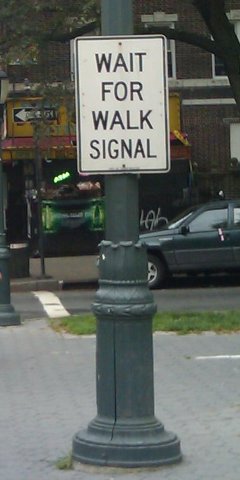
New Yorkers jaywalk habitually. Eastern Parkway has five lanes of high-speed traffic so they posted a sign advising pedestrians to actually obey the walk signal.
One big challenge is that I’m moving from a beautifully large kitchen chock full of cabinets and counter space into something well under half that size, and M has plenty of kitchen stuff as well. I take it as an interesting challenge to jigsaw everything into place in a logical, useful fashion, with every day items reachable by a woman whose height is emphatically to one side of the bell curve. As with any merger, there are redundancies to be reconciled by downsizing. Fortunately, those items left on the curb will readily find new employment in the brisk sidewalk economy of Brooklyn.
Near the end of the week I could tell I was feeling under-socialized. To be sure, I don’t require much social interaction, but even a computer geek in a new town needs some face time. Fortunately, my cousin the Actor / Tour Guide was by for lunch on Friday, and today I had lunch with a college friend, who although he grew up a nice Midwestern boy, has lived in New York long enough to have fully embraced at least the ambitious gusto of the city. “You can’t go about it by trying to save money here: you just keep striving and make more money,” he explains. Alas, he is a recruiter coming in on Saturdays to fix the office IT, and he has taken two pay cuts. But he’s excited that his novel is nearly ready.
Compared to the San Francisco Bay Area, where even a drywall contractor will show you his iPhone and talk about his cousin who works at eBay, New York City is not so tech savvy. When I went to sign the lease, the stereotypically Very Nice Older Brooklyn Jewish Lady seemed astonished at the idea that one could use the Internet to direct one’s bank to pay bills on their behalf. When she asked “what outfit are you with?” I answered and she was excited that I worked for the butchers! I’m pretty sure she had “the other Cisco” in mind but it was a refreshing surprise.
Another frustration is that our newly-renovated apartment has been renovated on the cheap, so various bits need to be fixed, while the “super” is busy managing the renovation of all the other units. (We are the fourth apartment occupied, out of about sixteen.) I won’t get in to too much griping detail, except to say that at one point the cable installers were here and frustrated at the truly horrible and mysterious site-wiring. (No, really, it is truly horrible. They had some nice wiring running to the units which they had cut off and replaced with cheaper coax that has apparently been terminated using a hammer and a pipe-wrench, and of course none of it is labeled.) The cable installer had his manager come in and I called the management company and at one point I had the grouchy guy at the management company and the field technician shouting at each other over the phone. Anyway, no cable until the site wiring is resolved: I’m going to sweet-talk the management company to get their inept contractor out here to label and signal test their drop-downs.
New York does not, to my knowledge, have a NextBus service, like San Francisco. From what I have seen, there’s not much need for it, since everything here operates reliably at all hours with fairly frequent service. It would be nice, for the power user, to know the status of complementary incoming trains on different platforms, but really I have had no problems getting where I am going. All the same, I’m glad Google Maps got transit directions into the Android application before I moved here. There’s also a little application that just shows you the subway map, and lets you zoom and pan around. Instead of looking like a tourist you’re just another douchebag playing with a trendy, overpriced toy.
Feedback Welcome
This is a note-to-self, since every so often I do this and each time I have to RTFM:
To select messages in a folder older than two months, it is:
~d >2m
Or, given my key-bindings:
T~d >2m
;d
Feedback Welcome
This time I am in a moving truck toting possessions of me and my lady to our new place in New York city, where we intend to live for one year for her work. She’s already out there, so it is just me, a 16′ Budget truck rental, and some $3 wifi access at a Motel 6. Hot diggity!
I have made this trek before, with and without my worldly possessions. This time through I own a crazy smart phone which is recording the trip via GPS, and I can upload progress to Google Maps, for all my friends and evil stalkers to see. I can send you a link: just shoot me an e-mail.
I am very happy with the Budget truck. It is a no-frills affair: the radio is just a radio. It has two power ports. I could gripe that it doesn’t have cruise control, but that might actually be a “feature” to keep the fool at the wheel alert. Best of all, it is a Ford, so I already know the dashboard!
This Motel 6 isn’t shabby either. I inquired at a casino just down the road, figuring room rates would be subsidized by gambling, but no. The Motel 6 is less than half the price and has all I need: a decent bed, toilet, shower, air conditioning, a desk and Internet access! (Oh and a TV.) They claim the lowest rates of any national chain, so I’ll have to research what they have down the road.
Ah yes, and as for work: I have received permission to work remote for my San Jose-based employer. As for my old apartment, which I love, a friend fell in love with the place and signed a lease. I left some furniture behind and some e-waste which I have to sweet-talk her into toting downstairs on a weekday, where San Francisco will collect it for free. Another blessing was the help of a trio of college friends who helped load the truck. I treated them to pizza and beers afterwards and we reveled in the pending home ownership of two of our friends. While this recession is hurting many folks, others who have been priced out of the housing market are finding their prudent patience rewarded.
Time to settle in for the evening so I can get on the road good and early tomorrow. The Motel 6 charges $3 for the wifi access, which is just the perfect price for a guy who’d like to kill an hour before bed!
Feedback Welcome
This past Saturday one Muni train rear-ended another at the West Portal station, half a mile from my house. I decided to stay away from the scene, so as not to crowd an accident scene where authorities were attending to around fifty injuries.
I have ridden these trains a great deal. They run under computer control through the subway and then convert to manually-operated streetcar service at West Portal station. Apparently, after switching to manual control at West Portal station, the driver blacked out, so his train rolled down the track at 20-23 MPH, colliding with the train in front of it.
The Chronicle points out that there is a consideration of the practice that Muni has been allowing trains to switch out of automatic mode in the tunnel before entering West Portal station: by overriding the computer control, a second train can get in to the station platform, allowing passengers a chance to change trains. Had this train remained on automatic, it would not have been allowed into the station, and the accident would not have happened.
But, to me, the thought of switching to manual control early doesn’t sound like the problem. The problem appears to be that the driver blacked out while operating a train, possibly due to a diabetic condition. In this case it may have been a blessing that he blacked out at West Portal, where his train was stopped by the train before it. Had he blacked out outbound of west Portal, his L train could well have been rolling downhill on Taraval across 19th Avenue, with little more substantial than automobiles and pedestrians to slow its descent.
I spent a little time researching whether the Breda vehicles are equipped with a dead-man’s switch or not, but couldn’t find anything conclusive. I found some reference to dead-man’s switches being required on all vehicles after 2000, while the Bredas were introduced from 1995 to 2003. My hunch is that there is a dead-man’s switch or other vigilance device, but it may not kick in automatically: had the train been rolling down Taraval maybe the brakes would have kicked, but a few seconds pulling up to the platform at West Portal was enough time for an accident between vehicles operating with minimal distance.
I don’t know . . . NTSB gets to figure it all out. I’m just glad nobody got killed.
Feedback Welcome
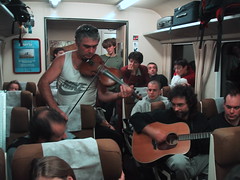
When I rode Talgo, there was a delay.
On Friday, Wisconsin Gov. Jim Doyle announced that 2 or 4 Talgo trainsets would be purchased for Amtrak’s Hiawatha service between Chicago and Milwaukee. Apparently, these will be Talgo XXI trainsets which have run at a top speed of 159 MPH, yielding a speed record claim for diesel train travel.
The Chicago Tribune reports that the trip to Milwaukee will come in at under one hour. Even better, the Hiawatha serves Milwaukee’s airport, Mitchell Field. If Chicago residents can get to Milwaukee’s airport in less than an hour, there would no need to build the fabled “third airport.”
High Speed Rail? Yes, we can!
I rode an older Talgo in Spain, which was delayed due to a fire on the tracks ahead of us. They passed out soft drinks as we sat, and the Spaniards began playing music.
2 Comments

Virgin America has wireless access on its flights. For $13 you get enough bandwidth to video conference. It was fun.
I tried not to talk too much or too loudly from my seat. To be sure, everyone on Virgin America is pretty much immersed in their personal entertainment anyway so its not so much of a thing.
(Thanks, Todd, for the screen capture.)
Feedback Welcome
I’m flying to New York. Fortunately, I needn’t lose a work day because for $15, Virgin America has got me on the Internet!
It is zippy enough, and the latency is perfectly fine, so I am guessing it is a terrestrial network. VPN works fine, too.
http://www.speakeasy.net/speedtest/
Last Result:
Download Speed: 964 kbps (120.5 KB/sec transfer rate)
Upload Speed: 337 kbps (42.1 KB/sec transfer rate)
It is a bit cramped, for sure. Fortunately, my Dell Mini 10 arrived yesterday, with Ubuntu pre-installed. (Vendor Linux!) I hope to write more about that later, but this is a zippy little thing that is probably about as usable as you’re ever going to get in a coach class airplane seat. Yay!
Virgin claim to have power plugs at each seat. I haven’t seen mine, but given the battery life this thing claims, I shouldn’t need to plug in for the duration of this continental crossing.
That looks like . . . Nevada. No . . . we’re above US Route 6 in Utah. 2112 miles to go. That’s another thing I dig about Virgin America: an interactive map at the seat terminal, and an adjustable headrest, which Southwest lacks . . .
Well, this is a work day, better get back to working.
Feedback Welcome
« Newer Stuff . . . Older Stuff »
Site Archive