This page features every post I write, and is dedicated to Andrew Ho.
I have worked as a waiter and I am regularly featured these days in the role of patron. My ex-wife is from Japan, and in Japan there is no tipping. She liked the simplicity and fairness of this model, and I can respect that. But I like — no, I love tipping. Why? It is that subversive little corner of our capitalist system that runs as a “gift economy.”
The act of giving, and the act of depending on the generosity of another person-these are both important activities required to build healthy people. In our society we have successfully taken the “guesswork” out of a lot of the giving-receiving relationships: you work for a specific wage, you pay a specific rent, a specific tax rate, you pay for food at a certain price determined by supply and demand, matters of government, and personal style. You subject yourself to the rule of law which is in turn mediated by your participation in Democracy.
We don’t live with the uncertainty of Kings, we don’t farm with the uncertainty of the weather. For those of us in the comfortable end of the middle class, the stressful uncertainties that mean more to people of lesser means mean a lot less to us: the price of milk, the price of gas, whether we are at war in Iraq . . .
It doesn’t take a lot of faith in the goodness of human nature to successfully live a life like mine. I’m insulated from a lot of the vagaries of the human condition. I’m not alone in this. And some of us, well, we forget about all that hassle: we are free to press our energies in to work, family, community, creative pursuits. I like this freedom, but . . . sometimes I open my eyes and see that the things that are stressing me out and challenging me are pointless, petty, or mundane. Especially in technology, victory becomes software shipped and larger numbers in the bank and retirement accounts.
We never go to bed hungry.
We will not wear body armor, carry M-16s and ride in Humvees through the garbage-filled streets of Baghdad, scared that we may not make it home from the cradle of civilization quite right.
We will eat until we are content, push the plate away half full. We will leave our lights on and run our dishwashers and our washing machines and stare into computer screens, trying to increase the zeros in those bank accounts. We will be constantly on the go, from climate controlled office to comfortable car to ski vacation to flights across the planet where we may dine on new foods, until we are content, and push the plate away again.
There have been a few times when I have been at the supermarket with not enough money. That kind of stress is memorable.
That kind of stress will be a part of anyone’s life. Your parents and grandparents will age and become infirm. Their hospital bills will eat up your savings accounts. You may in time return the favor of those diapers that were changed before you were too young to remember. You will be walking to your home one day and you will fall down and the doctor will explain that you have MS. Your wife will come home one day and tell you she needs to take a break, to go live with her new boyfriend.
The things that you take for granted today could change in an instant.
When I go out to eat, when I take a cab home, I have to make room in my capitalist business transaction for the tip. There are “rules” but the only enforcement is in your own character. When you give service, if you are honest with yourself, you accept that you are in an act of giving. Yeah, its your day job, and yes, chances are that the quality of your diet is a reflection of the quality of the tips you receive.
But, unlike the wage-earner, you are reminded every day that there is no guarantee, no law, nothing that says that your giving must be rewarded with anything beyond the minimum wage. So what do you do? There are no guarantees in life, you will do your best, and you will likely find that, despite some bad tipping and the occasional stiff, depending on the voluntary generosity of others actually works out okay.
You earn your income not merely with your Diligence, but with Trust and with Faith.
In my life, I have found that there are times when you have to depend on the voluntary generosity of other folks. I like that tipping remains a part of our capitalist economy. It is a reminder to those of us who are “comfortable” that we too, are subjects of fate. It is a reminder that our modern enterprise still relies a great deal in faith that the great majority of people can be relied upon to give. Voluntarily.
2 Comments
So, I am pretty good at keeping on top of my Inbox. Every so often I plow through, and I “delete, delegate, defer, do” which means that mostly I delete or archive messages that require no action, or I’ll make entries in my calendar, then delete or archive, or I’ll write a reply, perhaps a lengthier reply. Or, I’ll transcribe the notes somewhere to work into an article, or whatever. When I’m done plowing, I sometimes have an empty Inbox. E-mail is triage and when that plate has cleared you can close it and go on to other things.
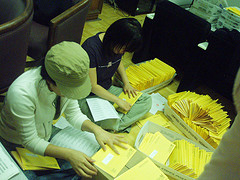
Sorting the mail . . . (CC:
KRCLA)
Delete, Delegate, and Do, are all really easy. They even map to the e-mail buttons fairly well:
| Delete |
“Delete” or “Archive” buttons. |
| Delegate |
“Forward” or make an entry in a bug / ticket system. |
| Do |
“Reply” with an answer or note that things got done.. |
| Defer |
??? . . . make an entry in your calendar? Tagging? |
Some casual poking reveals that this may be doable in Outlook, which really isn’t my style. Have any of my geeky readers thoughts or recommendations along these lines?
What I have tried, using Gmail: (more…)
3 Comments
[Some notes jotted down in the Sidekick long ago. Good stuff, I think. Maybe I should tack it on the wall somewhere, study, perhaps revise . . .]
Work
The joy of understanding problems and developing the most gratifying solutions.
The joy of learning new technologies with which to solve problems.
The satisfaction of getting things done, and being a reliable and respected resource for my coworkers.
The rewarding nature of setting expectations and goals and meeting or exceeding them.
Life
The satisfaction of walking on the Earth at different time, places, and seasons throughout my life, understanding what is consistent in myself and the world and that what is variable and “in play”.
Making connections with people, from fleeting moments of acknowledging eye-contact, to soul-sharing relationships that stretch across years and decades.
To be sufficiently self-aware about my relationship with the greater world so that I don’t take more than I need to achieve happiness.
To experience with honest fidelity the joy and the pain, the happiness and the sorrow, and all the rest of feelings and experiences that are inevitably felt in life.
Love
To practice being open and vulnerable and accepting, to allow for the possibility of love and growth in the relationships in which I engage.
To be present and attentive, to listen with good heart and a sharp mind when people speak to me.
To notice and confront dishonesty.
When “in love” to explore my partner to learn what makes them feel loved, and practice “true giving” towards them.
To always be completely honest.
Feedback Welcome
The Week reminds me that the Red States really are a different planet:
“Residents of Keizer, OR., are complaining that the towns new cement traffic posts resemble male genitalia. The posts, installed at a pedestrian intersection, are cylindrical in form with a rounded, slightly offset head, and, according to City Manager Chris Eppley, look very different from how they did in the catalog. Eppley says the city hopes to make them less phallic by giving them metal collars and linking them with chains. If that doesn’t work, “we’ll have wasted $20,000, and we’ll have to do something different.”
I live in San Francisco. I can accept that somewhere in America God-fearing people live in fear of seeing even vaguely phallic symbols . . . but I live in San Francisco. Collars and chains?
Something different, indeed!
I found some photos. From Oregon. They’re (obviously) work-safe . . .
Feedback Welcome
One habit that I have is that if I have gear I’m not using, I tend to give it away or lend it out to friends and acquaintances who might better use it. Especially with technology, this seems like a good idea: the utility of high-tech equipment degrades rapidly, and if a piece of equipment is going to become obsolete in the coming decade, someone ought to get the value from it.
Of course, right now I am stumbling around the apartment, looking for that DVD writer I bought a few years back. Where is it? Maybe I gave it away to someone. I guess the virtue is proper, but the accounting could be better. All the same, the reason this even comes up is because I am assembling a new workstation, mostly from retired equipment donated by friends. The DVD writer is not even mission-critical: I just wish I knew if it was in the house or not. If not, I can install a CD writer, which was donated to me some years back.
By the way, if you’re reading this: thank you Brian, Andrew, Michael, Lorah, Dennis, and everyone else!
And, if I ever gave you a 5.25″ Sony DVD writer, please remind me! =D
Feedback Welcome
Keith just posted his review of the iPhone. I appreciate it because he is coming off of a Sidekick 3, and he’s a Unix geek. It sounds like he really likes the web browser, and that the e-mail client is mostly good. He is still getting used to typing on the screen. Personally, I think I would have a hard time giving up the tactile feel of the Sidekick 2 keyboard.
I got to play with Ari’s iPhone last week. The web browser is pretty nifty. It handles Google Maps really well and you can click on elements within a web page and zoom in on them, turning the thing left and right to get a better view. Looks great for navigating when lost, or for casual web browsing on the train.
My take? (more…)
Feedback Welcome
Foreword: From a Top Blogger

I am a Top Blogger!
On June 28, 2007 I somehow found myself on a guest list of 35 people, “including top bloggers, top Web 2.0 companies, and members of the press.” We were guests of Powerset, to attend their premier public demonstration of their new natural-language search engine. Being as I must be, a top blogger I took notes on my Web 1.95 T-Mobile Sidekick.
I had previously applied to work at Powerset: where everybody gets a Mac. The offices are located near the Caltrain station, making them a reasonable commute for the Peninsula crowd as well as for those of us accustomed to public transportation. I had interviewed informally with a former colleague, who in sizing me up as a Systems Toolsmith, looked at me with pity when I confessed that my sole capacity for analyzing and expressing complexity is English, and not the formal notation Computer Scientists call “Big O.” (Why must they only hire smart people?)
He did, however, pique my curiosity. “The easy part” of building a new search engine, he had explained, was crawling the entire web. “The hard part,” he went on, was to bring in enough computing capacity to build natural-language indexes. To my ears, Powerset is pushing the envelope of what is feasible, which is cool. And as Google hath shewn, if you can build a better search engine, the world might beat a path to your URL.
Infiltration: Perimeter Security

Manipulate the Press with Special Kool-Aid
I found the corporate headquarters on-the-corner-of-Brannan-and-Fourth with only modest difficulty. Powerset had a guest list to get upstairs, but the building security guard informed me that if I was here for the Steelcase party on the ground floor, I should just go right in. Given my duties to the blogosphere, I indulged in a bit of Gonzo Blogulationalism, and crashed the Steelcase party for 25 minutes. Steelcase apparently designs really innovative office furniture that would look right at home in The Container Store. They also had a great spread of tasty Asian dishes, origami kits, and booze. I made sure to tip the bartenders for my Sapporo, and for the Anchor Steam that I pocketed for the journey upstairs to Powerset, where they had not only booze, but special Kool-Aid, and blue pills.
I was among the first to arrive at Powerset. I swiped a handful of Red Pills, and then a handful of Blue Pills, washing them down like candy with my illicit beer. As I waited for the jelly beans to kick in, I found myself chatting with a voluptuous and extremely blond computational linguist with a cool Nordic surname. She was afraid of being misquoted by would-be top bloggers, but I assured her that I am terrible at remembering names, and besides I had been ingesting dubious substances. I got her to admit that she had always approached her work with enthusiasm, but now she felt as if she was working in a company where every last person had great talent and intensity, on a project that she felt could improve the ability of people to search the Internet, and thereby change the world. To a person, the Powerset staff came off as sharp and enthusiastic. It seems that they do drink their own Kool-Aid.
The Powerset lobby quickly became choked with geeks–standards nerds–top bloggers, members of the press–and someone (Powerset) was giving booze to these god-damn animals–and hors d’œuvre! The mushrooms were seriously tasty. Before long, the Beautiful Norse Computational Linguist surprised the milling herd of geeks with a stream of self-confident ejective syllables, and we were ushered into the Powerlabs meeting room, where we took seats, kibitzed, and prepared to be dazzled.
Steve Newcomb, (pronounced “Nuke’m”) the COO, and other Powerset staff introduced themselves. Steve explained the Powerset tradition that every Thursday, at 4:20, all Powerset staff gather in the room where we were now assembled, and are invited to ask questions. The only rule on these occasions is that Steve has to give some sort of answer. It is in this spirit of openness that Powerset sought to present their technology to us. (more…)
Feedback Welcome
I recall Tom Limoncelli giving a presentation called “Time Management for System Administrators” and he explained how, as part of his routine, he would walk over by his customers–his users within the company he worked at–and check in at a regular time. Some days, they might ask questions that would reveal to him potential improvements in the systems architecture, and other times they might ask simple technical support questions. Either way, by dropping in at regular intervals, the users came to feel good about their Systems staff. This can be damned handy when, as they occasionally do, the systems go down hard, staff scramble to fight fires, and users are left out in the cold with little more to work with than their innate feelings about the Systems staff. If they like you, they will feel sympathetic in your hours of stress. If they don’t like you, they hope the present outage may be a nail in the coffin of your tenure.
I was put in mind of this by the story presented in today’s Daily WTF . . . the user, who could be described as “dim” had been following a really complicated, error-prone process. She had no idea that a trivial change to the system could be made to make her life easier. The hero of the story happened to be walking by, hear her frustration, politely inquire, and five minutes later, make betterness happen:
Still, there’s a good lesson here that’s often missed; pay attention to what users are doing with the provided system and by unblocking minor bottlenecks you can become the hero.
Amen. Amen. Amen. (more…)
Feedback Welcome

[Update: weaselly underscores omitted from cuss words per Andrew Ho’s patriotic fervor, and because it might look neat.]
Girlfriend came over, with six peaches she picked from her peach tree this very morning. I washed the earwig out of one. We walked down to the beach, and back up again, stopping for pastries and a slice of pizza. We watched “Winged Migration” which is really good if you don’t pay attention to the self-important French people, and tolerate the silly parts when the bird flies up an out of the atmosphere to circle the Earth like Sputnik, except yeah, “no special effects were used while filming the birds.”
Saw the girlfriend off . . . neighborhood goes boom . . . boom . . . occasional bursts in the distance. A groovy Independence Day.
Then I see a URL to a comic strip with kids eating Bald Eagle tacos. Okay, crass. But the commentary rant is worth sharing:
I know I’m starting to sound like a curmudgeony old bastard but… it really did used to be better, even just a few years ago. I swear to God right now you could watch Dick Cheney beat a homeless vet to death with a cinder block and everybody would just kind of let out a weak sigh and go “only two more years” but then go into full-blown warrior mode when the Youtube button on their iPhone got scratched. Stand in line to buy portable telephone, wondering what you’ll say to the first person to ask you to touch it while the thing you Pledged Allegiance to everyday when you were growing up gets gang-banged by a handful of frat boys that pay less taxes than you and don’t have to go to jail when they may have committed treason.
And, quiet as I have kept, I gotta admit, I think the iPhone spectacle . . . geeks waiting in line to pay $600 for a cell phone with a $1400 service commitment . . . but what is worse is to hear President Bush prattling on about how we must defeat Al Qaeda in Iraq or else they’ll follow us home–the best that can be said for why we need to be over there is because we chose to go there and f_ck up that sh_thole of a countryfuck up that shithole of a country, and it is hella true if Dick Cheney beat the crap out of a homeless man we would just shake our heads with a tear in our eye. If you commit treason you should go to jail, even, hell, especially if you’re just some hack taking a bullet for the White House! GAH!
Okay, back to munching on my toast and pondering my regular life. If there’s a protest in the streets sign me up . . .
2 Comments
The morning of July 2, I have arrived at the last page of June’s “The Sun” and find an occasion to chuckle:
“By all means marry: if you get a good wife, you’ll become happy; if you get a bad one, you’ll become a philosopher.”
–Socrates
Socrates is a mortal. And so am I.
“Wasn’t marriage, like life itself, unstimulating and unprofitable and somewhat empty when too well-ordered and protected and guarded. Wasn’t it finer, more splendid, more nourishing when it was, like life itself, a mixture of the sordid and the magnificent; of mud and stars; of earth and flowers; of love and hate and laughter and tears and ugliness and beauty and hurt.
–Edna Ferber
It was.
Yes, the title says “Two Perspectives” but we wouldn’t want this content to be too well-ordered, yeah? Here’s an assertion that I know many would take exception to. (more…)
Feedback Welcome
I received an e-mail:
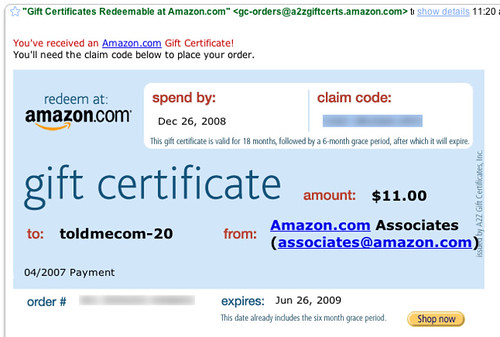
As I noted on Flickr: I just received my first "payment" for carrying Amazon.com advertising on my web site. Neat! This is hardly “f_ck you” money, but it is greater than zero.
For the record, I have been with Google AdSense for over a year now. That service brings in enough to cover the costs of my home DSL and then a wee bit more. Thanks to the generosity of friends, the hosting costs of my web site are nil, but I could probably cover that with revenue.
Of course, I am operationally “cash flow positive” but no financial incentive for content, just yet. No incentive beyond rhetorical diarrhea. :)
Pie-in-the-sky, my web site receives around 10,000 unique visits per month. I could probably “monetize” that better, but as I like to say, if I had 200 times more traffic, I could cover all of my living expenses.
Feedback Welcome
Photos Flickr now supports pretty URLs, and sports an inline Function Reference, that should become pretty fully fleshed out in short order.
Pretty URLs? Yes! If you are using permalinks and mod_rewrite, compare these two URLs:
/?page_id=3&photoset=72157600167167486&photo=481023042
versus:
/photos/photoset/72157600167167486/photo/481023042
BUG: Uhm, actually, if you have pretty permalinks this plugin will break unless your post slug is photos . . . I just tried to fix this but failed. Sorry about that.
See Photos Flickr in Action
What is New? What has Changed?
- New: Function Reference Manual
- Changed: Extended
photos_photo_index() to support titles and descriptions, pimp out default template.
- Changed: References to
$_REQUEST have migrated to refer to WordPress’ $wp_query->query_vars.
- New: Checks if blog is
using_permalinks() and if so, utilizes rewrite rules to make pretty permalinks.
- New Bug: Checks if blog is
using_permalinks() and if so, rewrites URL links along the assumption that your page slug is photos.
- New: Added
photos_photo_href() function.
What is Fixed?
- Fixed: Minor fix to
photos_private_getContext() to correctly get photoset
context.
There is plenty more work to make this an awesome plugin. You can track plans and progress on my “projects” page.
Feedback Welcome
« Newer Stuff . . . Older Stuff »
Site Archive