Link:
https://dannyman.toldme.com/2011/06/02/i-wallace/
Last week I enjoyed a great story by Rands, who, as a team lead, had a total communication disconnect with one of his team members. While he enjoyed an easy rapport with Harold and Stan, he just wasn’t clicking with Wallace. At first he accepted things as they were, but soon learned that the disconnect with Wallace was a genuine problem in need of improvement. Rands concluded that the only thing to do with Wallace was to completely unwind his normal assumptions about rapport and “clicking” with a colleague and just get down to making basic communication work. This can be pain-stakingly frustrating, but this is what you need to do when you’re not getting the easy, intuitive connection you want with someone you rely on.
One of the comments (Harry) chided Rands: “Here’s the deal: if your boss asks you to lead, he either gives you the power to sack people, or you don’t accept his job offer. In your case, Wallace is obviously not compatible with you. So you sack him.”
I thought “No–Good engineers are expensive, and it is preferable to learn to steer an existing engineer in the right direction rather than finding and training a replacement.” Other comments pointed out that Wallace wasn’t incompetent or incapable, just that he needed clear expectations with management. Someone named Dave chimed in:
“I’ve been a Wallace, and I’ve also been a Harold, and from my standpoint it has less to do with personality than with context. You can have a poor team dynamic, with no clear leadership and constantly-shifting goals, where everybody ends up isolated in their corner and becoming Wallace, at least in part. Or you can have a good team, where even the most Wallace-y engineer becomes Harold for at least a few hours each day.”
Amen. We each have in us both a Wallace and a Harold. They are Yin and Yang. The Wallace side of my personality wants to get heads down in to the work, but needs to know what to work on. The Harold side takes some time to chat up his manager and coworkers to find work and set priorities, then steps aside and lets Wallace get back to work. Tech workers tend to be more innately introverted, they tend to want a good manager to play the part of Harold, and come back and set clear work objectives and priorities. When things are not going well, unhappy people will tend to revert to their base personalities. For engineers this often means getting stuck in Wallace mode.
Sometimes employees are happy and eager, and sometimes they are curmudgeons. It depends on the context of work and life morale, mediated by an employee’s emotional intelligence. These are variables that can be influenced, allowing for change over time. Management needs to provide a positive work environment with clear goals. Employees need to do our part in building a positive home environment, with positive life aspirations, while also cultivating a greater degree of self awareness. An employee who learns to steer their own craft and deliver what management wants will create a more positive work environment for their colleagues.
Feedback Welcome
Link:
https://dannyman.toldme.com/2011/05/02/and-good-riddance/
Some folks are irritated with American reactions to the death of Osama bin Laden. Julie indicated that she had mixed feelings upon seeing our “own countrymen basically holding a frat party outside of the White House, hanging off of trees and singing ‘Nah nah nah nah, hey hey hey, goodbye!'” I have heard others moan that this doesn’t change anything, why are we celebrating?
So, I expressed my own feelings in a comment on Julie’s blog:
I was happy about the news yesterday, and I still am. We killed a bad guy who has devoted his life to killing us. That is a victory, and I am proud and glad.
When the crowd outside the White House gathered and sang the Star Spangled Banner, it brought a tear to my eye. Then, America the Beautiful. People gathered at Ground Zero for a candle light vigil. In both places, the crowd chanted “USA! USA! USA!” They spoke for me.
I think it is debatable who kills the most Muslims. Our military adheres to Rules of Engagement that put them at greater risk in order to protect Muslim civilians. On the other hand, extremists recruit the young and naive to walk into crowds of Muslims wearing explosive vests.
We are not perfect and we shouldn’t pretend to be. We make mistakes, we kill innocents, and we have failed to hold ourselves to our own standards of humane treatment of prisoners and jurisprudence.
We are drawing down forces in Iraq, which has changed from a brutal dictatorship built on terror to a messy, unstable, imperfect democracy vulnerable to sectarian violence. We now have one less reason to linger in Afghanistan, which may help motivate the government there to get its act together.
Last night was progress. America done good and a bit of pride is perfectly reasonable.
-danny
I mean, its no Moon Landing. No sincere attempt to curb global warming or end world poverty, hunger, disease . . . but it is progress and I’ll celebrate it just the same.
Feedback Welcome
Link:
https://dannyman.toldme.com/2011/05/02/the-final-frontier/
“The universe is probably littered with the one-planet graves of cultures which made the sensible economic decision that there’s no good reason to go into space–each discovered, studied, and remembered by the ones who made the irrational decision.”
— Randall Munroe
http://xkcd.com/893/
Better a has-been than a never-was.
Feedback Welcome
Link:
https://dannyman.toldme.com/2011/01/28/atherton-fear-the-shadow/
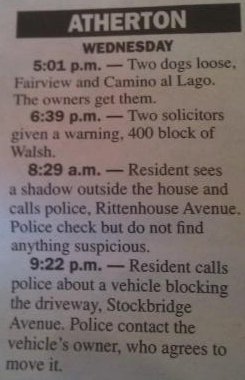
Beware the Shadow
Admittedly, not much of a photo. But here’s a shot from this morning’s local free paper. I always like to see what sort of petty crimes have made the Atherton Police Blotter. (Atherton is where we keep our rich people, sealed off in walled compounds.)
2 Comments
Link:
https://dannyman.toldme.com/2011/01/18/what-goes-down-goes-up/
The market has been doing well lately, but even I am surprised.

Back in March 2009 when things were looking their bleakest, I scratched together less-than-my-usual-amount of cash and bought shares in a market index. On that occasion, QQQQ (Nasdaq 100) at $28.17/share. Today I noticed that, at $57, that stock has more than doubled in value since I bought it.
Three things come to mind.
1) Yay me! (Though, I have seen plenty of my money evaporate in stocks, so I won’t get too smug.)
2) Warren Buffet’s advice, to “be greedy when others are scared, and scared when others are greedy.” Since people are getting greedy, I shouldn’t feel too bad selling stock at this height to cover wedding expenses.
3) My perpetual ambivalence about the stock market as a gambling parlor that doesn’t reflect true economic value, but is really a bunch of rascals trying to trick each other. The real value in our economy is in the workers and the planet, and the stock market on a good day is an ethically blind attempt to influence the direction in which the workers will direct their work.
Feedback Welcome
Link:
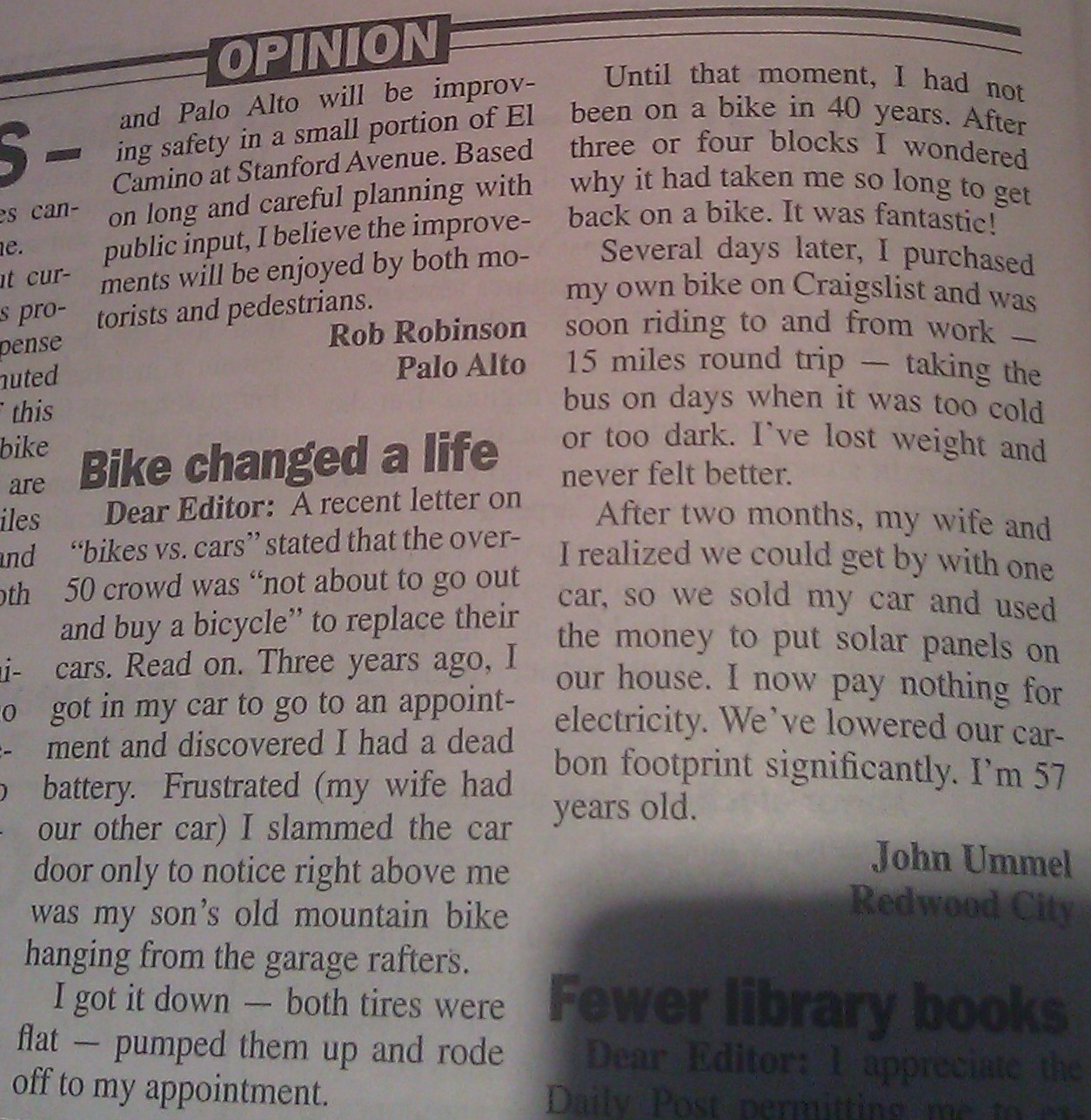
https://dannyman.toldme.com/2011/01/14/bike-changed-a-lidf/
Last month I “cut and copied” the following letter printed in the Palo Alto Daily News. (Or I think its called the Daily Post now.) Now I shall paste, transcribe and share:
The text reads:
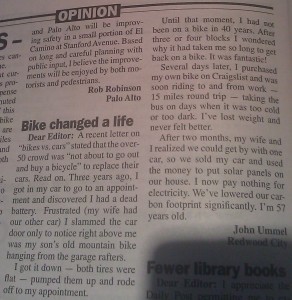
Bike changed a life
Dear Editor: A recent letter on “bikes vs. cars” stated that the over-50 crowd was “not about to go out and buy a bicycle” to replace their cars. Read on. Three years ago, I got in my car to go to an appointment and discovered that I had a dead battery. Frustrated (my wife had our other car) I slammed the car door only to notice right above me was my son’s old mountain bike hanging from the garage rafters.
I got it down — both tires were flat — pumped them up and rode off to my appointment.
Until that moment, I had not been on a bike in 40 years. After three or four blocks I wondered why it had taken me so long to get back on a bike. It was fantastic!
Several days later, I purchased my own bike on Craigslist and was soon riding to and from work — 15 miles round trip — taking the bus on days it was too cold or to dark. I’ve lost weight and never felt better.
After two months, my wife and I realized we could get by with one car, so we sold my car and used the money to put solar panels on our house. I now pay nothing for electricity. We’ve lowered our carbon footprint significantly. I’m 57 years old.
John Ummel
Redwood City
Feedback Welcome
Link:
https://dannyman.toldme.com/2010/09/30/september-2010/
Wednesday, September 1
This morning I skipped the bicycle ride to work, figuring that inhaling auto exhaust is less advisable on a “Spare the Air” day. Then I got double-whammied by the VTA at Evelyn station, where I arrived just-in-time to have caught a train on the platform, except I had to buy a ticket first. And of course, once the train was gone my $5 bill slid right in and required none of the usual massaging and unfolding-of-the-corners.
So, I caught another train one stop out to Mountain View: the end of the line. Since it is one track at Evelyn, any train waiting to start its run from Mountain View has to wait. And wait it did, until we pulled up to the platform. The train I wanted to be on slid back toward Evelyn before my train could even open its doors. So, I waited another several minutes to leave Mountain View, but I got to pass the time reading, which I can’t do on the bicycle, so I’m not going to complain much.
When I got back from lunch I learned that the market had rallied, and my limit order to sell TSLA at $20.45 had finally executed. It actually peaked ten cents higher and then closed at $20.45. This is the second time I had rode Tesla’s fluctuations successfully and now that I’m no longer on the East Coast and the market starts its day before I wake up, I figured I’d cash out of this fancy-pants chicanery and buy DIA. But I placed a limit buy at $100, which is where it has been lately. “Name your price!”
Thursday, September 2
“The simple view is that medicine exists to fight death and disease, and that is, of course, its most basic task. Death is the enemy. But the enemy has superior forces. Eventually, it wins. And, in a war that you cannot win, you don’t want a general who fights to the point of total annihilation. You don’t want Custer. You want Robert E. Lee, someone who knew how to fight for territory when he could and how to surrender when he couldn’t, someone who understood that the damage is greatest if all you do is fight to the bitter end.”
–Atul Gawande
“Letting Go”
The New Yorker
August 2, 2010
Friday, September 3
Biked to work today. Ordered a tape recorder for the99ers.net and pulled an old picture from the Tellme days for the theme’s header image. Dinner tomorrow with a friend who is moving back to Chicago. Sunday I’ll drop Mei off at the airport so she can fly to LA for the week for her boards review course.
Monday, September 6
Not much to say.
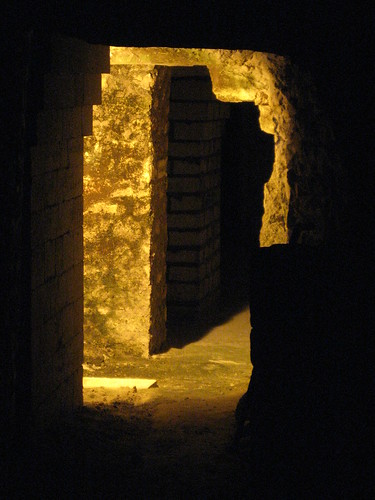
From the Catacombs, beneath Paris.
I don’t like Flickr’s new interface. It used to be that if you viewed “all sizes” you could get the HTML to link to a photo. Now you have to click on a FAQ, then navigate back to the photo, and go down a different route to grab the HTML. Would it be so wrong to support the navigation habits of users who have been using the site for over half a decade? All the buttons that used to be just a click away are buried under a menu, and I sometimes have to scroll down to beneath the photo to change the title. I also miss that tags used to each be on their own line. The new interface seems like its been labotomized so that we can be filled in with a bigger photo, and more white space.
*sigh*
Okay, just wanted to let that out.
The sweetheart is away. I am copying some episodes of The IT Crowd over to play.
Tuesday, September 7
I took a different route to work today, up Stevens Creek, over to Ellis and then tracing along 237 and 101, first on quiet frontage roads and ultimately on dedicated bike trail. It was nice and had very little traffic stress compared to my Evelyn-Wolfe-Arquez-San Thomas-Tasman route. On the other hand, I end up breathing in 8 lanes of highway exhaust much of the way. Do I prefer the quick death of a vehicle collision or the slow death of lung disease? Hopefully we can repair that stuff in a few decades.
It is not that children are just smaller adults, it is that adults are larger children.
Thursday, September 9
I have an orthodontic consult this afternoon. Consequently, I am working from home today. I took my hardware VPN back in since I don’t need it any more, and can free up some desk space and power drain. Alas, I had to jump through a few little hoops to get software VPN working this morning. I have been back at the office for just over a month now and my commutes to San Jose and San Bruno have all been via public transit or bicycle, with the occasional ride home from a co-worker. This little bit pleases me.
Sunday, September 12
“It occurred to him that life, which he’d treated as a pastime, and which he’d thought he could yet outdistance, had finally caught up with him. And he’d discovered, much as he’d suspected, that once life caught up with you, you could never quite shake it again. It endeavored to hobble you with greater and greater frequency. How you managed to remain upright became your style, who you were.”
–David Bezmozgis
“The Train of Their Departure”
The New Yorker
August 9, 2010
Mei comes back tonight. I pick her up at the airport around midnight. After too long, I have gotten my hair cut, at a Chinese place where speaking English is sufficiently awkward that the lady skipped the usual foreplay of asking what I wanted and just got down to the business of cutting my hair. Wham, bam, thank you, ma’am!
Compared to Brooklyn, Mountain View is a sleepy, slow town, where people spend their time waiting for turn-arrows and a trip to the convenience store invariably requires one to stand patiently in line, as the lady carefully counts out exact change and labors over the implications of whether it is worthwhile to sign customers up for the club card, while I quietly wait in line, nostalgic over all the times in the past year when I had ducked in to a store, exchanged quick cash with the proprietor, and was back on my way. Club cards be damned. They have no place at a convenience store.

Monday, September 13
From the upcoming “Social Network” movie, via The New Yorker:
“Listen. You’re going to be successful and rich. But you’re going to go through life thinking that girls don’t like you because you’re a tech geek. And I want you to know, from the bottom of my heart, that that won’t be true. It’ll be because you’re an asshole.”
As someone surrounded by geeks, I’ve always known that if someone thinks I’m an asshole, it is because either I am an asshole, they are an asshole, or between us we’re just confused as to who the asshole is.
Tuesday, September 14
Advice sent to a loved one:
Aaaaanyway what I’d do, if anything, is thank the lady for her good intentions, and apologize that sorry, I can’t send her any money because of my discomfort over the quality of decision making made in the name of religion. It sounds like her mission is to overtly spread the idea that personal morality can not be guided by the innate human capacity to discern right from wrong, but by a confusing and contradictory corpus of Iron Age mythology mediated by a competing group of organizations which are at best patriarchal in nature and at worst openly practice terrorism and sexual violence. This approach to enriching humanity is a cause I could never support. I would explain that I would be strongly inclined to make contributions on the behalf of secular charities with morally clear missions like Habitat or MSF.
Its like, you can gently suggest that someone’s belief system is foolish and deadly without having to bring up the inquisition, the IRA, or 9/11. After all, she thinks you’re going to hell, so, whatever. If someone ever wants to throw down I’m sure you can get all Richard Dawkins on their ass.
Wednesday, September 15
San Bruno fire Captain Bill Forester’s Engine 51 was one of the first two teams on the scene; the other big truck got hot so quickly its windshield exploded. “This looks like Armageddon,” Forester recalled thinking Tuesday. “It was like they took a Saturn V rocket and tipped it upside down during blastoff.”
Terrified residents were fleeing down the hill with the fireball chasing them, firefighters recalled, many already badly burned and screaming for help. There were so few ambulance trying to keep up that paramedics began asking unhurt residents to drive people with smoldering burns to nearby hospitals. Police officers and firefighters kicked down doors to rescue anyone stranded in homes.
Even with the wail of sirens filling the background of one radio call asking dispatchers to issue a third alarm, it is the rising alarm in a firefighter’s voice that tells the truest story. “We’ve got multiple houses” on fire, he reports to the command center. “We’re trying to get close. We have extreme heat. We have possibly several blocks on fire at this time.”
There is silence on the radio for a moment. Grasping fully the nightmare that she can hear unfolding in an invisible chorus of voices, the dispatcher slowly replies, “Copy that.”
More than 15 minutes into the disaster, a dispatcher issues a fourth alarm, summoning fire companies from all across the Bay Area to respond to “a plane crash.” A firefighter asks whether it’s a “large aircraft or small aircraft,” but no one knows. This would affect the firefighters’ initial response to the blaze because the accepted method of dealing with a plane crash is to put it out at the source in order to save passengers’ lives.
Gas main fires are extinguished by shutting off a valve, and there have been reports that it took PG&E well over and hour to close this one.
“With a pipeline that big, even if you shut it off a mile away it could burn for another hour,” said Kevin Conant, a battalion chief with the San Jose Fire Department who was not involved in fighting the San Bruno blaze. “I think it was completely legitimate for them to consider that there was an airplane involved because of the amount of fire they had.”
First responders say the most frightening moment occurred when they tried to tap into the neighborhood fire hydrants and heard only a sucking sound . . .
Mike Rosenberg and Bruce Newman
“Tapes Reveal Frantic Scene”
San Jose Mercury News
September 15, 2010
Later, Bike Snob NYC made me laugh:
“Like coffee, religion props people up and gets them through their day, and in this sense I believe that religious institutions are like Starbucks in that there are way too many of them and they sell a lot of crap–the only difference is that at least Starbucks pays taxes and offers WiFi.”
Friday, September 17
I was a little surprised to see sfcitizen whining about the physical impossibility for driving 25 MPH, so I chimed in:
Once the speed limit hits 20MPH, then your chances of a fatal pedestrian accident become extremely unlikely. There is advocacy in Britain to expand 20 MPH zones:
http://www.20splentyforus.org.uk/
If you keep light on the gas, it is entirely easy to drive slowly, and a pleasure to boot, because down in this speed range your mind can almost catch up with all that is going on around you: less stress! You just have to let go of the selfish idea that you have some God-given right to drive fast.
I just returned to the South bay from Brooklyn. I have to say, driving in Brooklyn at a constant 20-25 MPH, slaloming around double-parked cars, bicycles, and the rest, is a lot more relaxing than waiting two minutes at a left-turn light so you can tear down El Camino at 40 MPH.
Open your mind instead of the throttle. you might find you enjoy driving slow. Good luck!
-danny
Yeah, I know I’m a crackpot. And when I was younger I had a more leaden foot, but over the past decade or so my driving has mellowed a great deal, possibly because of the station wagon. When you’re driving a boat it is easy enough to relax and take it easy, and I maintain that style in smaller, more nimble cars.
Thursday, September 23
So, we decided to spend Thanksgiving with Mei’s folks in Hawaii and Christmas with my folks in Chicago, so I set up our Hawaii vacation for November. I have never been there myself but it should be easy to enjoy.
On Monday they opened up a long-closed bike trail up North of Moffett Field. This has been a long-awaited link in the Bay Trail project, and I am pleased because now instead of riding on streets and on a 237 frontage road I can ride up the Steven’s Creek trail, then around the North side of Moffett Field, then East along the Bay Trail and then along a canal to the office. That’s a bicycle commute that is over 90% off the street.
But . . . a lot of this new route is gravel. It takes more concentration to ride safely, and getting a flat on my road tires is more likely. The salt flats smell of salt, seaweed, and decay. But I’ll take the occasional flat tire and maybe a gravelly wipe-out or two over being killed by a distracted SUV driver, and the wetlands scenery is a greater pleasure for the eyes and the nose than riding through high-speed suburban street traffic and waiting for red turn signals. I feel lucky.
When I rode the trail home on Monday people would smile and greet each other as they passed, because hey, we had a new toy.
The other new toy I have this week is Civilization 5. I was able to play the first half of a game last night, and so far I really enjoy it. It is a pretty huge change in a lot of ways from Civ 4. Civ 4 is more of a simulation game with lots and lots of variables thrown in to keep a player challenged. I think the developers leaned back and said “Civ 4 is great, but it is pretty dang complicated. Let’s make it easier for new players.” So, Civ 5 has streamlined a lot of things. The graphics are really beautiful, and the tech trees and units are pared down. Diplomacy is re-worked and the whole religion-civics thing has been consolidated into a new set of “Social Policies” which you can enact as you amass more culture.
The interface has moved from the traditional sim-manager style to more of a “builder” paradigm. For example, happiness is now an aggregate for your entire Civ instead of something managed in each city.
Aaaaaaanyway . . . . . I want to understand the military and diplomatic interfaces better, and just get a few games done and out of my system.
Friday, September 24
“I think we are making a transition, the most important in the history of Homo sapiens — more important than our long walk out of Africa and across Europe and Asia. This is our moment. Anyone who died before 1930 never lived through a doubling of the human population. Anyone born after 2050 likely won’t either. We are in a 120-year transition that will require an emerging consciousness if we’re going to make it through.”
Wes Jackson
“Farmed Out”
The Sun, October, 2010
Monday, September 27

We purchased a humming bird feeder this weekend. Within about ten minutes of installation, the first little bird flitted over. They catch on quicker than the larger birds, who we can occasionally hear at the other feeder, spilling a steady trickle of seed on to the balcony.
Thursday, September 30
It is nearly noon and I am relaxing with the ever-studying Mei at my favorite coffee shop. My work hours today are going to be around 1pm-9pm, due to afternoon and evening deployment windows for software on our production networks. That’s my day job. Well, today my day job is slacker, and my evening job is deployment engineer.
Feedback Welcome
Link:
https://dannyman.toldme.com/2010/08/19/sister-helen-prejean-describes-an-execution/
From the August, 2010 issue of The Sun Magazine:
Cook: You’ve said that if executions were made public, people would realize the brutality of this system and work to end it. Yet, in our past, crowds would show up for public executions, some with picnic lunches. In our age of violent media, what makes you so sure average citizens wouldn’t applaud the execution of a killer they were certain was guilty?
Prejean: There would be some, no doubt, who would pull out a beer and cheer that this terrible murderer had been killed. But for most people who see it up close, capital punishment is very unsettling. The head of the Department of Corrections in Louisiana has to arrange the protocol for executions, and part of that is gathering witnesses. At first he thought he’d have a line of people stretching across the Mississippi River waiting to get in, but soon he realized that no one who witnessed an execution asked to come back. When you’re in the death chamber, you see when they have to jab the needle eighteen times into the arm of the condemned. You hear the stumbling last words of those who are killed: “Mama, I love you,” or “I’m so sorry.” Imagine an ordinary American family having their evening meal, and the news comes on, and the kids ask their parents, “Isn’t that murder too?” and, “Why are they putting antiseptic on his arm if they’re going to kill him?” It would not take long for people to cry out against this, and that’s why it will never be public. You have to keep it from the eyes of the people.
Cook: You have served as spiritual advisor to six men who were executed. What were their last days, their last hours, like — for them and for you?
Prejean: Being with someone who is about to die is surreal. When you’re with someone in the hospital who is dying, it’s at least a natural process; you can see them leaving you. When someone is fully alive, and you’re talking to him in the way you and I are talking, you can not get your mind around the fact that in two hours, now one hour, now forty-five minutes, he’s going to be killed.
The death itself is almost scripted: Now they’re walking in. Now I’m telling him goodbye and kissing him on the back. I’m praying for him and asking him to remember me to God. Now the guards have me by my arms. They are sitting me down in a witness chair. There’s the big clock on the wall. There’s the exhaust fan, already turned on, that will suck from the room the stench of the human body burning. There’s the blank glass with the executioner on the other side. They’ve already tested the chair. It’s run on a seperate generator, so nobody can prevent the execution by throwing the main switch. The lights are bright floursecents. There are two red telephones on the wall: If one rings, it is the court issuing a stay of execution. If the other rings, it’s a pardon from the governor. Neither phone rings. The victim’s family is sitting in the front row to watch. The other witnesses and I are sitting behind them. There are two newspaper reporters writing vigorously on narrow spiral pads. And the condemned man is looking at me. And I put my hand out. And he can see my face. And they put the leather mask over his face, so tight I worry he can’t breathe. How quickly they strap him in the chair and step away. It’s an oak chair. They put a cloth soaked with saline solution on his shaved head and then the metal cap. A thick, curled wire runs from the cap to the generator. And then the strap goes across his chest.
I didn’t look the first time, because with the mask I knew he couldn’t see me anymore. With lethal injection he can see me, but not with the electric chair. I closed my eyes and heard the sound of it. The huge, rushing, powerful sound of the fire being shot through his body. Three times. They run 1,900 volts, then let the body cool, and then 500 volts, and then 1,900 volts again. What’s terrifying is that they’ve done autopsies of people who have been electrocuted, and the brain is mainly intact. We don’t know what they feel. We really don’t know, when we kill a human being, what’s going on inside, the pain of it.
Cook: You believe that the days leading up to an execution amount to torture.
Prejean: I don’t say this lightly. According to Amnesty International, torture is “an extreme mental or physical assault on someone who’s been rendered defenseless.” Just imagine if somebody took you hostage in a room and said that in twenty-four hours they were coming to kill you. And, when the time comes, they put the gun to your head and pull the trigger. It clicks. It is an empty chamber. They laugh and walk out and say, Not today. Maybe tomorrow. That’s torture.
Everybody I’ve known on death row has had the same nightmare: they dream it is their time, and the guards come and drag them out, and they are screaming and sweating, and then they wake up and realize they are still in their cell. Just think about when you have to go to the dentist for a root canal. If the appointment is for Friday, all week you are living in dread. That’s just for a root canal.
You can read a longer excerpt at the Sun’s web site.
Feedback Welcome
Link:
https://dannyman.toldme.com/2010/07/13/books-for-demetrius/
We are preparing to move back to California, and my nephew has reported that he has no plans for this summer before his senior year of high school, so late one night I tore through the shelves for volumes I thought might find a suitable home with his family. I figured to create an “annotated bibliography” and why not post such a thing online for the sake of possible discussion?
See the World
“Vacation Work’s Work Your Way Around the World” by Susan Griffith
An outdated guide that can give a sense of ways one might spend more time overseas. (Though the first advice is that the best place to work and save money for travel is usually the USA.)
“Dark Star Safari” by Paul Theroux
Paul Theroux is best known for his books about railroad travel, but in his overland journey from Cairo to Capetown, there are few trains. A taste of travelling in Africa, including an actual wild life safari.
“Japan” by Lonely Planet
An out-of-date guidebook which might have interesting stuff for a Japan-o-phile to read.
“Teaching English Overseas: A Guide for Americans and Canadians” by Jeff Mohamed
Worth a skim if you think you might want to live overseas one day.
“Overseas Timetable: Surface Transport for Africa, Asia, North and South America and Australia” by Thomas Cook
Outdated, but fun “travel porn” if you wanted to fantasize or estimate the different ways you could get around the world’s surface. Europe has its own book of the same size.
Coming of Age
“The White Boy Shuffle” by Paul Beatty
A fictional coming-of-age experience of a nerdy young black man in California. I particularly enjoyed the parts that recounted the LA Riots.
“Not Without Laughter” by Langston Hughes
Another fictional coming-of-age of a young black man, this time in the 1930s.
“Apartment 4B, Like in Brooklyn” by Evan Ginzburg
Short stories of what it was like to grow up in 1960s Crown Heights, as the neighborhood turned black. (This year I have lived in the same area, which is “gentrifying.”)
“Son of the Revolution” by Liang Heng
An autobiographical account of growing up in Communist China, through the Great Leap Forward and the Cultural Revolution. This is a book I had to read in college which I held on to because it is such a great story of what it is like for a young man to grow up under vastly different circumstances.
Question Convention
“No More Prisons!” by William Upski Wimsatt
A very different kind of book: Wimsatt explores different ways to make life more fulfilling and successful. It was originally published by the anarchist Soft Skull press, if that gives you any idea. The title serves as both a call against our modern prison system, but also for emancipation from the less visible prisons we find ourselves trapped in.
“Heart of a Dog” by Mikhail Bulgakov
A short, sweet novel narrated by a dog in Moscow.
“Death at an Early Age” by Jonathan Kozol
Explains the numerous failings of public education in 1960s Boston. It was weird how much similarity I had personally witnessed in the Chicapo Public Schools of the 1980s.
“The Omnivore’s Dilemma” by Michael Pollan
A long-winded exploration of the failings of our contemporary food system, and how we might go about eating right.
“The Years of Rice and Salt” by Kim Stanley Robinson
An alternate history of a world in which no Europeans survive the 14th century Black Death.
“The Diamond Age” by Neal Stephenson
Science fiction set in a near future where there is no longer any shortage of food or stuff: now humanity has thoroughly different problems. Totally blew my mind.
“The Myths of Innovation” by Scott Berkun
How great technological advances actually come about. (And how they don’t.) Good storytelling helps to better understand the creative process. (Signed by the author.)
“Freakonomics: A Rogue Economist Explores the Hidden Side of Everything” by Levitt and Dubner
Applying the science of economic statistical analysis and field research to explore questions economists don’t usually explore, like the economics of drug distribution in Chicago. A fun way to look at things from a different angle.
“Fast Food Nation” by Eric Schlosser
The history of fast food in America and how it works today, between government and industry, and how it is hurting us.
History
“A History of the World in Six Glasses” by Tom Standage
A unique and enjoyable World History told from the point of view of how different beverages through history influenced the shape of particular civilizations.
“A Little History of the World” by E.H. Gombrich
A quick way to get up to speed on the idea of history, and some of Western History in particular. The intention is a good story-telling narrative for kids, but the narrative quality is inconsistent, and there is a definite German cultural bias. Possibly worth a quick read.
“David Thompson: The Epic Expeditions of a Great Canadian Explorer” by Graeme Pole
Among the things one might do with one’s life, surveying the Western Wilderness of Canada in the early 1800s . . . definitely an excellent adventure!
“To Live” by Yu Hua
Inspired the Zhang Yimou film of the same name, a fictional autobiography that starts at the end of Imperial China, through personal tragedy, the Japanese occupation, the civil war, and trying to raise a family through the difficulties of the Communist era. The protagonist and his story are so engaging I couldn’t put the book down.
“How to See Europe on 50 Cents a Day: A Tramp’s Trip” by Lee Meriwether
This guy sounds like Uncle Bill or maybe even Grandpa Howard: Lee Meriwether travels around Europe, mainly on foot, in the 1880s, conducting surveys of the economic circumstances of Europeans. It is fun to see what “backpacking” was like in a much earlier time, and I enjoyed the peeks into traditional European peasant economics.
Art
“Drawing for Older Children and Teens: A Creative Method for Adult Beginners, Too” by Mona Brookes
I never got in to this book, so hopefully some people with more free time than I have can dig it.
“Sams Teach Yourself GIMP in 24 Hours” by Joshua and Ramona Pruitt
An outdated edition that might still help someone learn a thing or two about editing computer graphics.
1 Comment
Link:
https://dannyman.toldme.com/2010/07/13/i-like-to-type-on-my-smartphone/
I still fondly recall the nice rubber keyboard of my Sidekick 2. So nice, I was reluctant to “upgrade” to a G1, which has a nice enough keyboard. A few months back I got to spend some time with a Nexus One, which was really nice . . . but I just could not adjust to the on-screen keyboard. The on-screen keyboard has gotten very good for inputting addresses and short messages, but if you’re a compulsive typer like me you need an excellent physical keyboard.
So, I keep my eye out for an Android device with an excellent physical keyboard, and naturally I do a little research on this HTC “T-Mobile myTouch 3G Slide” . . . the name is truly awful, but it sounds like the keyboard shows promise. (It sounds like the physically-similar HTC “Touch Pro2” has an excellent keyboard, but I don’t want to run Windows on a mobile phone.)
So, in case, like me, you have wondered if the keyboard is any good, here is what various online reviews have had to say:
From http://www.intomobile.com/2010/06/14/review-t-mobile-mytouch-3g-slide-is-this-this-the-android-youre-looking-for/:
Of course, the main reason to get the myTouch Slide is for the full QWERTY keyboard. There are a few negatives but, overall, it’s an excellent way to bang out messages on the go. The shape of the keys are just right and the feedback and “clickability” make it easy to write long e-mails wherever you are. Hitting the secondary function or Caps lock key will bring up a handy light above the keyboard and I always appreciate dedicated comma and period buttons. There’s also pretty good auto-correction software with the keyboard so you don’t have to worry about throwing in apostrophes. The sliding mechanism produces a satisfying sound and it feels like it will hold up over time.
On the downside, I found the Tab button and A a little too close together and this led to multiple frustrating typos. What’s even worse is that the top row doubles as the number keys. This happens on many keyboards but usually you’ll have the letters and numbers a different color or font size to help you quickly find what you’re looking for. The myTouch Slide has “T5” “Y6” “I8” and others the exact same color and size, which can take some time to get used to. None of these quibbles are deal breakers though, as I was quickly able to get up to speed with my typing.
(The keyboard has four rows instead of five, and the top row reads “Q1 W2 E3 R4 T5 Y6 U7 I8 O9 P0” which looks dumb and would take some getting used to. Alas, the Touch Pro2 has five rows, like all the keyboards I am used to.)
From http://mobile.engadget.com/2010/06/01/t-mobile-mytouch-3g-slide-review/:
The keyboard is one of the best four-row designs we’ve used in recent memory (LG, seriously, take some pointers from this before you go releasing an Ally 2) with great feel, spacing, and clickiness — it’s readily apparent that HTC’s deep experience in making these kinds of keyboards is paying dividends. They’ve made room for all of the most important keys that you should be able to access without pressing Shift or Alt, notably the comma, period, and “@” symbol, plus you’ve got Home and Search keys and duplicated modifiers on the left and right sides. HTC aficionados will also be pleased to see that they’ve carried over the lit Shift and Alt symbols above the numeric row, which makes it super easy to see what character you’re about to press. It’s a nice touch.
From http://www.phonedog.com/2010/06/03/noah-s-mytouch-3g-slide-review/:
Keyboards are a very personal thing, and personally I love Slide’s QWERTY. While not quite as luscious as the Touch Pro2 on which it’s based, mT3G Slide’s thumbboard has been a joy to use save for some minor issues I have with the labels on the keys. Buttons on the keyboard are offset and isolated and have decent travel and solid tactile feel – in other words, its the exact opposite of the Moto Droid‘s flat grid of near motionless buttons, which I can’t stand. If you just read that sentence and wrote off the rest of my review because you love, love, love Droid’s QWERTY, then you may well hate Slide’s keyboard. Like I said, QWERTYs are a highly personal matter.
From http://www.mobileburn.com/review.jsp?Id=9572: “the keyboard has great feel, but is visually flawed.”
From http://www.mobilecrunch.com/2010/06/10/review-t-mobile-mytouch-3g-slide/: “who is this for? It’s for folks who miss their Sidekick and want a keyboard for messaging. The MyTouch 3G Slide’s processor won’t win the blue ribbon at the County Fair, but it is an impressive bit of cellphone.”
My verdict? I would want to try it out in the store, but it sounds like the keyboard would probably be “good enough” for me. That said, I think I will continue to hold out on upgrading for the following reasons:
- My current service plan is $55/mo+tax, but these days it seems extremely difficult to get “smart phone” service for under $70/mo.
- The Slide’s display could be better, its processor could be faster.
- I want that 5-row keyboard, or at least one less stupidly designed.
Given that it may be either a hassle or an impossibility to upgrade my phone without paying more money each month, an expensive “upgrade” had better be worth it. The Slide sounds like it would be good enough as a new phone–a better alternative to the G1–but it has a few too many compromises to justify the cost of upgrade.
Feedback Welcome
Link:
https://dannyman.toldme.com/2010/06/28/japanese-eel-related-quotes/
Several years ago I watched a Japanese film titled “Unagi” which is the Japanese word for “eel.” The film was one of those 1960s-type free-form free-spirit no-plot-really affairs, where the protagonist one day comes home early to find a guy schtuffing his wife, murders his wife and her lover, then reports himself to the police. He serves his time as a model prisoner, and although prisoners are not allowed to have pets, he was allowed to feed the eel in the prison pond, and the warden gave him the eel to take home with him at the end of his sentence.
That is the beginning of the movie. First five minutes or so. After that, there’s not much plot. At least, not that I recall. The movie then lingers on a bunch of folks in his town who don’t have much going on. But the protagonist, Yamashita, did leave a quote I still adore:
“Nobody knows your father, but you’re still a fantastic eel.”
Just now, I saw a YouTube video about a Christmas tree that was lit by the power of an electric eel. When the eel swims, it discharges electricity, and the tree lights up. What could the commentator on the video possibly have to say about this wonder?
“If we could gather all the electric eels from around the world we would be able to light up an unimaginably large Christmas tree.”
Yes! Exactly what I was thinking. (Well, not really, but far more enchanting than my whimsical musing regarding the feasibility of electric eels as an alternative energy source.)
1 Comment
Link:
https://dannyman.toldme.com/2010/06/06/growing-up-and-counting-the-cost/
I used to believe . . . that growing and growing up are analogous, that both are inevitable and uncontrollable processes. Now it seems to me that growing up is governed by the will, that one can choose to become an adult, but only at given moments. These moments come along fairly infrequently — during crises in relationships, for example, or when one has been given the chance to start afresh somewhere — and one can ignore or seize them.
Nick Hornby
I think that is a fair description. I think that for a long time I chose to be swept along with the current, without taking much responsibility for my destination. In the past few years I have gained a better understanding that the crises are “growing up” opportunities, and that I have successfully “grown up” from some of these experiences. Still, it is easy enough to be swept along and fail to learn lessons, and I have surely missed the opportunity to grow as much as I could have from some of these crises.
I also remember John Chambers, Cisco’s CEO, recounting advice he had received during the dot-com boom, that you really only have a great company after you have survived an existential threat. After you have had to “grow up” and see what hard decisions you make when it comes time to make those hard decisions. John recounted with a grim face the large number of layoffs that Cisco chose to make in order to survive the dot-com crash. Today, Cisco pays well, and hands out bonuses, but although it has billions in the bank, it is also religious about managing expenses, which can be frustrating at times. All the same, I prefer to work for a company that can sometimes feel frustratingly stingy, if it means my job is less likely to be axed in the next recession. I like to think that this “stinginess” is the mark of a “grown up” company which is keen to reduce the risk of future crisis.
There is a well-worn adage that those who set out upon a great enterprise would do well to count the cost. I am not sure that this is always true. I think that some of the very greatest enterprises in the world have been carried out successfully simply because the people who undertook them did not count the cost; I am much of the opinion that . . . the most instructive consideration for us is the cost of doing nothing.
Thomas Henry Huxley
The cost of doing nothing? Global Warming springs to mind. I have talked myself down from a lot of ideas because, for example, I have a better and better understanding of the costs of building a service on robust and scalable architecture. For the most part that is a good thing: great ideas should be able to wrestle down their opponents. But sometimes you just have to charge forward, and in the words of Buckminster Fuller, “dare to be naive.”
Feedback Welcome
Link:
https://dannyman.toldme.com/2010/02/02/week-of-january-31-2010/
Sunday, January 31
I slept in, but Mei was catching up on sleep from her night shift, so I wandered down to the Tea Lounge. After she got up I met her at Cheryl’s for brunch, then we picked up groceries, and she ran off to the gym as I cleaned my desk area, and began writing holiday thank you cards, as she returned and cooked up food for the week.
1.0h Frontline
Monday, February 1
I was pretty productive at work, most notably cleaning up the mess I made on Friday moving my project from stand-alone Django to hosting via WSGI. The big win was in adding this to my WSGI handler:
# So, usually in django you can have print statements in your code to
# aid in debugging, but this cause trouble for WSGI, so we'll direct
# print statements to stdout instead to stderr, hopefully landing them
# out of the way and in the error log.  -dannhowa
sys.stdout = sys.stderr
Mei made her macaroni and cheese from scratch.
Later, while watching Frontline’s “Young and Restless in China” I was struck by and admired Jingjing’s concise and honest account of a tragedy in her personal life:
I’ve been through a difficult time. My fiancé and I are both very, very busy. Actually, I focused more on my work than my relationship, and it faded. He gave up. I could feel it. His heart wasn’t here any more. There were new temptations, probably a better woman than me. I felt like I was the one who always blamed or criticized him, but the other woman flattered and admired him.
He said it first: “let’s just end it.”
I tried really hard to get him back, but I just couldn’t.
Fortunately, Mei and I are both aware of the danger of putting work ahead of personal relationships.
Pushups: 34
0.75h Frontline
0.25h Saturday Night Live
Tuesday, February 2
I was glad to hear that the groundhog bit the mayor last year.
This blog got hacked for the second time. This time I am running the most current version of the software. An edit was made through the “admin” account to link an entry to some web site in Russian. I reverted the edit and deleted the “admin” user. I should probably update my plugins.
Pushups: 41
0.5h Daily Show
1.5h How Much Do You Love Me?
Wednesday, February 3
This morning I was thinking that winter might help make people liberal: they understand that suffering is universal and temporary, we are proud of our survival skills. Sometimes people need a hand, though, and you ought to help them out because we’ll all be doing better come spring time.
Where the weather is always warm, suffering is more often regarded as a consequence of personal failure, and personal failure is often inherited from shiftless parents. Helping out the hopeless just gets in the way of one making the most of long pleasant days: a noble distraction for some, but nothing one should be burdened with in the form of taxes.
It is certainly more complicated than that, but there is a gradient where you see the great social democracies at the Arctic Circle, and as you move closer to the Equator that capacity for efficient government seems to evaporate. (Also, necessity being the mother of invention, collective action being a prerequisite for mere survival in Sweden.)
Pushups: 31 + 21 + 25
Situps: 100
1.5h Barack Obama versus The GOP
0.5h Daily Show
Thursday, February 4
Advice to a coworker wondering if he should sue Toyota or request rental car reimbursement:
They might could loan you a car, being a car dealer and all, but really the fix takes about a half hour, except the government’s thinking it might be an issue with the computer, possibly caused by electromagnetic interference, so good luck figuring that one out. You might consider disabling excess electronic junk in the passenger compartment: put your mobile device in airplane mode, etc. (Personally, I would just man up and accept that my mortality is bound by fates beyond my understanding, though personally I avoid driving anyway.)
But what I really want is to hear the Governator slur it just right:
TOHTAH RECALL!!
If recalls bother you then you might be better off with a used car, which has had several years for any consumer defects to have been detected, analysed, and amended. My father, who spent many years repairing electronic systems, always preferred cars from the junk yard with minimal electronics because he KNOWS they’re failure prone in unexpected ways, and he figured that after the nuclear war his car would still be driveable. (What with the EMPs . . . )
After dropping Mei off at work in the evening I finished off an open bottle of dessert wine, and watched a bunch of TV, including several episodes of “The Daily Show”, “The Colbert Report” and “Aqua Teen Hunger Force” which featured a two-part episode where the Mooninites stole Carl’s hypno-rims and hypnotized him into sodomizing himself with a broom. Now, “Aqua Teen Hunger Force” is pretty “out there” but mid way through the second part I just had to turn that crap off.
Friday, February 5
This morning I received an unexpected phone call from a stranger in Dublin who explained that the directory link count on a Unix filesystem indicates the number of directory entries contained in that directory. Two of those are . and ... This might also explain why you can only use symbolic links for directories, since the link count field has a different purpose.
Technical Debt — A term coined by Ward Cunningham to describe the obligation that a software organization incurs when it chooses a design or construction approach that’s expedient in the short term but that increases complexity and is more costly in the long term. The technical debt vocabulary provides a way to communicate with non-technical staff in an area that has traditionally suffered from a lack of transparency. Shifting the dialog from a technical vocabulary to a financial vocabulary provides a clearer, more understandable framework for these discussions.
“Woonerf” – Anarchy the Key to Safe Streets? — Europeans are experimenting with an idea that tearing out sidewalks and sharing road space between vehicles, bicycles and pedestrians can improve both safety and speed of travel in towns with fewer than 15,000 residents. The safety is achieved by slowing vehicles to a maximum of 20 MPH-a speed at which drivers can react effectively and the human body is most likely to survive an impact. Vehicles gain speed because they can move efficiently through intersections without waiting at traffic lights.
Saturday, February 6
Today I went in search of adventure. I started walking, following the directions allowed by traffic lights, and made my way down Flatbush, right on Church, past Ocean Parkway then down past Cortelyou to Ditmas where I happened upon the hobby shop I have wanted to visit, Trainworld. That was a groovy place and I was tempted to maybe buy a ready-to-run holiday trainset or a Bachman set with a Norris locomotive but aside from not-needing-to-spend-the-money there’s also that where-would-I-put-it-anyway. At one moment I thought how my calculus for spending money on things that don’t have an obvious place to live would be changed if the request were made by my children, and I reckoned I will one day say yes to them a little more easily, but that when I was a kid I learned that since parents say no, it is important to consider the cost and value of different wishes, and that something is gained when a child learns to choose their battles.
After flirting with my boyhood fantasies and leaving the shop empty-handed, I walked toward the adjoining elevated train station, but postponed my train trip to watch several fire trucks and a small crowd of people respond to a fire in a small building. Smoke poured out the doorway and the firefighters knocked out windows and brought in a hose, while two guys climbed the fire truck ladder onto the roof, I guess for tactical reasons. Everyone admires the heroism and strength of firefighters, and for a boyish instant I wanted to become a firefighter too. While this particular fire didn’t look like much, everyone in the crowd was glad at the chance to see these men entering a burning building to make things right.
After the smoke had mostly cleared I hopped on the train and rode the F out to Coney Island, which was rewarding because that station is built in the style of the grand train terminals you still see in Europe, with possibly a dozen tracks alongside each other under a soaring ceiling, trains coming and going constantly. I hopped an N train back North, which didn’t offer the scenic view I had had on the F, because it ran in a ditch. But I did get to see the operator reach out the window at one stop to press the “local” button, which I imagined was rigged up to set the switches for the train to run on the local track. Seeing this little detail of the MTA operations was a thrill. Though, I was a little disappointed that we ran local, because the subway map says the N runs express up to Pacific Avenue. Along the way there were darkened trains parked in at the express tracks in the stations, and I wondered if they might be trying to keep some of the extra trains warm, or maybe they were doing yard maintenance and were using the express tracks for storage.
2.0h New York: Episode 2
1.0h Dirty Jobs
Feedback Welcome
Link:
https://dannyman.toldme.com/2010/02/01/death-of-books/
I just posted a comment on a friend’s Facebook status:
I think the Death of Paper Books has been predicted with the advent of newspapers, radio, television, microfiche, books-on-tape, CD-ROMs, the Internet, portable computers, e-books readers, and smart phones, but it still hasn’t happened yet.
I like books, I like holding them in my hands, and I like stacking them on shelves along the walls of my apartment. I suspect that this love of books will be transmitted to my children, much as it was inherited from my parents. I doubt we’ll have an “unabridged dictionary” or a set of encyclopedias like when I grew up, but hell yeah, as long as I and my descendants have the money to spend, paper books aren’t going to die out.
I think eBooks will serve a particular role, especially in lightening the load in school backpacks. For my normal routine of reading one book at a time, though, and then palming it off to a friend or family member, I am fine with having the pulp copy to thumb through, though access rights if I later want to search the book digitally would be nice.
Feedback Welcome
Link:
https://dannyman.toldme.com/2010/01/26/when-will-google-voice-support-apps-users/
Background: Google Apps is a service where Google will host the e-mail and calendar for your domain. So, instead of going to gmail.com I go to mail.toldme.com and log in as dannyman for dannyman@toldme.com. The annoying thing that has been going on for several years now is that only a minority of the growing array of Google software that features personalized content will support my Apps login, so I have two completely separate Google accounts:
Apps Account: dannyman@toldme.com
Gmail Account: picasasucks69@gmail.com
The first contains an archive of e-mail going back 15 years, my combined e-mail, telephone, and address book of all my friends, and Calendar appointments for the past five years. It integrates seamlessly with my Android Phone.
The second is for all the stupid Google applications that do not work with my Google account and require me to have a Gmail account that I never use otherwise: Picasa, Blogger, Google Maps, Google Voice . . . that last one is especially annoying, because now the brokenness leaks onto my Android phone!
The following is adapted from http://www.google.com/support/forum/p/Google+Apps/thread?fid=475790531056779f00047e151dc314f4:
As a big Google fan, I have an Android phone and a Google Apps account, and a Google Voice account. Google Voice is really neat, but since it only supports Gmail logins it is really poor that my Gmail / Android contacts aren’t available in Google Voice. That’s right: since I’m a really big Google fan, the Google Voice application will NOT sync with my Google Phone.
I understand that it is possible to install software that pulls the data out of your Apps Gmail account or Android phone, and then re-copies that back in to the Google Voice non-Apps account. But this requires extra effort on my part to maintain a kludge to have duplicate copies of data stored in two different places.
What I want instead is the obvious and sane solution, where I log in to Google Voice the same way I log in to everything else: with my Google Apps account. My Android phone logs in to my Google Apps account and has instant access to my contacts list, and my hosted Gmail logs in to my hosted Apps account, and has instant access to the very same contacts list shared seamlessly with my Android phone. So, when I log in to Google Voice, I want to log in with my Apps account, and then Google Voice has instant access to all of my phone numbers and e-mail addresses associated with my Google Apps login.
Basically, I am asking for sanity, and short of sanity, at least an acknowledgement that sanity is a desired outcome.
This “second class citizen” treatment is really frustrating at times: the biggest fans get the worst support. Any idea when Google Voice is going to stop locking us out? And when that time comes will I be able to keep my phone number, or will it be like when I was forcibly migrated from Google Calendar over to a blank Google Apps Calendar, losing all my appointments and shared calendars, with no option to migrate my data?
I have tried to get an answer from Google Voice to no avail. I would like to think the Google employees behind Apps are working behind the scenes to make Google Voice available seamlessly to paying and loyal customers. Or maybe this simply is not a priority and us common folk Google Evangelists just shouldn’t get too worked up about Google products, and consider switching to competing technologies. Thanks!
These days my Android phone is in a weird way, because I’m starting to use Google Voice for SMS, except Google Voice has no access to my address book, so everywhere I am accustomed to seeing names and pictures for my contacts I see a ten-digit number, because Google Voice has no access to the contacts in my Google account.
Ugh!
1 Comment
« Newer Stuff . . . Older Stuff »
Site Archive