This drives me insane. Part of the challenge is that most software dictionaries are unaware of the word “colocation” and are happy to offer “collocation” as an alternative, but that is wrong wrong wrong wrong and it makes me a little nuts every time.
So, here is some explanation I just sent to the NOC and copied to the Sales team of a “Colocation Provider” who keeps sending me messages from something called “Collocation Status Report”:
Dear NOC:
A collocation is a statistic used by linguists to determine the
frequency with which words and phrases are found together.
On your contact information page, there is an option to contact Sales
about “Colocation”
Assuming that you are indeed in the business of Colocation, and not
actually updating us on the status of word frequencies, please fix the
name in your outgoing envelope from “Collocation Status Reports” to
“Colocation Status Reports”
A paragraph I had highlighted as I finished my reading of Du Bois’ “Dusk of Dawn”:
The Dyer Anti-lynching Bill went through the House of Representatives and on to the floor of the Senate. There in 1924 it died with a filibuster and the abject surrender of its friends. It was not until years after that I knew what killed that anti-lynching bill. It was a bargain between the South and the West. By this bargain, lynching was let to go on uncurbed by Federal law, on condition that the Japanese be excluded from the United States.
Sometimes Divide and Conquer needs some unity of purpose to succeed. All too often, we have made compromises to accommodate critically-needed constituencies, and it takes us far too long to realize the evil in the deals we have made, and far too long to correct it. These days I feel that efforts to reduce carbon emissions for the sake of a stable climate are for our generation what race and gender equality, voting rights, workers rights, national infrastructure and slavery were for previous generations.
Marriage says to a child: The man and the woman whose sexual union made you will also be there to love and raise you. In this sense, marriage is a gift that society bestows on its children.
At the level of first principles, gay marriage effaces that gift.
[ . . . ]
But there are more good things under heaven than these beliefs. For me, the most important is the equal dignity of homosexual love. I don’t believe that opposite-sex and same-sex relationships are the same, but I do believe, with growing numbers of Americans, that the time for denigrating or stigmatizing same-sex relationships is over. Whatever one’s definition of marriage, legally recognizing gay and lesbian couples and their children is a victory for basic fairness.
I think that there is more to marriage than children, and that those children who can not be adequately cared for by their birth parents are still entitled to be cared for by whatever competent and loving parents society can find for them. At any rate, I am glad to see a Prop 8 supporter come out of the closet and realize that the way to strengthen marriage is to focus on strengthening marriages, rather than denigrating homosexuals.
The other day they were talking about Aung San Suu Kyi on the radio, that the path she chose to follow was the path laid forth by Mahatma Gandhi and Dr Martin Luther King. The idea is not to seek victory over the enemy, but to identify the universal capacity for virtue, to love the enemy and change the enemy’s heart, to be open to a more enlightened and equitable path. I feel that David Blankenhorn’s evolution here, along with the evolution of many Americans, is evidence that this sort of spiritual warfare is carrying the day in my country.
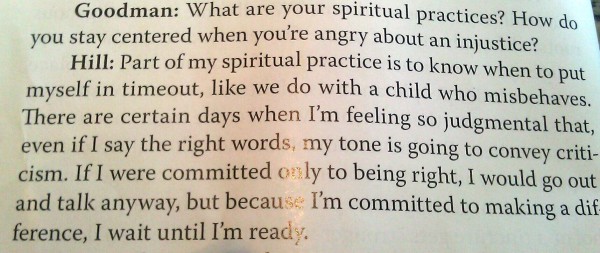
“If I were committed only to being right, I would go out and talk anyway, but because I’m committed to making a difference, I wait until I’m ready.” –Julia Butterfly Hill
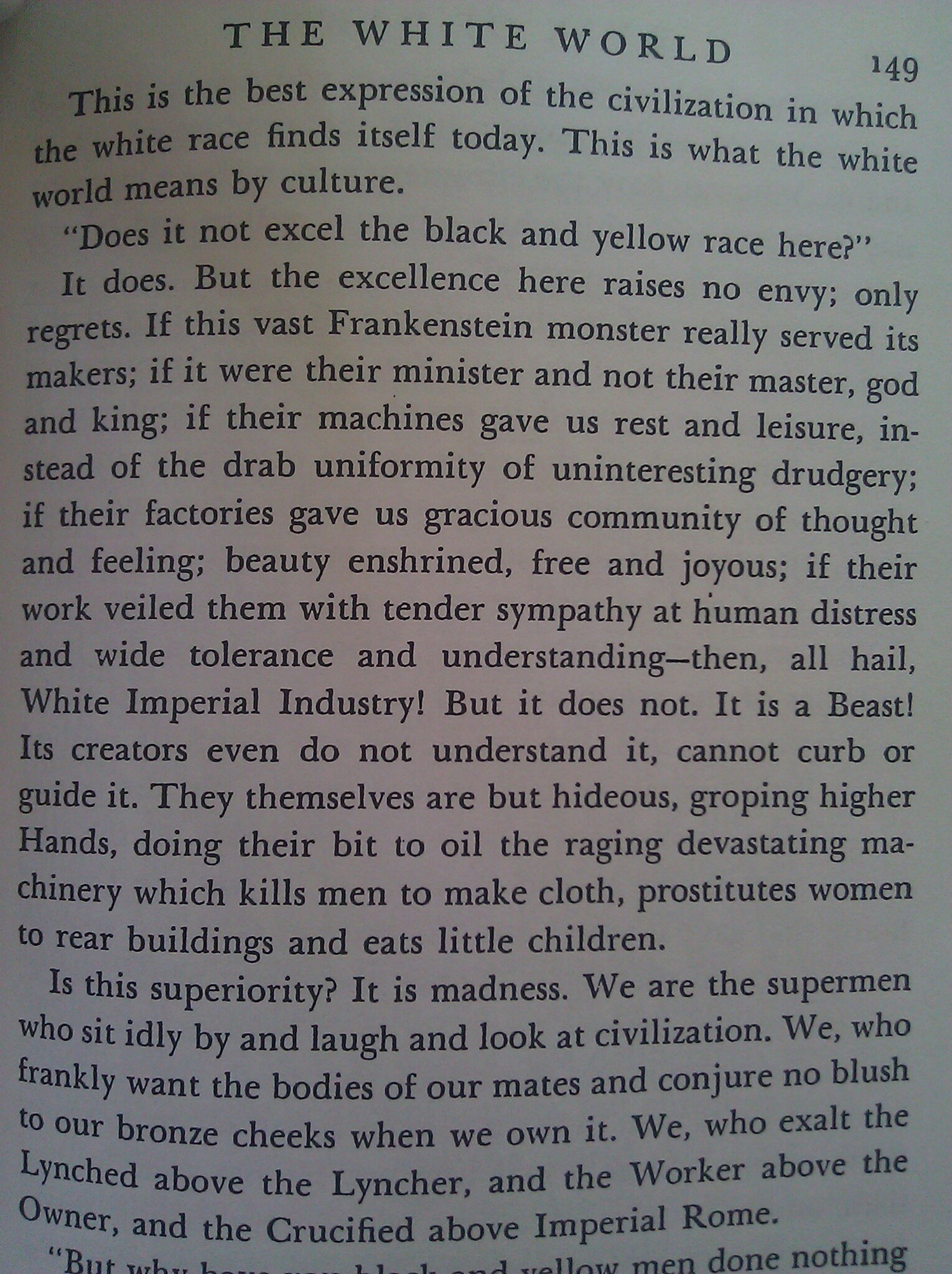
Even as America’s race problem has evolved since Du Bois published Dusk of Dawn in 1940, his perspective is valuable. A fuller excerpt from Chapter 6, wherein he conducts a Socratic dialogue with a pair of composite “White Man” colleagues, and delivers an excellent perspective on world history, and modesty: (more…)
Above all science was becoming religion; psychology was reducing metaphysics to experiment and a sociology of human action was planned. Fighting the vast concept of evolution, religion went into its heresy trials, its struggle with “higher criticism,” its discomfort at the “revised version” of the New Testament which was published the year I entered college. Wealth was God. Everywhere men sought wealth and especially in America there was extravagant living; everywhere the poor planned to be rich and the rich planned to be richer; everywhere wider, bigger, higher, better things were set down as inevitable.
— W. E. B. Du Bois
… who entered college in 1885
Actually, Chapter 3 of “Dusk of Dawn” describes a transition from the world Du Bois was born into of the latter 19th century:
“(As) a young man, so far as I conceived, the foundations of present culture were laid, the way was charted, the progress toward certain great goals was undoubted and inevitable. There was room for argument concerning details and methods and possible detours in the onsweep of civilization; but the fundamental facts were clear, unquestioned and unquestionable.”
In contrast with the “today” of 1940:
“TODAY both youth and age look upon a world whose foundations seem to be tottering. They are not sure what the morrow will bring; perhaps the complete overthrow of European civilization, of that great enveloping mass of culture into which they were born. Everything in their environment is a meet subject for criticism. They can dispassionately evaluate the past and speculate upon the future. It is a day of fundamental change.”
I feel my heart and mind whipsawing between a world culture which is on the cusp of some fundamental, unimaginable change, and a world in which we will pretty much keep doing what we have done, just bigger, bolder, better, faster, with nanites and a higher rate of return . . . I get dizzy thinking about this world I try to live in.
And Religionists and Conservatives keep shouting their objections to a changing world ever louder, ever more viciously. They’re still attacking Evolution, so the concept and theological implications of Anthropogenic Climate Disruption are even more of a leap . . .
But the today of 2012, when the big revolutions appear to be how the European Union will manage debt among member states, and whether Arab countries can successfully democratize, whether there will be regional wars on either side of Asia, and the capacity of fundamentalists to kill civilians . . . today’s world isn’t tottering as obviously as 1940’s “today.”
But it is the Big Things you don’t hear in the news every day; When will climate change trigger famine and mass migration? Will China’s rise be sustained to the point it becomes a world power or will it implode? When are we going to be hit by that asteroid that superheats the atmosphere? Just after the devastating global pandemic that trained against antibiotics and traveled everywhere on jet planes before we noticed it? Will nanofabrication make industry and perhaps agriculture obsolete? Will the Singularity bring upon us a supra-individualist world consciousness? Will medical science and DNA repeal the eternal inevitabilities of aging and death? Is that when we will feel comfortable encapsulating our bodies on centuries-long trips to distant star systems? The new Magellans will refer to centuries as we refer to decades. My thinking is so early 21st . . .
These are the things I tend to wonder about between meetings at work.
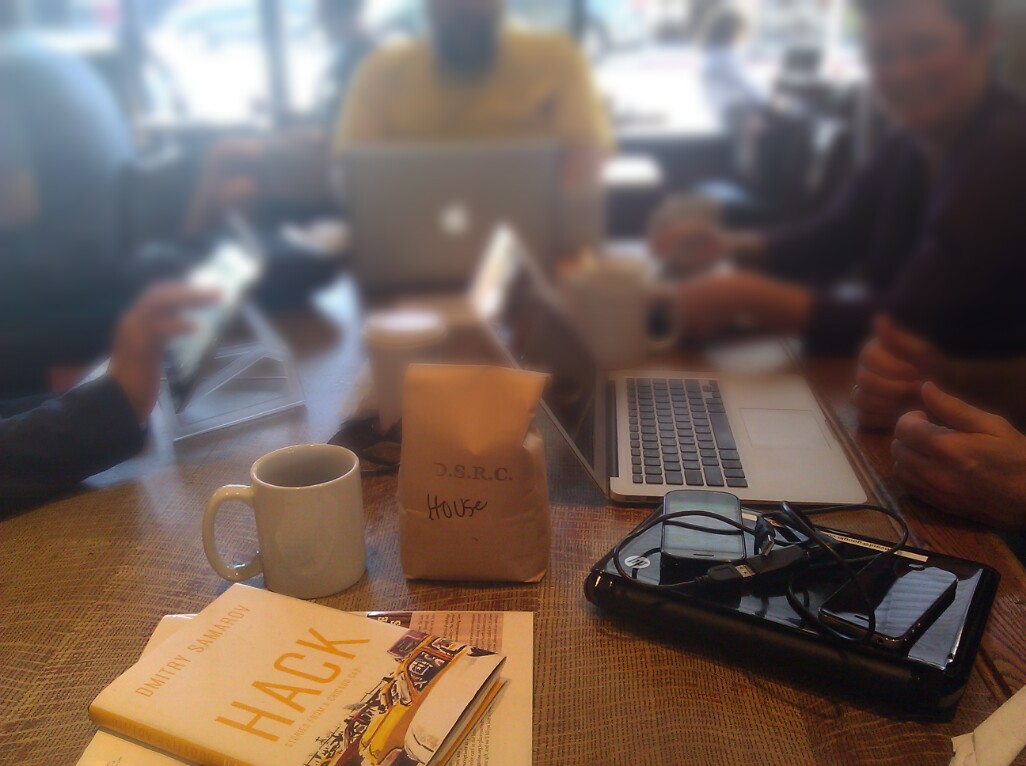
Enjoying Dmitri Samarov‘s new novel about driving a taxi in Chicago, I looked up at my cafe table in Mountain View, CA and noted that mine was the only analog screen. Technologist that I am, I’m just not ready for an e-reader yet. I’m too attached to hardbacks and paperbacks.
My mother, however, has a Nook. She used to drive a cab in Chicago.
“The cure for Apple is not cost-cutting. The cure for Apple is to innovate its way out of its current predicament.”
I work for an Information Technology bellwether, which is both highly profitable and obsessive over maintaining its profit margins. Costs must always be contained. While we have a variety of interesting technology we are working to develop, we are presently completing our latest round of workforce reductions. I wish our leadership could be a little more like Steve Jobs:
“This is not a one-man show. What’s reinvigorating this company is two things: One, there’s a lot of really talented people in this company who listened to the world tell them they were losers for a couple of years, and some of them were on the verge of starting to believe it themselves. But they’re not losers. What they didn’t have was a good set of coaches, a good plan. A good senior management team. But they have that now.”
You know what John Chambers might say to that?
“The problem with the Internet startup craze isn’t that too many people are starting companies; it’s that too many people aren’t sticking with it. That’s somewhat understandable, because there are many moments that are filled with despair and agony, when you have to fire people and cancel things and deal with very difficult situations. That’s when you find out who you are and what your values are.”
House Republicans could have kept the debt ceiling issue wholly separate from the budget cut issue.
Instead, Republicans put the gun on the table. They raised the menace of deliberate default in a way it has not been raised before.
Then, having issued the threat, they discovered that their own core supporters would not allow the gun to be holstered again.
They issued demands they knew could not be met, for budget cuts much bigger than Republicans ever enacted when they had the power to enact them. They cocked the weapon. And now here we are: the demands are unmet and Republicans find themselves facing a horrible choice between yielding on their exorbitant demands or pushing the United States into financial upheaval.
David Frum was a speechwriter for President George W Bush.
Some article in The Atlantic about how President Obama has decided to stop being the reasonable guy who makes every last concession imaginable and then some and as of last night is now playing Chicken with the Republicans, daring them to screw the country over, since they’re likely to take the greater share of the blame. Yeah, anyway, this part got me laughing:
There’s an old Soviet joke that a friend once told me. An old man has been standing in line for bread for eight hours. His feet hurt, his back hurts, and he is faint from hunger. Finally, finally the door opens and the baker comes out. He starts to salivate. He fingers the rubles in his pocket.
“Comrades, go home,” says the baker. “There is no flour to make bread today.”
Something in the old man snaps. He has been waiting in these lines for decades, and he has had enough. “This is ridiculous!” he shouts. “I fought in the Great Patriotic War! I worked for forty years in the factory! Now you make me wait in line for eight hours when there’s no flour? You didn’t know this eight hours ago? I spit on you, and I spit on the regime!” And he spits in front of the baker.
A man steps out of line behind him. “Careful, comrade. You know how it would have been in the old days if you had said these things.” With his thumb and forefinger, he mimes a gun being fired at the temple.
Defeated, the man steps out of line and trudges home with everyone else. He goes into his apartment and sits down at the table. His wife walks in just as he pours the last of his vodka into a glass, and drinks it down in one gulp.
“Sergei, what’s wrong?!” she cries, seeing the look on his face. “Don’t tell me they’re out of bread!”
“It’s worse than that. Much worse.” he says heavily.
“What could be worse?”
“They’re out of bullets.”
Americans should maybe be stocking up on their dark humor.
“Even though bicycle commuting is on the rise all over the country, as cyclists we remain vulnerable. We’re like mammals in the waning days of the dinosaurs: far more adaptable and with much better long-term prospects, yet in the meantime still in imminent danger of being squashed.”
You’d imagine that at some point Americans would wake up to the fact that they’re being sold a very expensive illusion of safety that is in fact killing them and opt for practicality and efficiency over sheer size, but until that day there’s nothing illusory about city streets filled with light-running SUVs driven by a gentry who are more or less free to maim with impunity. And when it comes to cycling for transportation, the fact that your safety–indeed your very life–is not a consideration is what you might call a “barrier to entry.”
We all approach this barrier differently depending on our dispositions. Some of us hop it as adroitly as a cyclocross racer and ride undaunted. Others step over it with considerable trepidation, riding only occasionally or strictly for recreation. Still others simply go around it by opting for other modes of transport. And of course millions of people buy gigantic “safe” automobiles and just drive through the fucking thing while jockeying their smartphones, with two or three cyclists pinned to their bumpers.
As far as the larger-cars-are-safer myth: more massive vehicles need greater stopping distance to break or perform emergency maneuvers. Having more tons of metal surrounding you helps only if you assume you will get into an accident, possibly because your vehicle is bulky and awkward and you have a false sense of security which lowers your vigilance. Then you end up killing the other guy, in the smaller, more fuel-efficient car or bicycle. If you drive an SUV you get bonus points for driving a top-heavy vehicle vulnerable to flipping, which, as a light truck, is unencumbered by the Socialist mandate of rollover protection. Live free and die an avoidable fatality!
“We are like tenant farmers chopping down the fence around our house for fuel when we should be using Nature’s inexhaustible sources of energy — sun, wind and tide . . . I’d put my money on the sun and solar energy. What a source of power! I hope we don’t have to wait until oil and coal run out before we tackle that.”
Last week I enjoyed a great story by Rands, who, as a team lead, had a total communication disconnect with one of his team members. While he enjoyed an easy rapport with Harold and Stan, he just wasn’t clicking with Wallace. At first he accepted things as they were, but soon learned that the disconnect with Wallace was a genuine problem in need of improvement. Rands concluded that the only thing to do with Wallace was to completely unwind his normal assumptions about rapport and “clicking” with a colleague and just get down to making basic communication work. This can be pain-stakingly frustrating, but this is what you need to do when you’re not getting the easy, intuitive connection you want with someone you rely on.
One of the comments (Harry) chided Rands: “Here’s the deal: if your boss asks you to lead, he either gives you the power to sack people, or you don’t accept his job offer. In your case, Wallace is obviously not compatible with you. So you sack him.”
I thought “No–Good engineers are expensive, and it is preferable to learn to steer an existing engineer in the right direction rather than finding and training a replacement.” Other comments pointed out that Wallace wasn’t incompetent or incapable, just that he needed clear expectations with management. Someone named Dave chimed in:
“I’ve been a Wallace, and I’ve also been a Harold, and from my standpoint it has less to do with personality than with context. You can have a poor team dynamic, with no clear leadership and constantly-shifting goals, where everybody ends up isolated in their corner and becoming Wallace, at least in part. Or you can have a good team, where even the most Wallace-y engineer becomes Harold for at least a few hours each day.”
Amen. We each have in us both a Wallace and a Harold. They are Yin and Yang. The Wallace side of my personality wants to get heads down in to the work, but needs to know what to work on. The Harold side takes some time to chat up his manager and coworkers to find work and set priorities, then steps aside and lets Wallace get back to work. Tech workers tend to be more innately introverted, they tend to want a good manager to play the part of Harold, and come back and set clear work objectives and priorities. When things are not going well, unhappy people will tend to revert to their base personalities. For engineers this often means getting stuck in Wallace mode.
Sometimes employees are happy and eager, and sometimes they are curmudgeons. It depends on the context of work and life morale, mediated by an employee’s emotional intelligence. These are variables that can be influenced, allowing for change over time. Management needs to provide a positive work environment with clear goals. Employees need to do our part in building a positive home environment, with positive life aspirations, while also cultivating a greater degree of self awareness. An employee who learns to steer their own craft and deliver what management wants will create a more positive work environment for their colleagues.