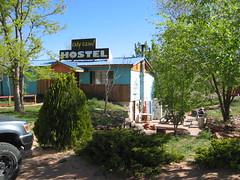
It was a rough night at the Lazy Lizard on a thin mattress with a thin pillow. I tossed and turned and just as I was getting my sleep on right my roommates began to stir in noisy ways so that they could get a start on the day’s rock climbing. Americans are not accustomed to the ways of youth hostels, and these guys loved to rifle through their luggage and tromp in and out, leaving the door open. I got up several times throughout the morning to shut the door. At one point I sat up awake waiting for one of the last guys to finish his noisy morning rituals and make his way out of the room. He greeted me and asked if I was a climber. When I told him no he expressed a sentiment that I was probably a nice person anyway, and he was gone, and I rested well a bit longer.
Probably around 0800 or 0900 I made my way out of bed, downstairs, apologized for waking the guy up in the middle of the night, and gave him $9.80 (tax, you see) and bathed. I packed up the car, looking forward to a breakfast in town, some hiking, and some scenic driving. I turned the key in the ignition and where the car usually makes a confident rumbling sound to get the engine purring I heard a click.
Click.
Click.
Huh.
The battery wasn’t dead, but perhaps it was weak. I got the cables out and bummed a jump off a fellow traveler. Nada. A bit longer? No.
Could be a bad battery. The hostel guy suggested the auto parts store was a twenty minute walk into town, and the maintenance guy might be going that way in a while and could give me a lift. I said I wanted a hike anyway, so I walked down the highway for not more than five minutes and bought a new battery. The battery was much larger than the one I purchased last year, but I figured bigger is better. The folks at the store lent me a crescent wrench to get the new battery swapped in.
I had thought to stow the battery in my backpack, but the battery was too large, and needed to be carried level, and besides it was heavy enough to possibly damage or destroy the backpack that has been my long-time companion around the world. I carried that sucker, taking breaks every hundred feet or so to switch arms . . . a guy was packing something in his pickup truck along the way and he offered a ride, which I politely declined . . . it is not that far. A bit farther and another guy offered another ride in his pickup truck. I accepted, and was dropped off in front of my car.
I extracted the old battery, stowing it on the floor in front of the passenger’s seat, and installed the new battery, all charged and ready and–click.
Click.
Click.
“Well, I took an auto shop class twenty years ago . . .” offered the hostel guy. He took a listen to the click. The starter solenoid goes click. Well, you could try replacing that . . .
I walked back down to the parts store and easily carried back a starter solenoid. More work with the wrench and nada. Dang.
So, I asked a couple from Oregon about the mechanic they were waiting to hear back from. They said the guy had been really busy and might not be able to figure out there car today and the woman had figured out Greyhound tickets so she wouldn’t have to miss work on Monday. Gee. I wandered down the road a bit to what looked like a service station where the guys were working on Jeeps. I explained my plight. The guys said they did Jeep rentals and only knew how to service their own fleet. The more mechanically-inclined fellow affirmed that yes, start with the battery, then the solenoid . . . he recalled that with Fords often if the current from the battery is too low then the solenoid wont send any current to the starter . . . anyway, there’s a really good mechanic a little ways down in a big yellow building, and in front of him is another mechanic who is also pretty good.
So, I wandered down the road. Both mechanics were closed. I sighed and wandered back towards the hostel, figuring that worst-case, Moab isn’t such a bad place and the hostel should be cozy for a few days. I badly needed coffee and so stopped by the roadside espresso stand just a little ways down from the hostel. The guy working in the stand was friendly and asked how everything was. I replied that things were good overall, but I had to figure out my car problem. He suggested another guy that might be helpful just a few doors the other side of the hostel, and explained what he called “an old redneck trick” of climbing under the car and shorting the terminals on the starter to get a car started. That sounded worth a try, maybe. He didn’t know if his friend would be open, but he might be. He gave the guy a call and left a message, “but that doesn’t mean he’s closed.” My coffee was on the house.
I walked over there and the guy looked pretty closed, which was easy for me to accept, the kindness of the guy at the espresso stand had buoyed my spirits. I wandered back to the car, and poked around a bit. The wires coming off the negative terminal have always been a bit gnarly, so I cleaned them up a bit and gave the ignition another try and the beast started!
So, I rolled down to the auto parts store and waited a decent while to return the old battery. (I figured the big new battery a worthwhile investment, anyway.) While I was waiting I ended up talking to this other guy about the various symptoms–for example, the alternator light was on as I left the car idling. He suggested I hit it with a piece of wood and see if it started to whine. I banged the alternator with something and yes, it started to whine and the light went out. “That doesn’t mean its bad,” something about setting it to a known state because the indicator light needed a baseline or something. After we had concluded our respective business he had me follow him over to his shop, where he hooked the alternator up to a load tester, which verified that things looked good.
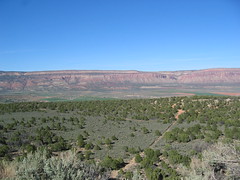
Well . . . I had missed my opportunity for a hike, but I could still have a meal and a scenic drive to Silverton. I popped into the Moab Diner with my maps to consider my itinerary options over a meal. The hostess assured me that a waitress would be right with me. I pored through maps and double-checked calculations, pondering some alternates . . . everything looked good and nobody had yet taken my order. I put my maps away, looked around. I tried making eye-contact with a few waitresses but they all seemed harried and uninterested. I calculated how much time I would need to order and eat and get out of there in order to make it to Silverton before sunset. I figured 3:45 would be my “drop dead” time and five minutes of being ignored later, I finished my ice water and headed out of town, stopping at the espresso stand, where a lady was now working, left a generous tip, and drove off into some beautiful beautiful breathtaking wonderful beautiful scenery. With my failing camera. That’s okay: some things are for my own eyes.
It was a good trip down UT-46, which became CO-90, but no gas along the way until I stopped at Naturita. There I found a green dinosaur logo and stopped at an old-school pump at a Sinclair station. The station was with the convenience store, and I asked the lady at the cash register is $3.05 per gallon was expensive by Colorado standards, and she explained that she hadn’t been beyond the neighboring town since Christmas, so she had no idea. Cool!
I pushed on and down US-550 South from Ouray, where I calculated I had enough time to make Silverton before dark . . . and I drove up, past signs advising of curvy roads, avalanche zones, and speed limits between 10 and 30 MPH much of the way. Up and up twists and turns and curves and well-plowed snow and ice, and freezing water streaming across the road way. Occasional wild animals and oncoming cars, nobody passed me and I passed nobody. Much of the time it was me, the car, and a blue-gray sky going on twilight. Where the scenery of the afternoon had been beautiful, the scenery of early evening was transcendent. It felt very much as if I had drove clear up into some special realm where we mortals are allowed to tread only in times of fair weather, and with great caution. My experience of the road between Ouray and Silverton was this: sublime.
I pulled in to Silverton, which looks every bit an old west mining town with very broad streets. There was snow piled along the streets, and it was nice to be visiting with a proper Winter. I couldn’t figure out the street signs but managed to find the Silverton Inn and Hostel without much trouble. I parked in front, walked right in, studied the notes left to would-be visitors explaining guest cards and rates, toured the available rooms, picked a bed, filled out a card, and took a key. I stopped down the corner where the guy admitted he would have been closed an hour ago, but that he would “make hay” and although he was out of most of his toppings he managed to make for me a delicious pizza, which I enjoyed in the company of his other customers, whose primary interest was skiing. There was further discussion of the guy’s need to sell the property we were on, which included not only the cafe we were enjoying but the energy-efficient house he had built behind it, because he was moving to New Mexico. I then dropped by the bar one block over, and for two or three dollars enjoyed good beer in the presence of a colorful cast of relaxing locals.
I turned in early and slept a good, solid, comfortable Winter sleep on a firm $20 bunk.
I wanted to get down to Durango, about an hour away, in enough time to catch the day’s scenic excursion ride to Silverton and back on the Durango and Silverton Railroad, before pushing on to arrive in Pueblo. I took a nice hot shower, then packed and loaded up the car. I was concerned at the ice on the windshield, and I without a scraper, but that concern was backburnered because the car didn’t start.
Awww crap.
I figured I’d revisit the problem after I had grabbed a cup of mind-enhancing coffee.
I grabbed my travel mug and headed toward the cafe where I had dined on pizza last night, and encountered a lady who explained that that guy usually opens around noon. I walked over to the main street and up a couple blocks and grabbed some coffee and a muffin at a bustling shop full of snowboarder duuudes.
I hustled back to the car, and the same lady from earlier passed by, and I asked about mechanics. There were a couple in town, but they were closed today. You could knock at their house, and they might help, but it is probably better to let them alone. I agreed that I like to have my weekends off, too, and as much as I’d like to spend the evening with the family in Pueblo, I figured that I could get a lot of reading done and rest easily another night in this quiet little mountain town. Maybe I could track down the train station and welcome the steam train as it arrived in this old snowy mountain town, which could be a lot of fun even if I didn’t get to ride.
All the same, I fiddled with the wires some more, but I couldn’t do much without even the most basic tools, so I wandered toward the highway were there looked to be gas stations, where I might find a brief diversion, and possibly even something useful.
I found someone useful. The guy at the Citgo admitted that this was the first weekend of the season that they were open for weekend service, but that he wasn’t a real mechanic, just the weekend warrior. (The owner / mechanic’s son, it turns out.) He said he had a few ideas that might help, but that he’d have to close the shop for a few minutes . . . I wandered back to the car and a bit later he pulled up to the hostel, cleaned up my ugly battery wires, noting that the one terminal had been overtightened and cracked, so let’s put on a new one . . . explaining that you only have to tighten the terminal to the point where it doesn’t move on the post . . . doesn’t start? Okay, so, you did the right by the battery, and the solenoid, so yeah, its looking like a bad starter.
Sure, he could order a new starter and get it replaced during the week, but in this situation, sometimes you could tap the starter a few times with a hammer, and then he crawled under the car on the muddy street, found the starter motor, tapped, got out of the way, and I successfully started the car. He explained where the starter is, and that it looks like a cylinder, and in my case, a very rusty cylinder, and that I could tap it myself if I had to, but that at this point, the starter is likely about to fail completely . . . it might work fine, the tapping trick might work a few more times, but most likely I’ve got just a few more starts, if any, before the thing fails completely and leaves me stranded somewhere. We figured that I might as well keep the engine running and get to Pueblo as soon as possible, where the starter could be replaced under favorable conditions. He reminded me that you don’t actually have to stop the engine to fill the tank . . .
I beamed as he modestly basked for just the briefest moment in heroic glory. I got the sense that he might be most content to account the incident as a good deed, and waited just a moment more before I inquired as to whether and how much cash he should charge for his time. He figured about fifteen or twenty dollars. He then, as I figure it, very quickly considered my circumstances versus my poverty . . . computer guy from San Francisco . . . not working . . . going to see Dad . . . nice old clunker . . . is going to need a starter . . . stayed at the youth hostel . . . and set the charge at $15.
I headed down the road, and there was still a chance I could make Durango in time to catch the train, maybe, and I thought over whether it would be worth the risk if I could, and concluding that yes, if I made Durango in good time I would risk stopping the car if I got to ride the train, because even if I got stuck, I would have had a good time for my trouble.
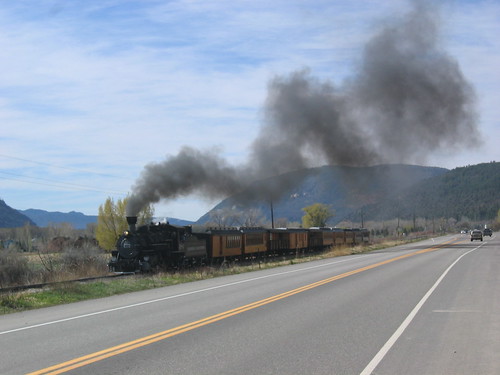
At any rate, I was still on the highway at 10:00, when the train was set to leave. Several minutes later I noticed some smoke on the horizon . . . I slowed down and listened out the window . . . yes, that was the train coming toward me, parallel to the highway!
You know I pulled over to the shoulder and managed to squeeze some pictures out of my dying old camera! And these were the last pictures I ever took with this camera, which has since refused to work at all.
My last camera, a Canon S100, died at around the same time as Grandma Howard, so I gifted the-camera-I’d-taken-round-the-world to my Grandma to take with her in her coffin to her next life, which makes me inclined to see changing-cameras as epochal. It had been a weird twist of fate to have been in the Midwest at that time, which allowed me to visit her in the hospital just before she entered hospice, and which allowed me to drive back up to Michigan for her funeral not long after. I was pretty broke that summer, working in the cafe in Champaign, and it wasn’t until I was back at Mom’s house and living on Unemployment Insurance that I dared to buy my Canon S400, which I badly wanted for a trip that Yayoi arranged for us: we drove together in my car to Boston so she could check out a job fair. That was the first road trip that I took with a woman who, when I returned to professional work, I invited to live with me. Later, we would marry, move to California, and become separated. I took a third professional job in San Francisco during the divorce process, and shortly after the divorce concluded, so did my most recent job.
So, you will pardon me if I read extra significance into these last photographs and bust into personal metaphor; As the day began, the trip to Durango looked unlikely, but with some outside help, I was pleasantly surprised to be on the way. I was warned that stopping to catch this train was risky, but I decided to take the chance and try for the ride. It proved to be a long shot, and I ultimately missed the full experience, but I am glad I made the effort, because I got close enough to be reminded of my own love for what I had pursued. I don’t regret the near miss, and I know better than to blame anyone. What I do know is that I really dig trains, and that at the next appropriate opportunity, it will be my privilege to buy a ticket, hop into the cab, and work to keep the fire stoked for a prolonged ride through beautiful country. (And until then, I will work for a better understanding of the whole darn thing, to avoid or at least tackle nasty surprises on the next trip.)
So, I rolled through Durango without stopping, and turned East onto US-160. Since I hadn’t stopped to ride the train, I was ahead of time, and perhaps the natural beauty of the mountains on my final leg was further enhanced by mid-day light, as well as my own hunger from not stopping for food, and my eagerness to pull into Pueblo sooner-than-expected, to see Dad and Gwen. That was a good ride, and a homecoming that did us all some good.
At Grand Junction I walked a few blocks over to the Enterprise Rent-a-Car. Three adults and two kids: I had put in for a “full-size” car. The lady indicated “a small SUV” – a Chevy Blazer, that did us just fine. Grandma is a tall woman who spent a lot of time in the back seat with the grandkids, and said the legroom was sufficient that her knees did not complain. Electric was not on the menu, and over the next few days in the Colorado backcountry, I counted all of one Rivian, one first-generation Nissan Leaf, two late-model “Sieg Heil” Teslas, and several blue signs indicating where EV chargers were to be found. As a smug EV owner, I assume the gas I bought on the trip was expensive. About $50 per half tank.
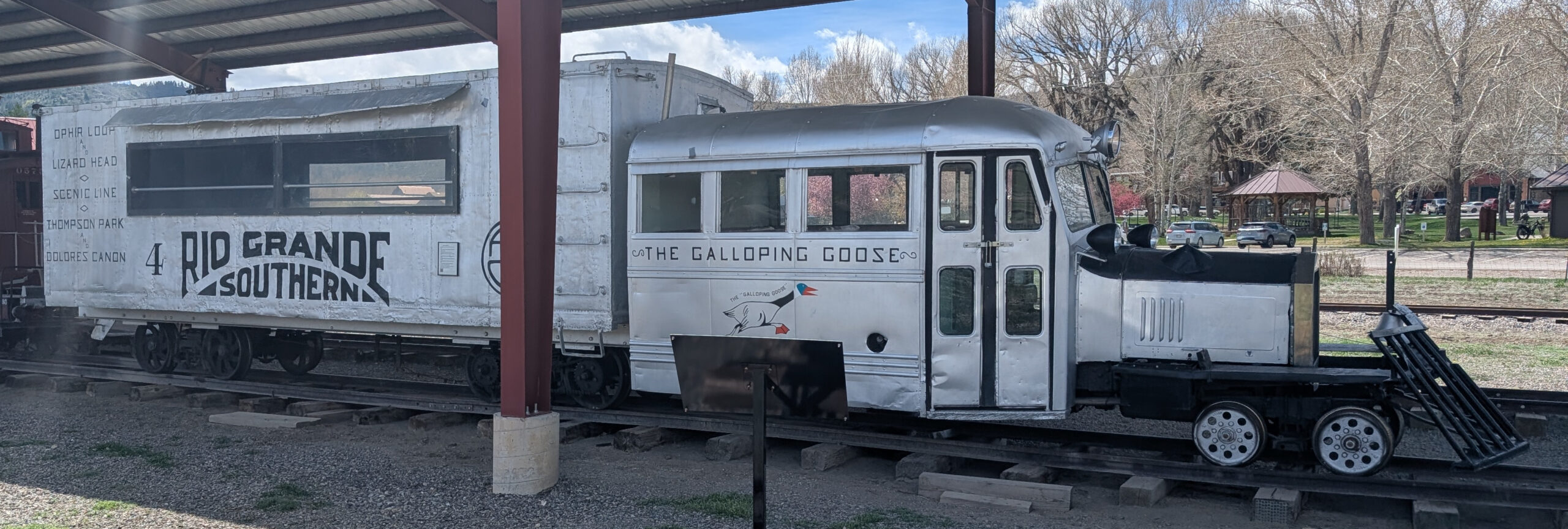
Galloping Goose at Ridgeway
South down US-550 to Ridgeway, where I stopped to admire a Galloping Goose. The story goes that in the 1930s, the Denver and Rio Grande Railroad had fallen on hard times: the mines were closed, but they were still carrying mail. The mail revenue was not enough to operate steam trains profitably, so the folks in the shop tried putting an old bus on rail wheels, to haul mail and a handful of passengers on a low budget. This worked out really well, so they built six more of these improvised railcars. They were painted grey and they “galloped” along the tracks, which were probably not in the best shape at that time. Hence the nickname: “galloping geese.”
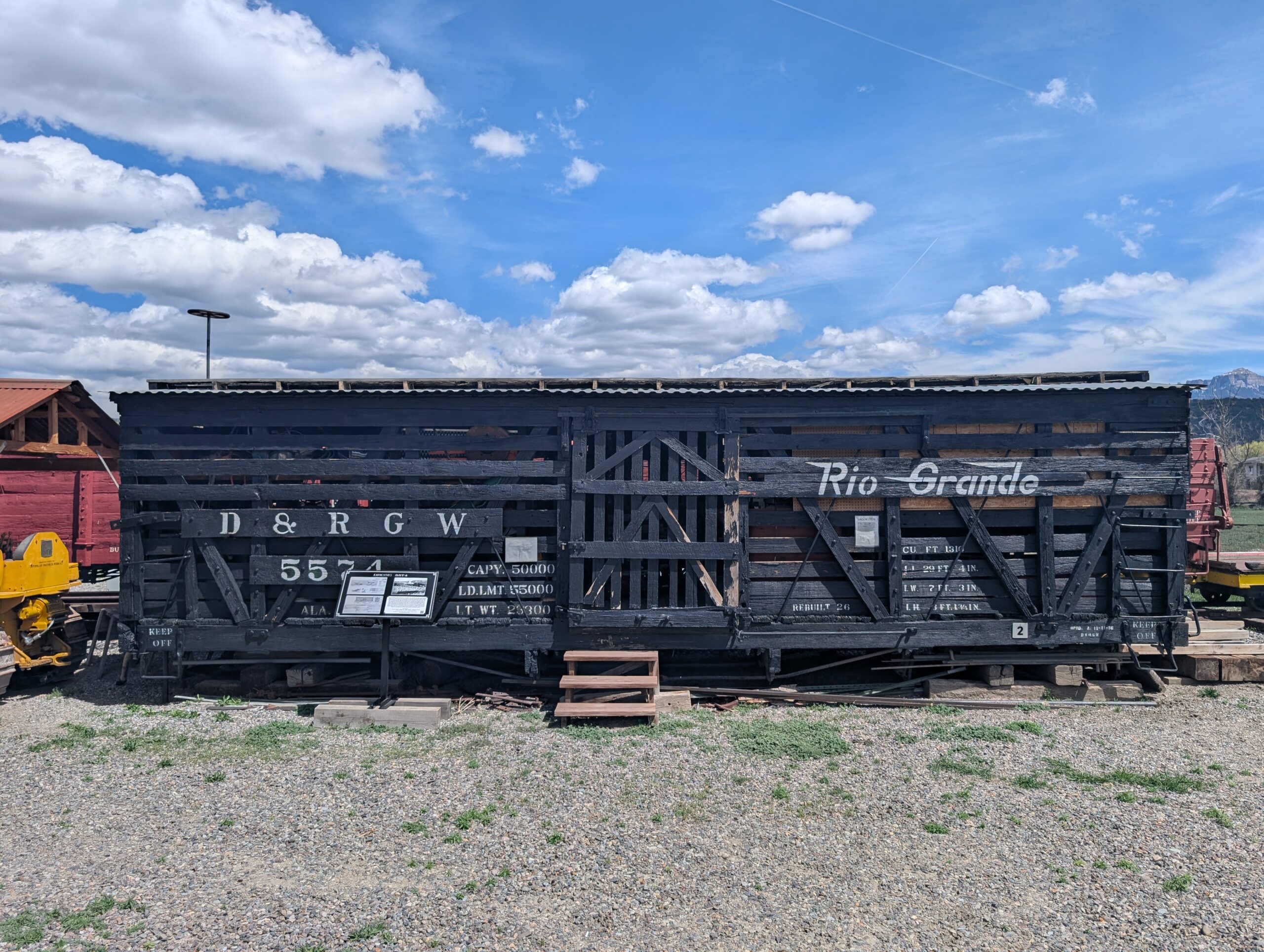
An old Rio Grande stock car basks in the sun at Ridgeway.
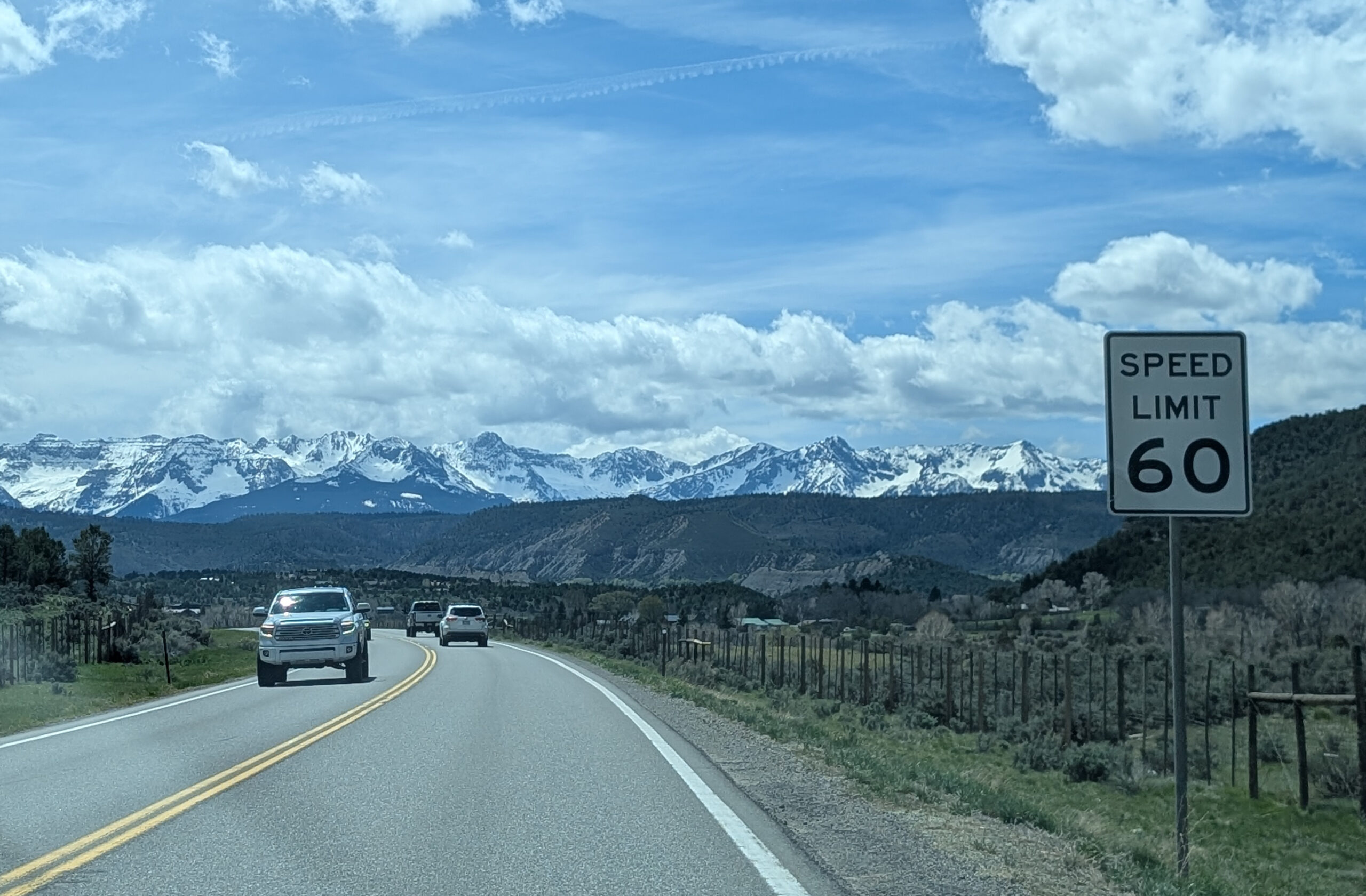
Passenger-side view North of Ridgeway. We drove up to Silverton, somewhere in those distant snow-capped mountains, before descending again into Durango. The speed limit south of Ouray is much lower.
I pushed on and down US-550 South from Ouray, where I calculated I had enough time to make Silverton before dark . . . and I drove up, past signs advising of curvy roads, avalanche zones, and speed limits between 10 and 30 MPH much of the way. Up and up twists and turns and curves and well-plowed snow and ice, and freezing water streaming across the road way. Occasional wild animals and oncoming cars, nobody passed me and I passed nobody. Much of the time it was me, the car, and a blue-gray sky going on twilight. Where the scenery of the afternoon had been beautiful, the scenery of early evening was transcendent. It felt very much as if I had drove clear up into some special realm where we mortals are allowed to tread only in times of fair weather, and with great caution. My experience of the road between Ouray and Silverton was this: sublime.
This time through Silverton, though, I had a car full of dozing family members. The amazing views as the car rocked slowly, slowly, back and forth into the thinning mountain air had knocked them all out. Better them than me. I drove up the main street and back down another, places I had experienced once before, but there was no nostalgia to be had. They woke up at a convenience store at the edge of town. We answered the calls of nature and acquired snacks, and continued the quiet drive back down slow roads to Durango.
The object of my quest was to ride the Durango and Silverton Narrow Gauge Railroad, a train I had missed on a couple of occasions. This trip being the occasion of my fiftieth year on the planet, I splurged for two nights and two rooms at the General Palmer Hotel, next door to the train station. Who is General Palmer? A Civil War veteran who built the Denver and Rio Grande Railroad is who. The original ambition had been to build a line from Denver to Mexico City. Americans know the Rio Grande as the Mexican Border, but it flows to that role from Southern Colorado down through New Mexico. Anyway, he had to battle the Santa Fe railroad. The battles were fought in state and federal courts and with guns in the Royal Gorge and Raton passes. Ultimately, the narrow-gauge Denver and Rio Grande curved not South to Mexico, but West through the Rocky Mountains to tap lucrative mine traffic. They built a branch line to Silverton, where Silver and Gold were mined. (“Silver … mined by the ton!”) The last of the mines closed in 1992, but the first tourist train, “The Silverton,” began running in 1947. Durango sprouted a tourist district near the station in subsequent decades. The Durango and Silverton was spun off in 1980, and when the world isn’t on fire, steam trains run daily from Durango. Though, in the winter, they only run as far as Cascade Canyon.
The General Palmer is a comfortable hotel, ideally located for catching the morning train at 9:15. The gentle toots next door remind you that Train Time approaches, so finish breakfast! There were three options for tickets: First Class 21+, where you get to sit at a table far from any children and drink, I guess; First Class, which is a glass-top observation car built a decade ago; and Coach Class, which is upholstered seating in vintage passenger cars. I wanted to ride a properly old train, and the old coach cars have toilets, so I opted for thrifty seats with handy access to bathrooms.
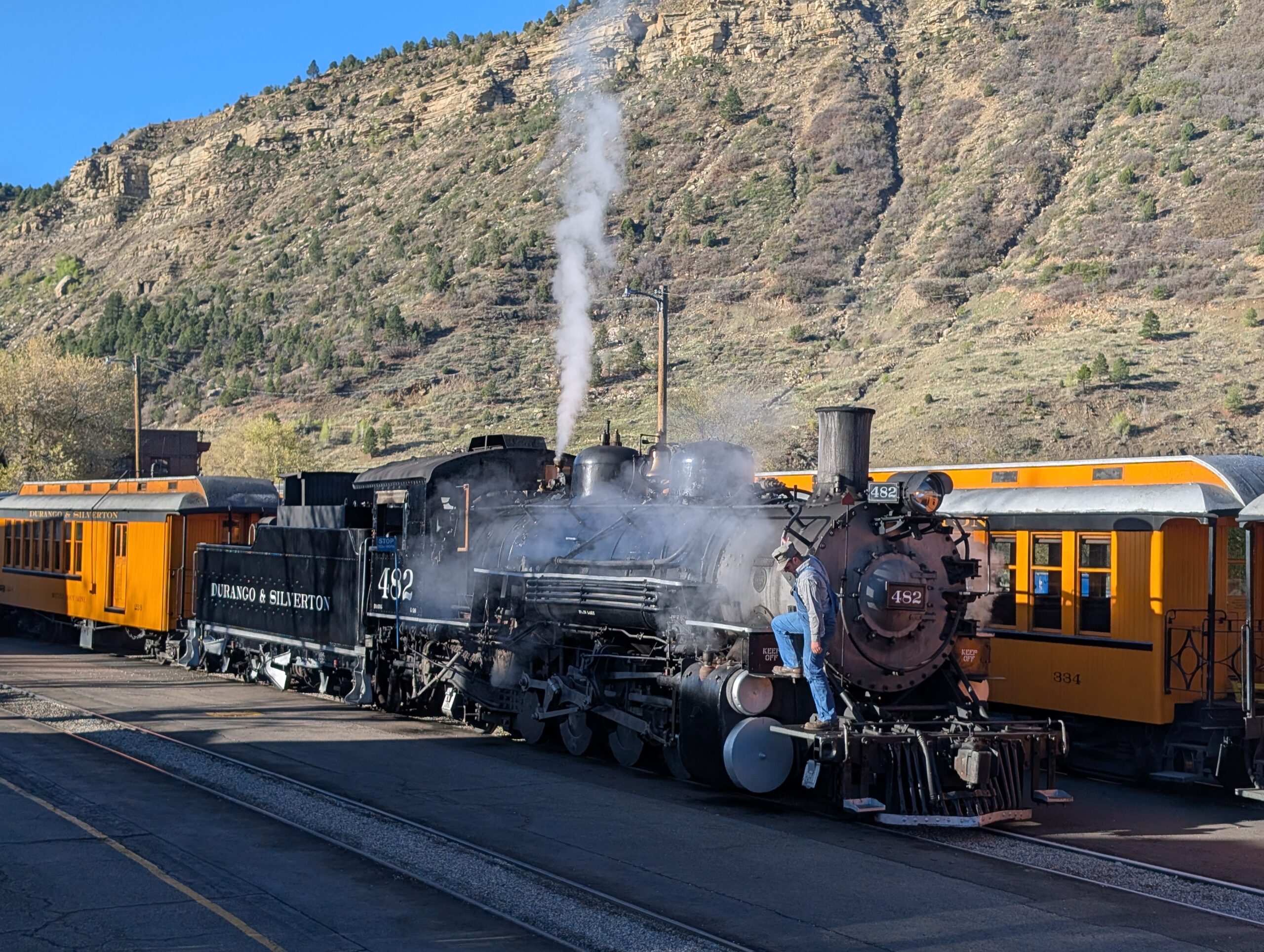
The Engineer inspects D&S steam engine 482 at Durango station.
The desk clerk, himself a father, gave me a list of budget-friendly family activities. First on the list is a hamburger place on the other side of the downtown area that will serve you a burger for $3.50. That sounds swell, but when you’re travelling hamburgers become the stopgap food for when you’re hungry and desperate for something predictable. Our first night in town we dined at a saloon in the other fancy old hotel a block away. We were waited on by “saloon girls” in corsets and fishnets and sensible flat shoes. The ladies were upstaged by a guitar player. At each table there was a two-page menu of songs that he knew, and he knew others as well. We had fun singing along between bites of tasty food. The second night, after our train ride, we went to another restaurant a block away that was the sister of a concert venue. The service was stellar and the delicious food a little more creative than we had hoped. My wife had the prime rib, and I indulged a boozy milkshake for dessert.
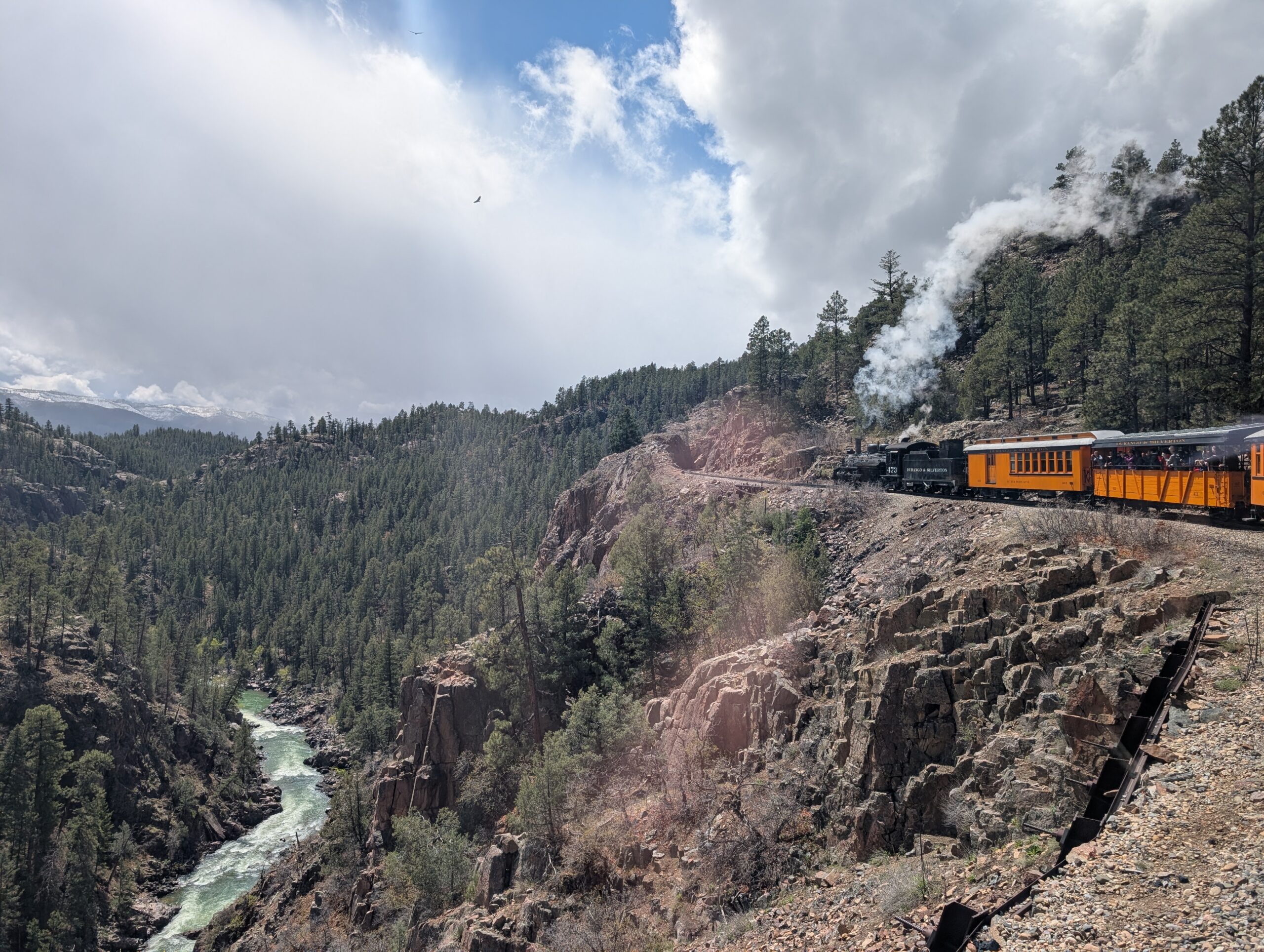
A “postcard view” of the Durango & Silverton chugging up the mountain, the Animas River far below.
Between those dinners we caught The Train, which is the whole point of visiting Durango. General Palmer serves a breakfast buffet next to a gallery looking out at the railroad. Eat your eggs and amble over to the train at 9am. Fifteen minutes later, you start to move and smile at the gusto with which the engineer whistles the train’s way through Durango. Up the river. Higher. Higher. Before very long you’re chugging along cliff faces between a river gorge and rock walls. Trees and rocks and river, and on our journey, snow that grew from a hint of dust to a flurry of floppy wet April flakes as we climbed the mountain. There’s a reason the train only runs halfway to Silverton in April: the mountains of Colorado get extra months of Real Winter.
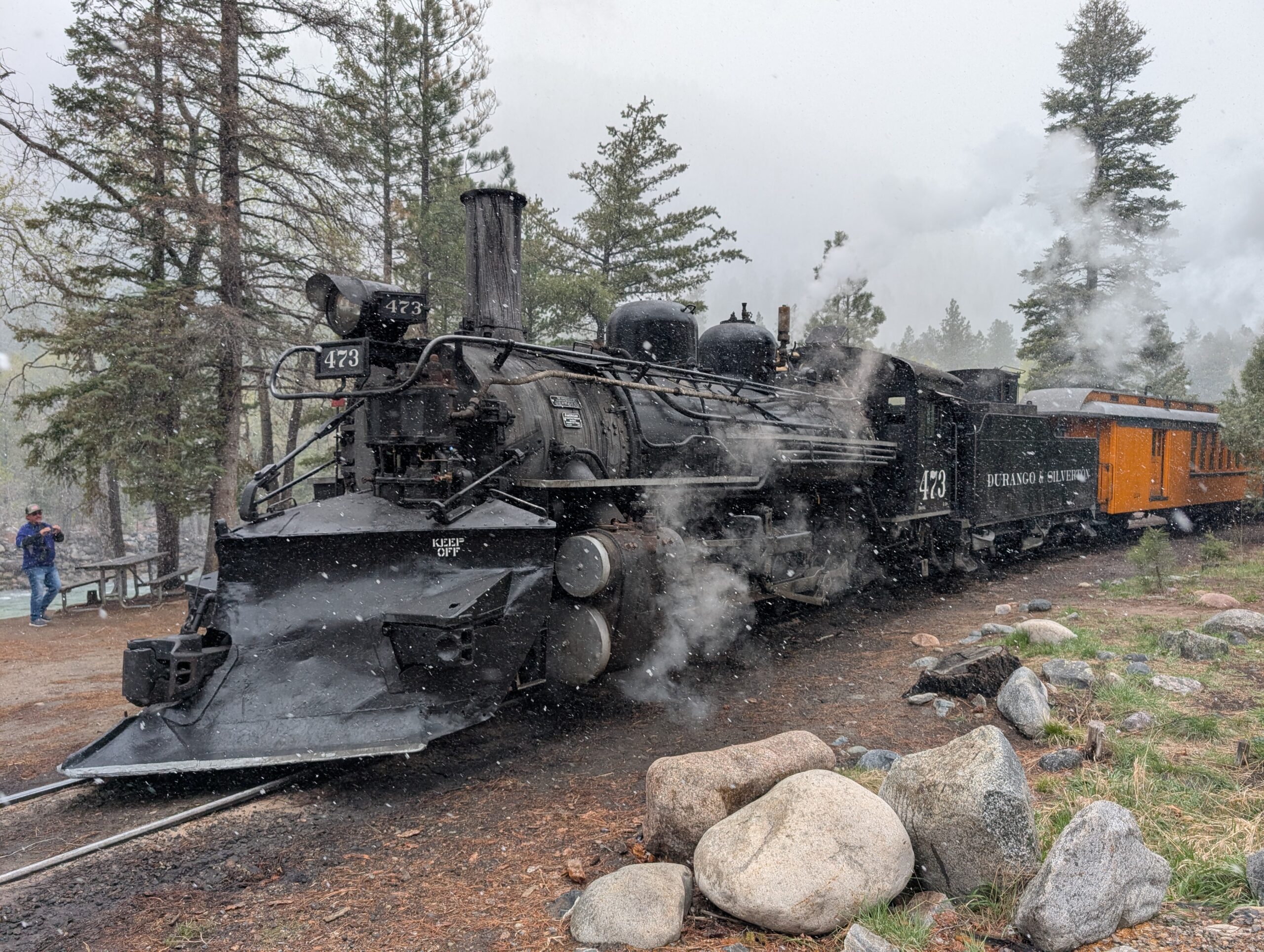
D&S 473 poses for photos on the Wye track at Cascade Canyon, on a wintertime excursion before the return to Durango.
It is a five-hour excursion. The passengers in coach class began to mingle. Our section was older men from the Midwest with familiar relationships to the University of Illinois and Purdue. The chatty great grandpa who used to hang drywall in Florida asked the conductor his age: seventy-eight. Great Grandpa was a mere seventy-six! Folks wandered to the snack car for something to do and we took turns standing in the open-walled observation car, gawking at the scenery and testing our camera skills until numb hands coaxed us back inside. The observation car was two back from the Engine, and as the engine chuffed over a bridge it shot off extra steam on either side. What’s going on? In a moment, we saw the rainbows!
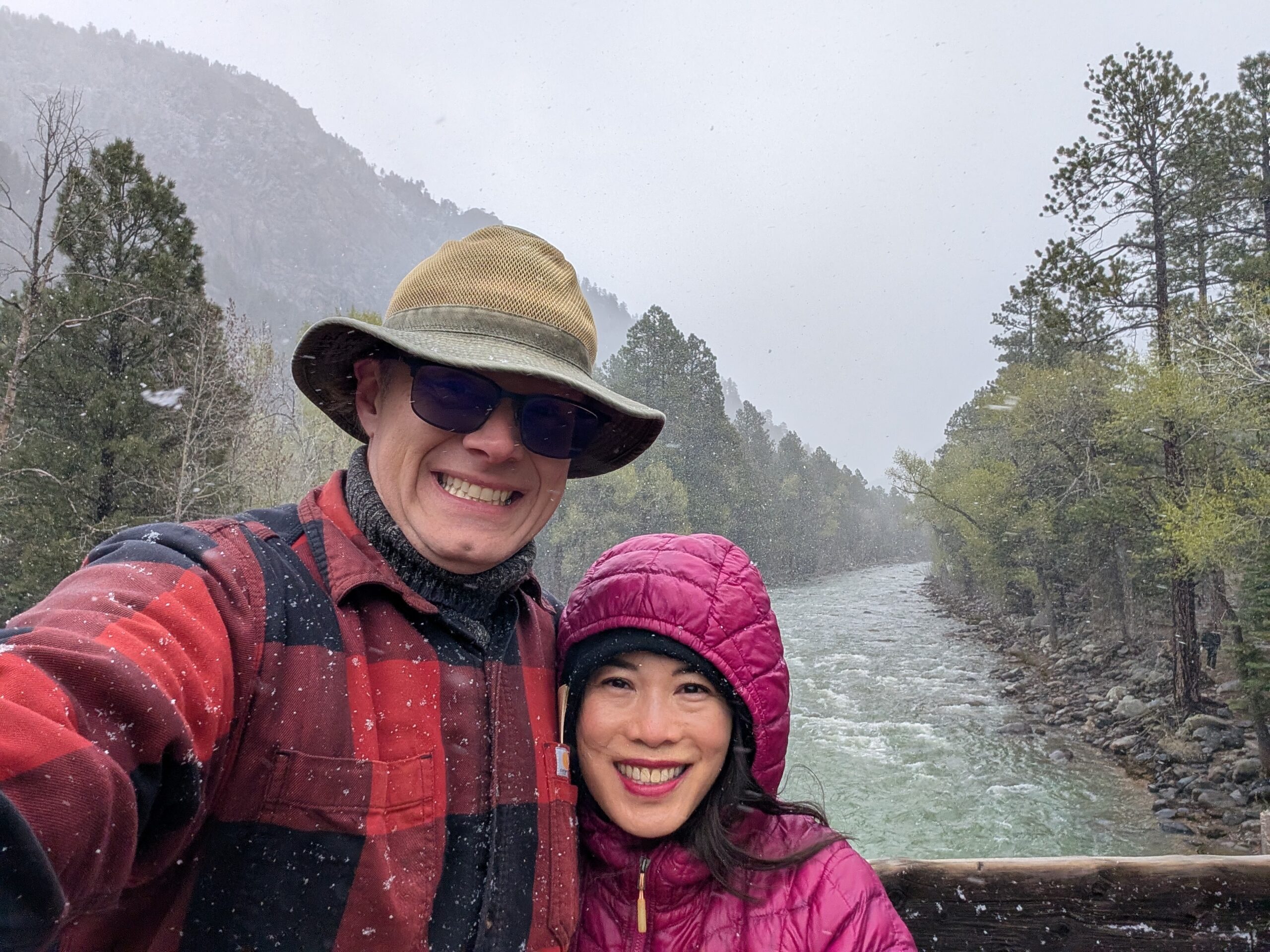
My Sweetheart and I together on a snowy bridge over a river at the end of the world.
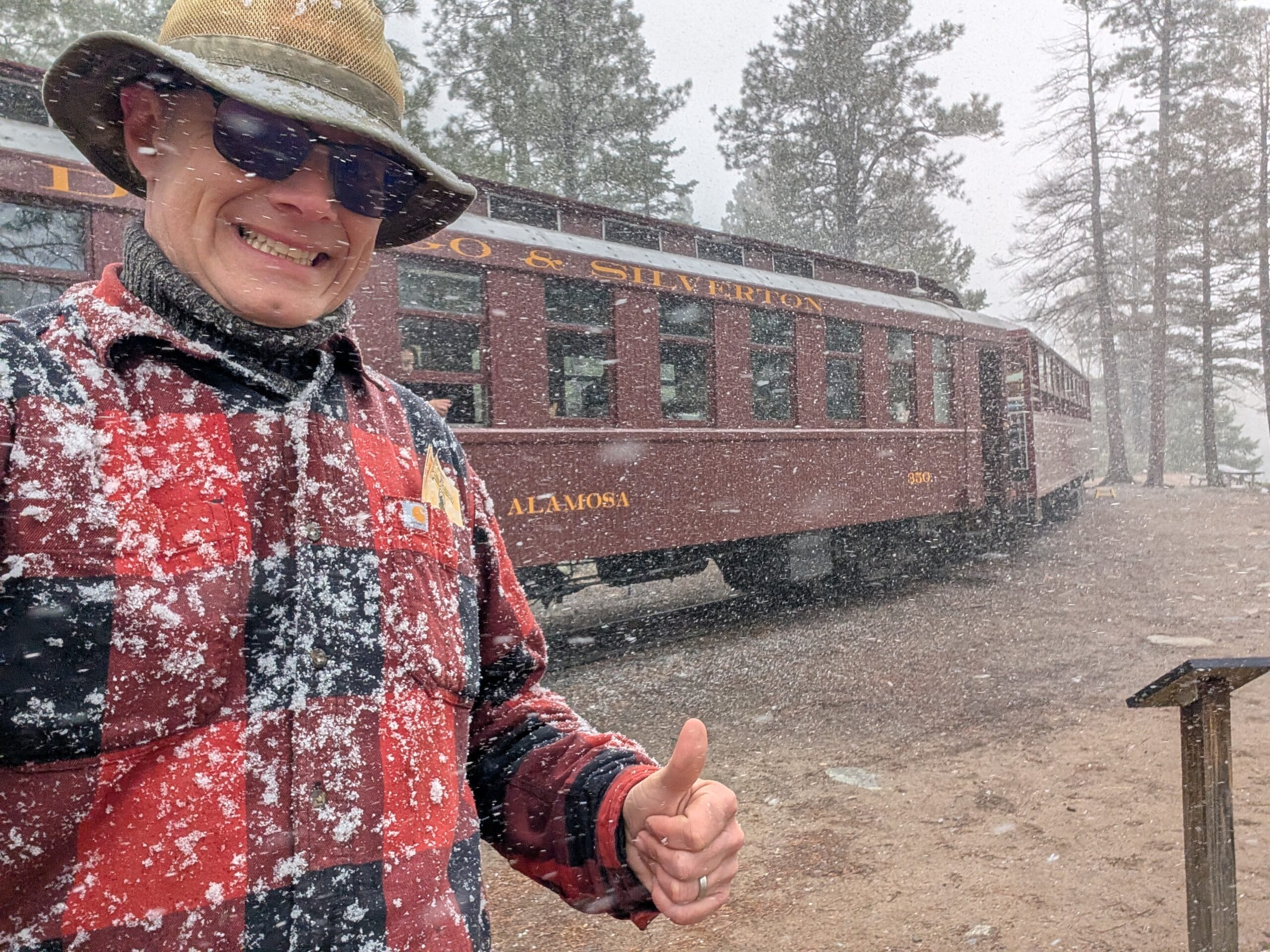
The train backed into a wye track at Cascade Canyon, and we had 45 minutes to frolic. I walked around the train, took selfies with the engine. The snow fell faster. The Earth was quiet. I walked back and found the end of the track, then up a short trail to a bridge over the river, just downstream from where a tributary joined. Most folks by this time had returned to the warmth of the train. My wife and I enjoyed a quiet moment with the snowy river. Back at the train, I lingered alone, enjoying the scene, the quiet, and letting the snow accumulate on my shirt. As the conductor came along, preparing for departure, I climbed back up the stairs, for our return trip to The World.
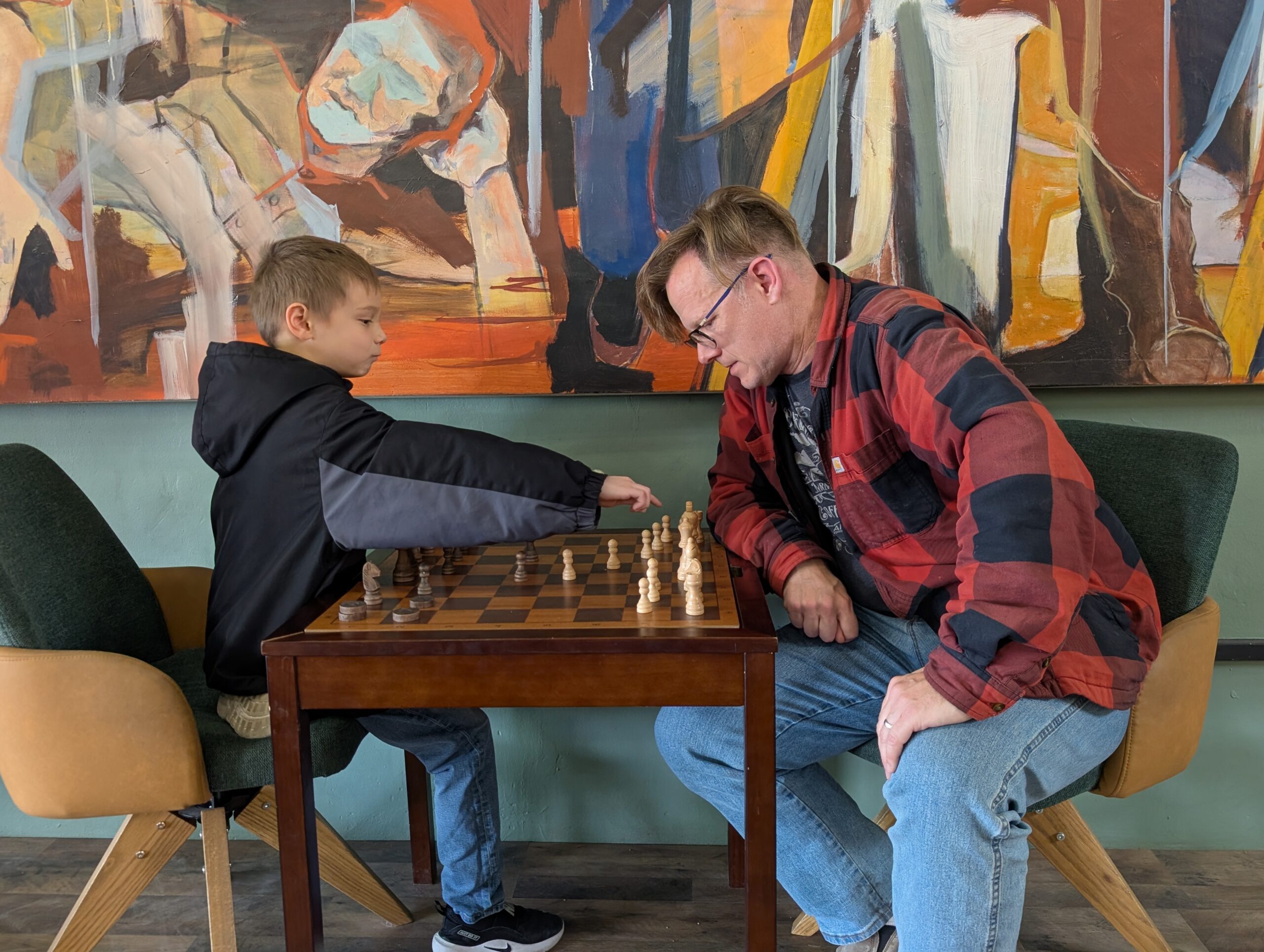
The next day, we drove East along Highway 160 through the San Juan Mountains. A quiet green river valley in a bowl of pine trees. We lunched at a cafe in Del Norte, which we learned was pronounced “del nort,” then we headed North. There were a few delays for road construction on the two-lane roads, and one delay due to someone flipping a pickup truck. We made Bishop Castle with twenty minutes to spare before it officially closed at 6pm.
Chess match in Del Norte
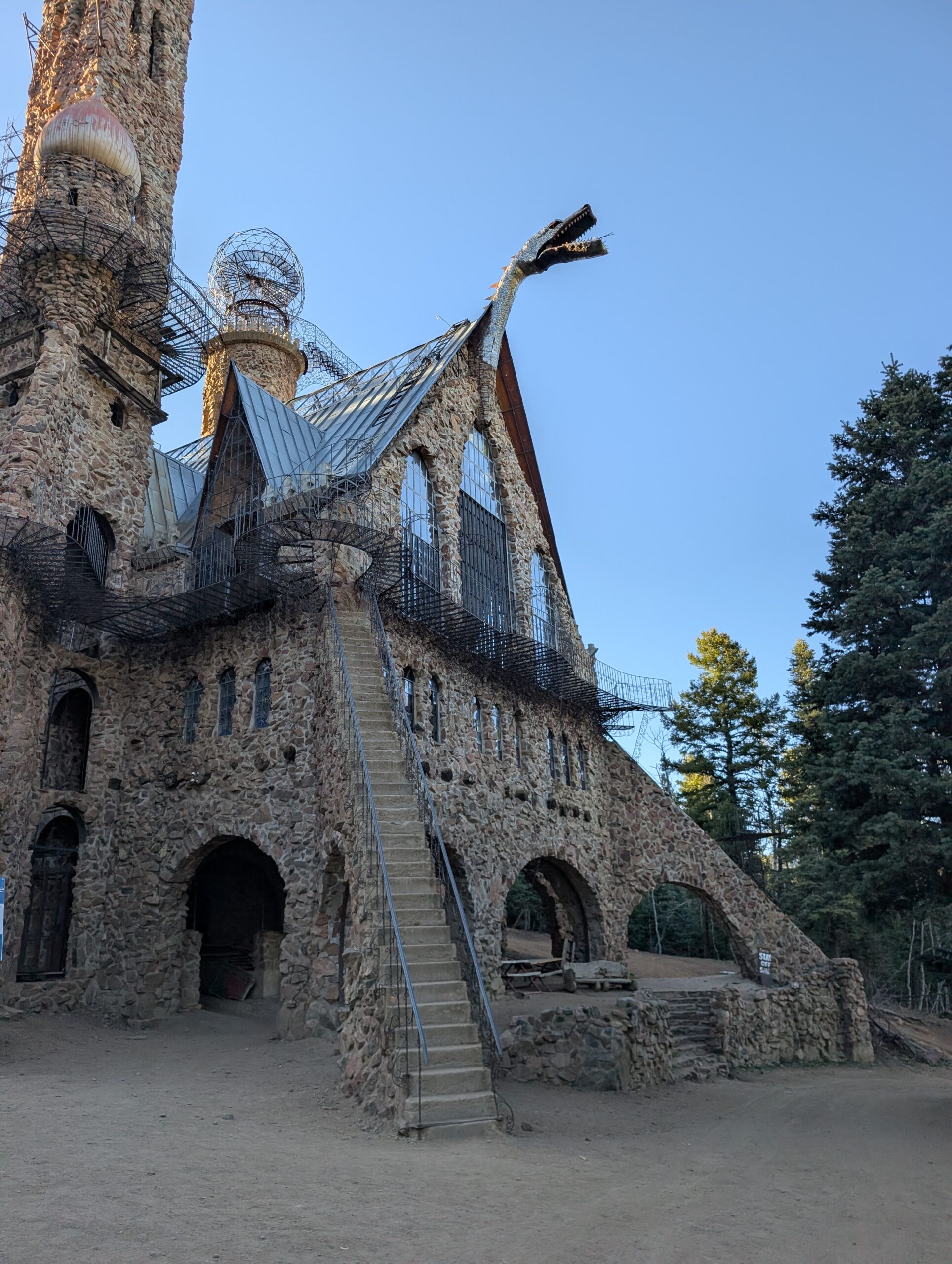
Bishop Castle is built on uneven ground. Grandma waited in the car as we crossed the drawbridge and climbed up the spires to the Great Room of what could pass as a rustic cathedral if there were a congregation around to enjoy it. The place was hand-built in the middle of nowhere in defiance of the government and its pesky permitting and construction safety standards. You visit very explicitly At Your Own Risk.
The dragon is capable of spitting fire.
Younger Brother understood a world-class playground structure, and proceeded up and up and up and up the dubious spiral staircase, trailed by Mom, who had selected the destination. Older Brother and Dad carefully picked our way down and tried to spot our loved ones from six stories below. I left a donation at the gift shop. The place is a work of art: art of course is in the eye of the beholder. To my eyes, the place is a monumental tribute to poor judgment.
Along the way, we had been hoping to meet up with my Uncle John, who was traveling in his van. Unfortunately, the van had broken down in New Mexico, and parts were hard to acquire. He had hoped to meet us at Grand Junction, then Silverton or Durango. But now he had finished repairs at Albuquerque. I had chosen not to structure the day, but figured we might stay in Golden, outside Denver, possibly visit the Colorado Railroad Museum along the way to the airport. With about 90 minutes of sunlight left, we set our sites South of Denver: Cañon City, still in the mountains off of I-25.
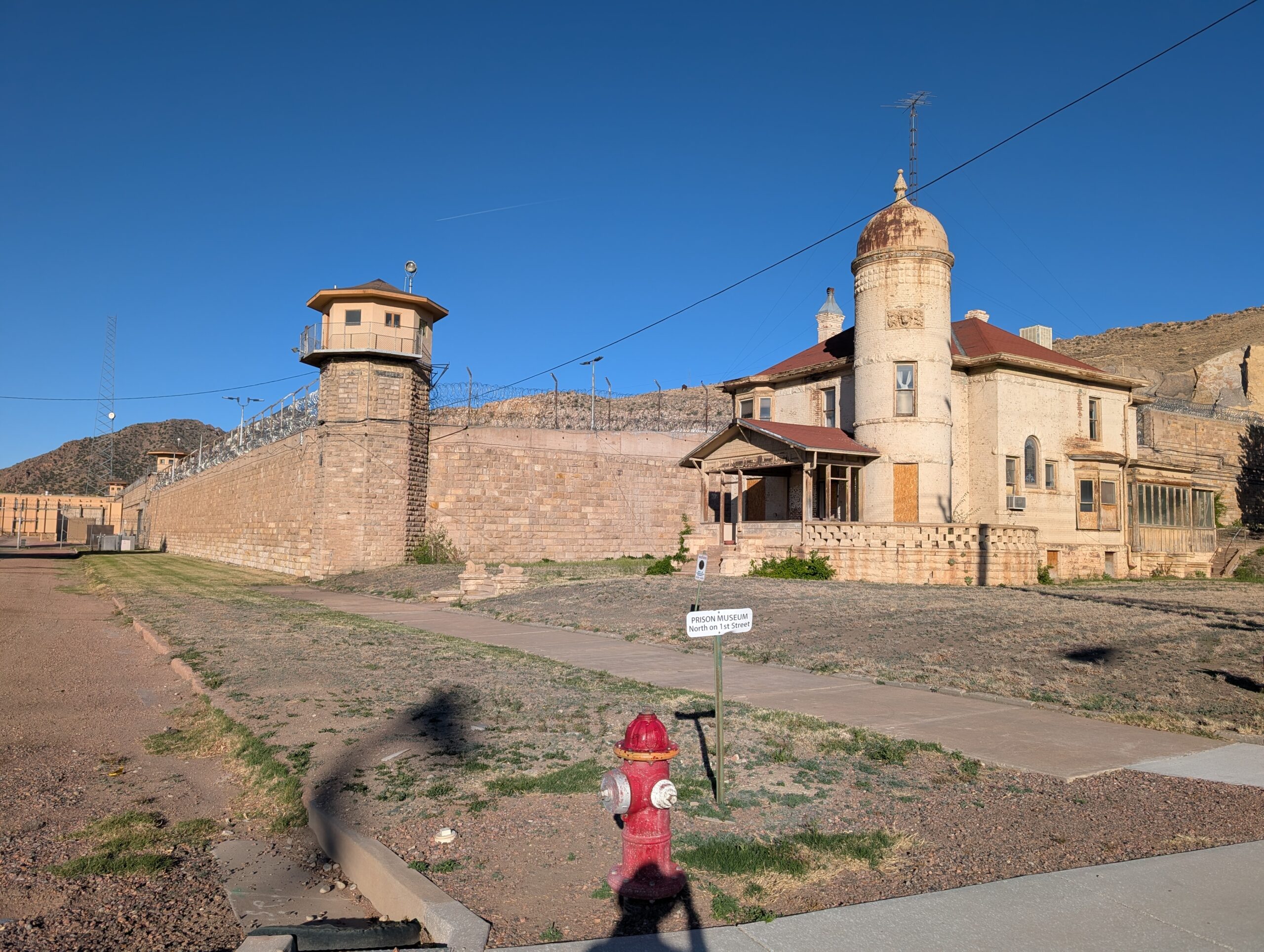
Cañon City’s economy has long relied on the prison industry.
We had a nice dinner downtown. As the meal wound down I rolled over to a budget hotel two blocks away, which boasts a pool and a hot tub and an indifferent clerk, who charged my card and handed me key cards to a pair of rooms which were … adequate. The next morning, waiting for people to stir, I took a nice walk around the old part of Cañon City, taking pictures of dinosaur statues and the historic prison. Uncle John rolled up, and we all brunched in the dining room of the historic hotel three blocks over, and someone asked why we hadn’t stayed there. I had asked myself the same question. However, the budget hotel had a pool and a hot tub, though I don’t think any of us ever confirmed this with our own eyes.
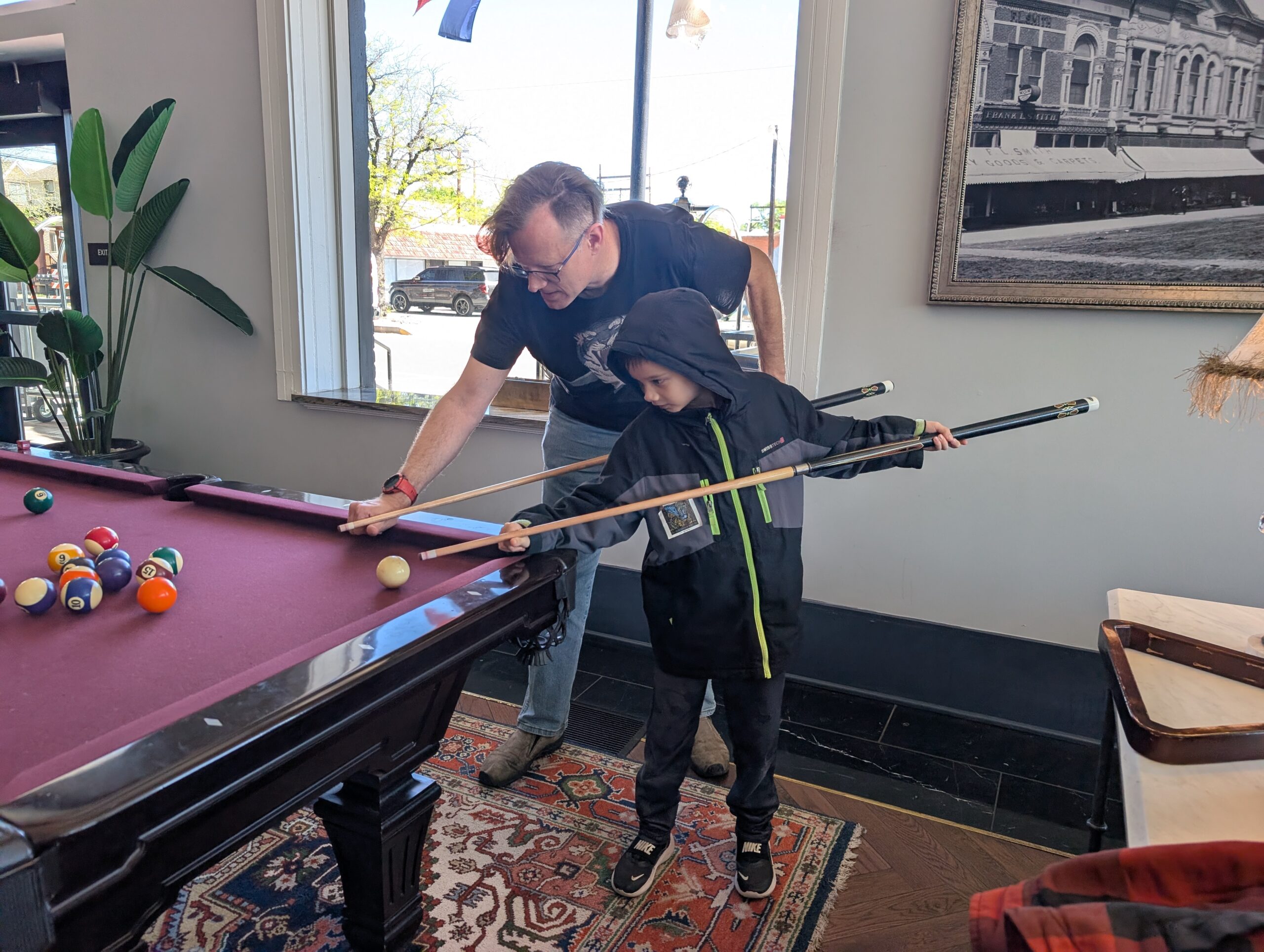
After breakfast at the fancy hotel where we didn’t stay, Younger Son was drawn to their pool … table.
Cañon City has a tourist railroad. It boards just across the street from the budget hotel. I looked into it. The fare was about 50% more than a night at the adjacent budget hotel, and 25% higher than the Durango and Silverton. The trip is half as long. A diesel engine from a freight train. “But the cars have premium butcher block dining tables where you will eat food from our onboard restaurant. And yes, German tourist, you should tip the server.” On the day of my 50th birthday in January I took the family on a “wine train” excursion near Sacramento. It was okay, but what I figured out is that there are two kinds of tourist trains you can ride: one kind is the “historic preservation” railroad where folks who love trains try to fix them up As They Were and fund the work with rides and tours. The other kind is “that old branch line is worth money.” Go find some old rolling stock and a business plan and Capitalism ensues. I gave the Royal Gorge Route Railroad a pass.
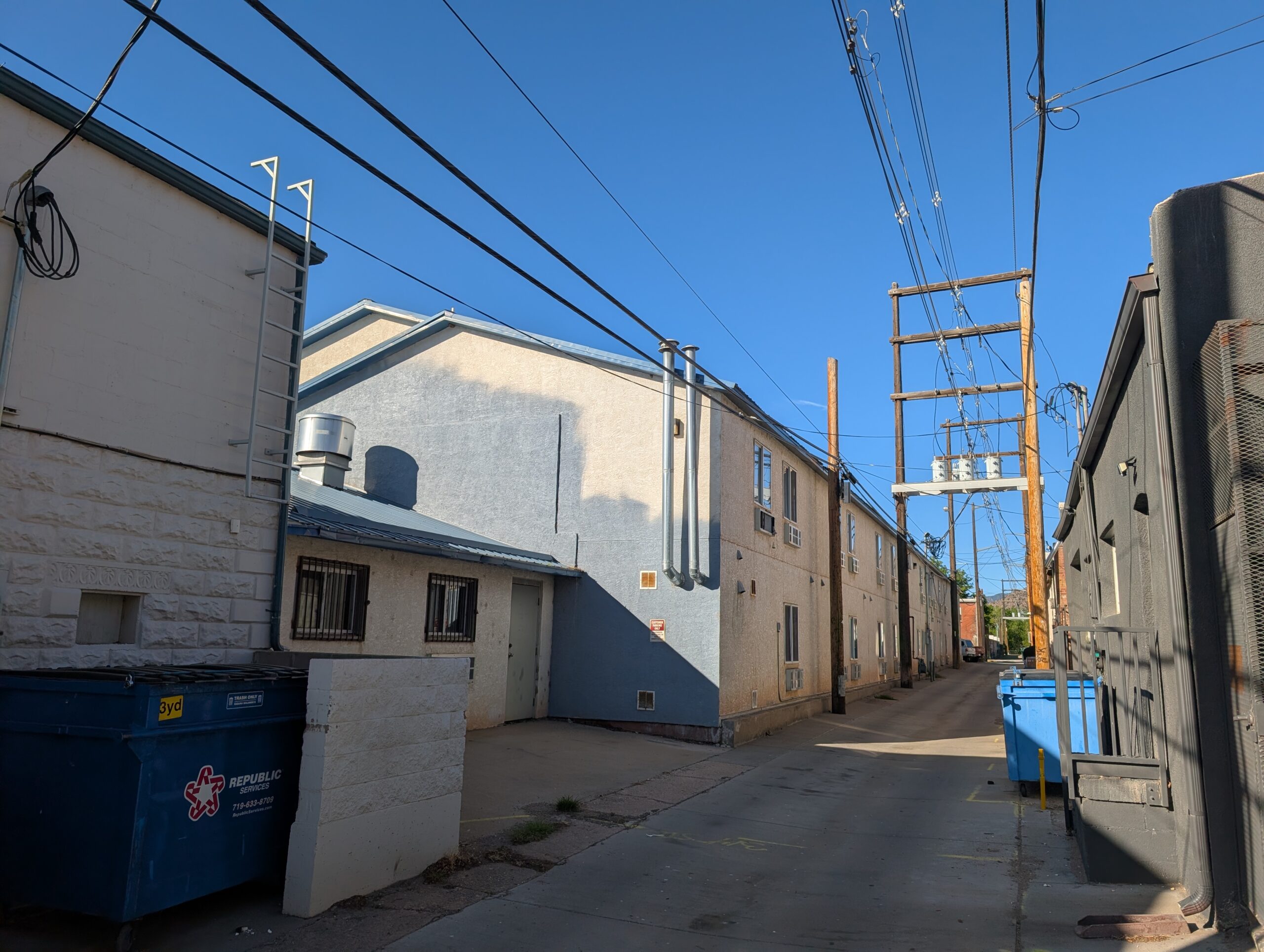
Our Budget Hotel room window opened onto the alley, which was alright. On my walk, I noticed that at some point they apparently lost interest half way through re-painting the exterior.
We had an afternoon flight, and had had a fulfilling week. Our next destination was Denver International. Instead of making a beeline to I-25, we chose to drive Northeast, milking the experience of rural highways for one last hour, until we hit Colorado Springs. There, Grandma and Uncle John kept Northeast in the van, bound for Chicago. I merged onto I-25, commencing our return trip to Civilization.