Away from the noise of social media, the Internet is still brimming with great stuff to read. The old way of finding a feed reader, subscribing to some sites, and coming back on occasion to be wowed still works great. Kagi has pitched in with their “Small Web” site to help folks find new voices. It takes a little more effort to get this going than it does to visit the increasingly barren FaceBookMegaMart or injecting TikTok into your retinas, but damn it is so much more gratifying.
Unlinked quotes here are most likely taken from The Sun Magazine, which has great writing in the even older and more convenient format of the printed magazine.
But, quickly, the feeling to be without a smartphone changed from anxiety to liberating. I felt really happy not to have a phone on me while outside. I was rediscovering my old way of getting lost in my thought, of sometimes talking to myself to clarify an idea. Which is less weird these days because everybody assumes you have an ear bud and are on the phone with someone else. In fact, when walking alone, I’m often on a call with myself.
“When you bury a parent, you bury the beginning of your life.” –Bob Hikok
No one who isn’t us is going to destroy the Earth, and no one who isn’t us is going to save it. The most hopeless conditions can inspire the most hopeful actions. We have found ways to restore life on Earth in the event of a total collapse because we have found ways to cause a total collapse of life on Earth. We are the flood, and we are the ark.
–Jonathan Safron Foer
“Grief doesn’t make an appointment. It just shows up while you’re doing the dishes.” –Lalaie Ameeriar
To argue that the current extinction event could be averted if people just cared more and were willing to make more sacrifices is not wrong, exactly; still, it misses the point. It doesn’t much matter whether people care or don’t care. What matters is that people change the world.
Doomscrolling is a protection racket. Every horrifying headline you consume without acting on is a toll you pay to the algorithm in exchange for the feeling of engagement without the inconvenience of actually engaging. Power loves this arrangement. Power has always loved a population too exhausted and too demoralized to walk out the front door. The algorithm is doing work for authoritarianism that authoritarianism used to have to do itself. It’s very efficient. You should be furious about it. Preferably while moving.
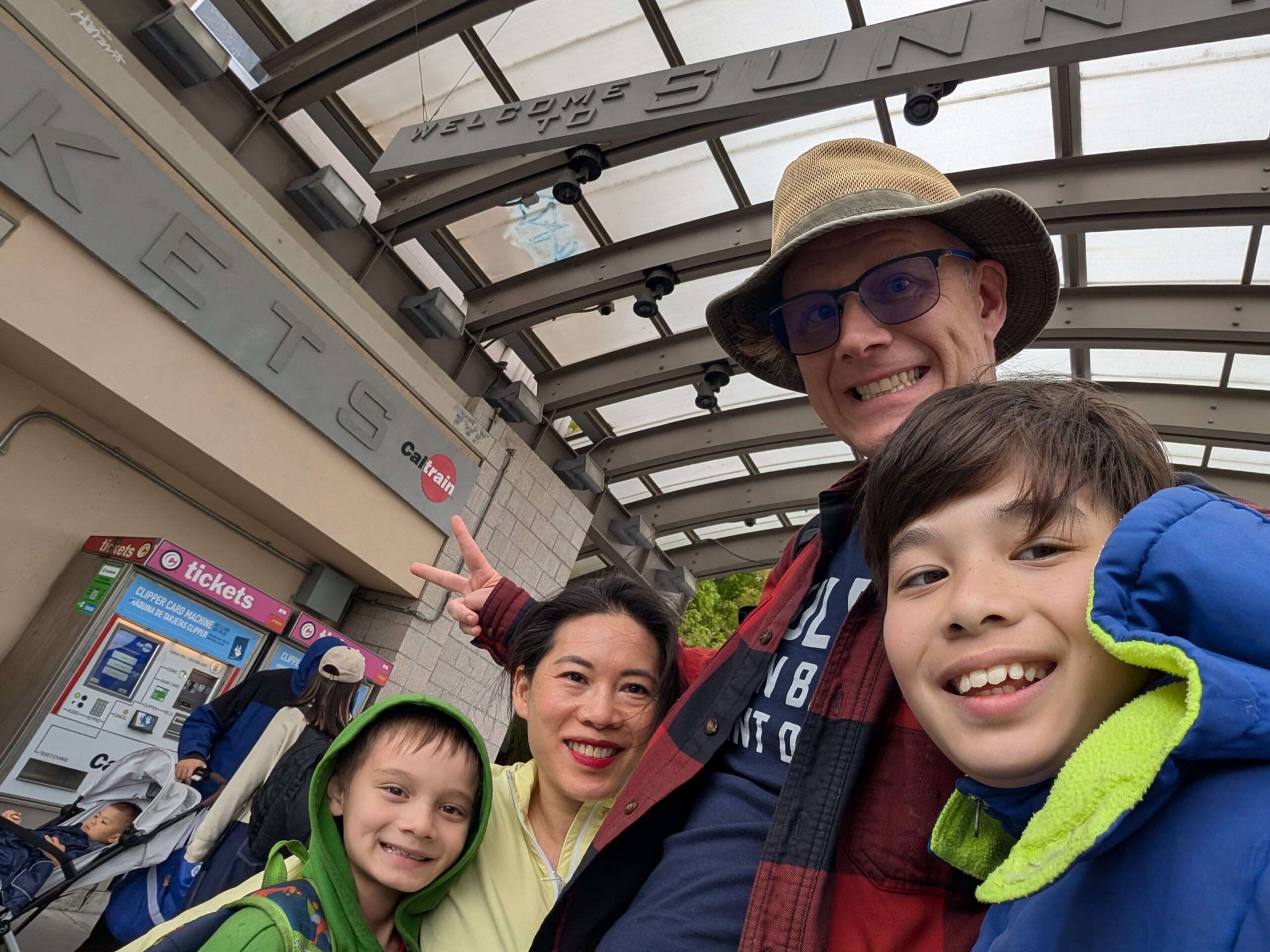
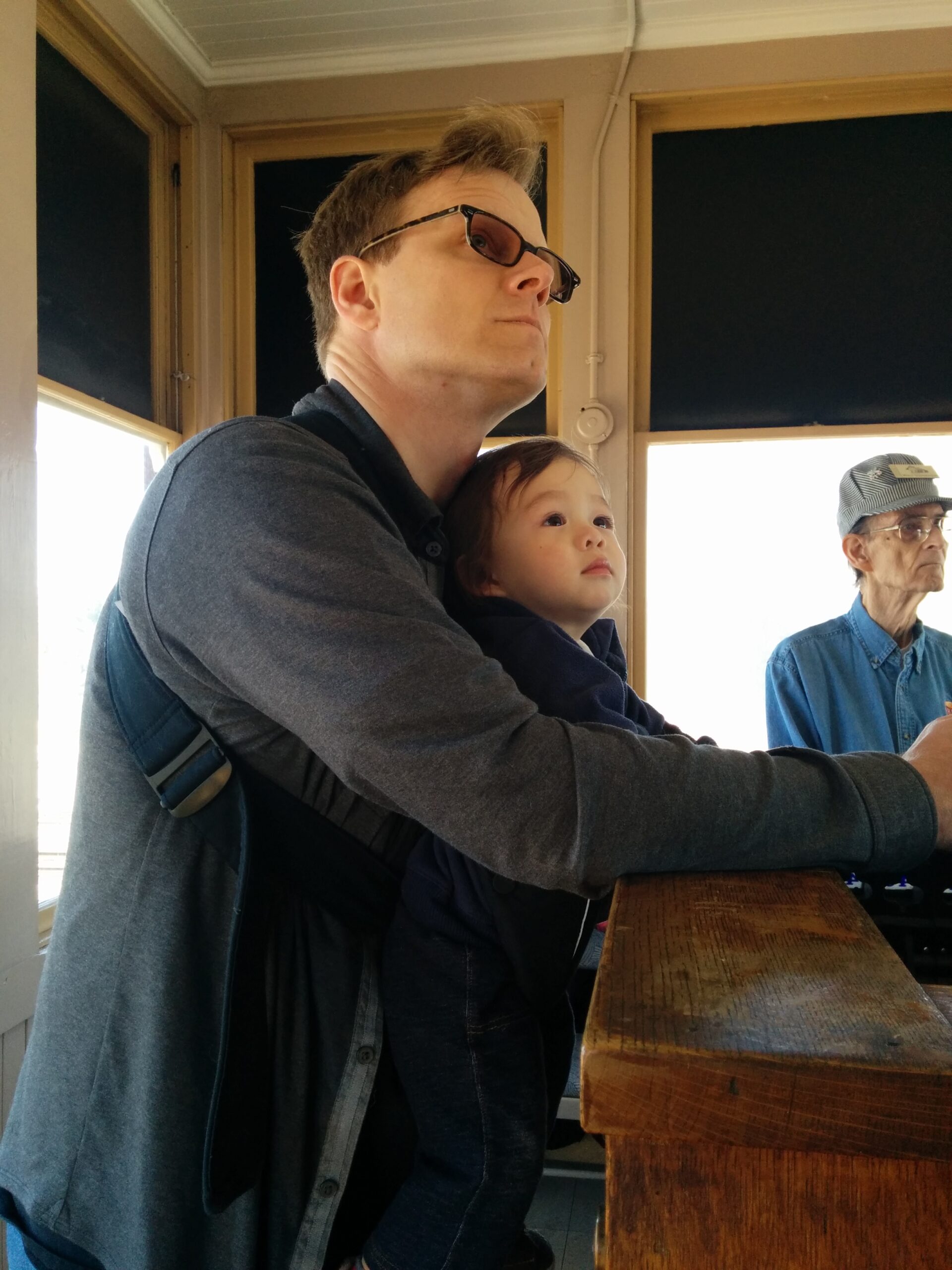
We started with brunch, after a walk of less than a mile downtown. We ate at our usual brunch spot. The lady there who is the soul of the operation but not the owner will be around some weeks more, before she moves to an affordable part of California with her new husband. We rode Caltrain a few stops down to Santa Clara and had nearly two hours until the Capital Corridor train was to arrive. Fortunately, it was Saturday, and the Historical Railroad Society was open. Bonus: it was their Open House weekend. The volunteers held our luggage in the Historic Waiting Room. We gazed at the model railroads, the boys with less sustained interest than me. Plenty of time to check out the signal tower. “You know, Older Son has toured the interlocking before, strapped to my chest.”
Ready to board Caltrain, the first leg of our adventure!
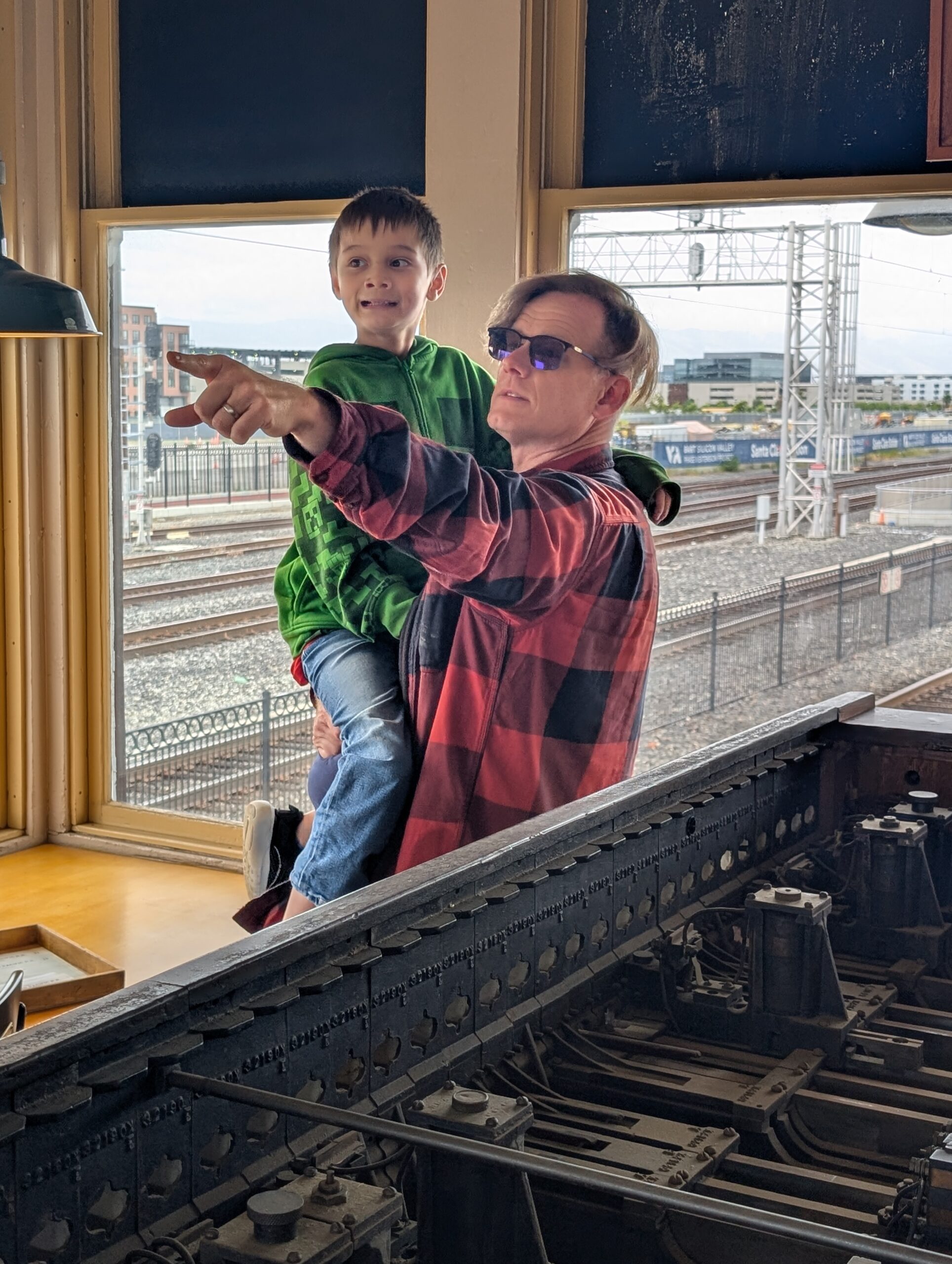
Signal towers are some impressive under-rated problem-solving. Train lines come together at junctions, and you need to ensure they don’t crash into each other. The signal tower is built high enough to look things over. And a siding is added so trains can pass. A little yard. Now there are a dozen switching points for half a dozen tracks and they all need to be coordinated correctly and consistently, so they get tied together with cables, such that if one switch between tracks is thrown, the matching switch is also thrown, and the appropriate cables that control the semaphor signals are pulled to the correct positions so the engineers know if they need to stop, or if they are allowed to go.
Touring the Santa Clara Signal Tower with Older Son, in 2014.
The earliest versions were “Armstrong” systems, so-called because it took strong arms to pull the levers that pulled the cables to correctly set the switches and signals. At Santa Clara, they had a more modern 1920s signal tower, where switches activated electrical relays that triggered the switches and signals. The regular trains ran through on schedule, special trains had orders made up on the typewriter in triplicate thanks to the miracle of carbon paper, and work went on until the work of the signal tower was replaced by a central computerized operations center in 1993, and handed over to the Historical Preservation folks for historical preservation.
Touring the Santa Clara Signal Tower with Younger Son, in 2026.
Appreciating the sweep of history I made mention of the future which we hope will eventually arrive: California’s High Speed Train system. It will run through the Santa Clara junction, passing below the old preserved tower. The guide got a glimmer in his eye, and said that what isn’t said enough is that we were standing over the first operational high-speed segment. If you took a high speed trainset and set it on the tracks here, it could pop up its catenary to Caltrain’s overhead wires and run between San Jose and San Francisco as Caltrain currently does. Today trains can run up to 79 miles per hour. With improvements to the signaling and tracks that will come along with the High Speed Rail construction, our new Caltrains are rated to 110 miles per hour. They ran faster than that when they were tested in Pueblo, Colorado.
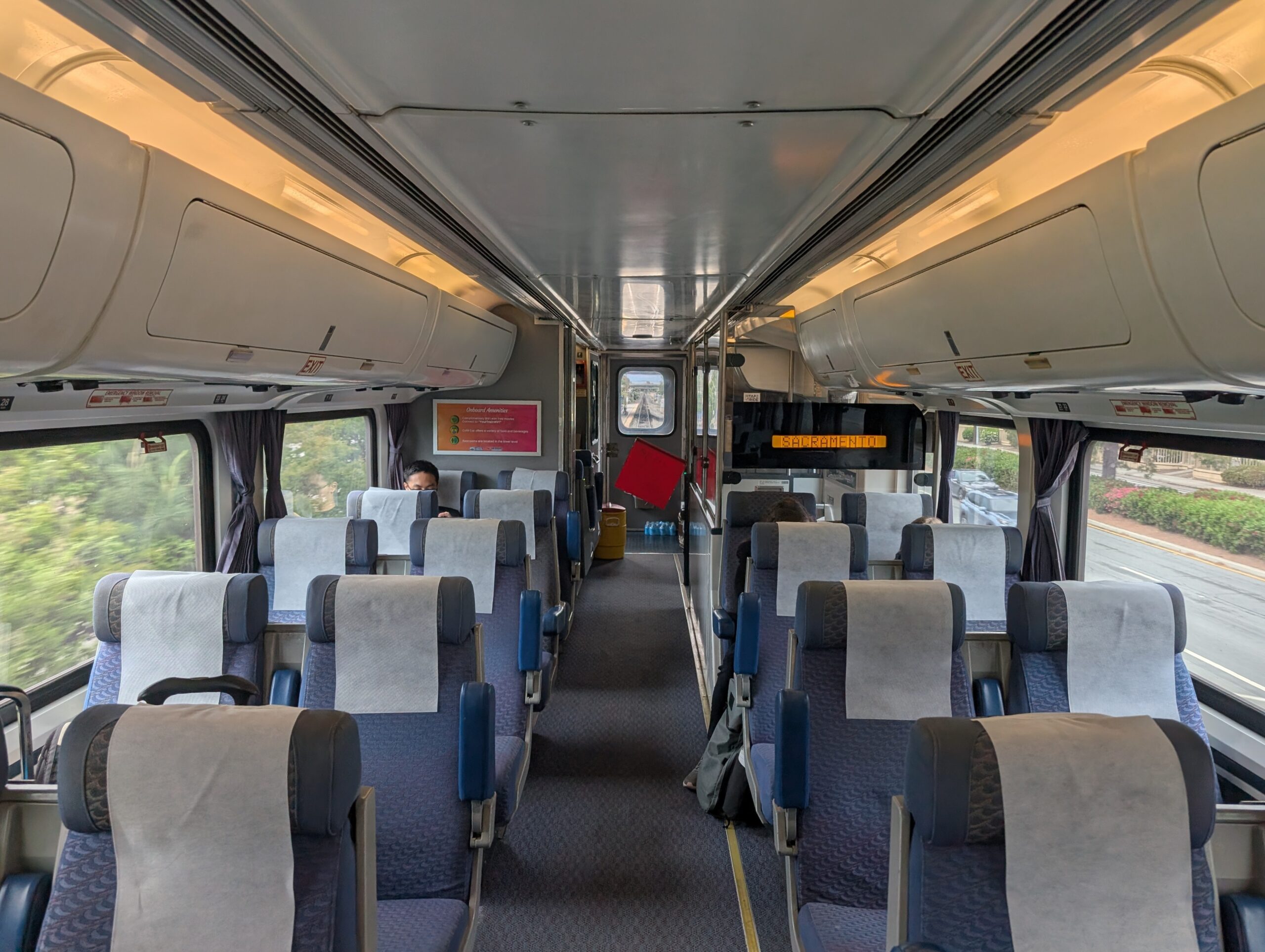
The view from inside a Capital Corridor train, bound for Sacramento.
The Sacramento train arrived, to take us on the branch that has no pretensions of High Speed travel. North through the salt ponds. Why are they red, asked Younger Son? The Internet suggests that the algae that most enjoy the saltiest water are red. We cruised through the industrial backyards of the Bay Area, where all the cool equipment gets stored amid the graffiti. There seem to be fewer homeless folks camped along the way than there were on my last ride, two years ago. My hunch is that two things are true: in some cases we have done decent work of helping people move up from homelessness, and also that we have sent the cops in to shove The Problem further out of sight. Which is more true I could not tell you.
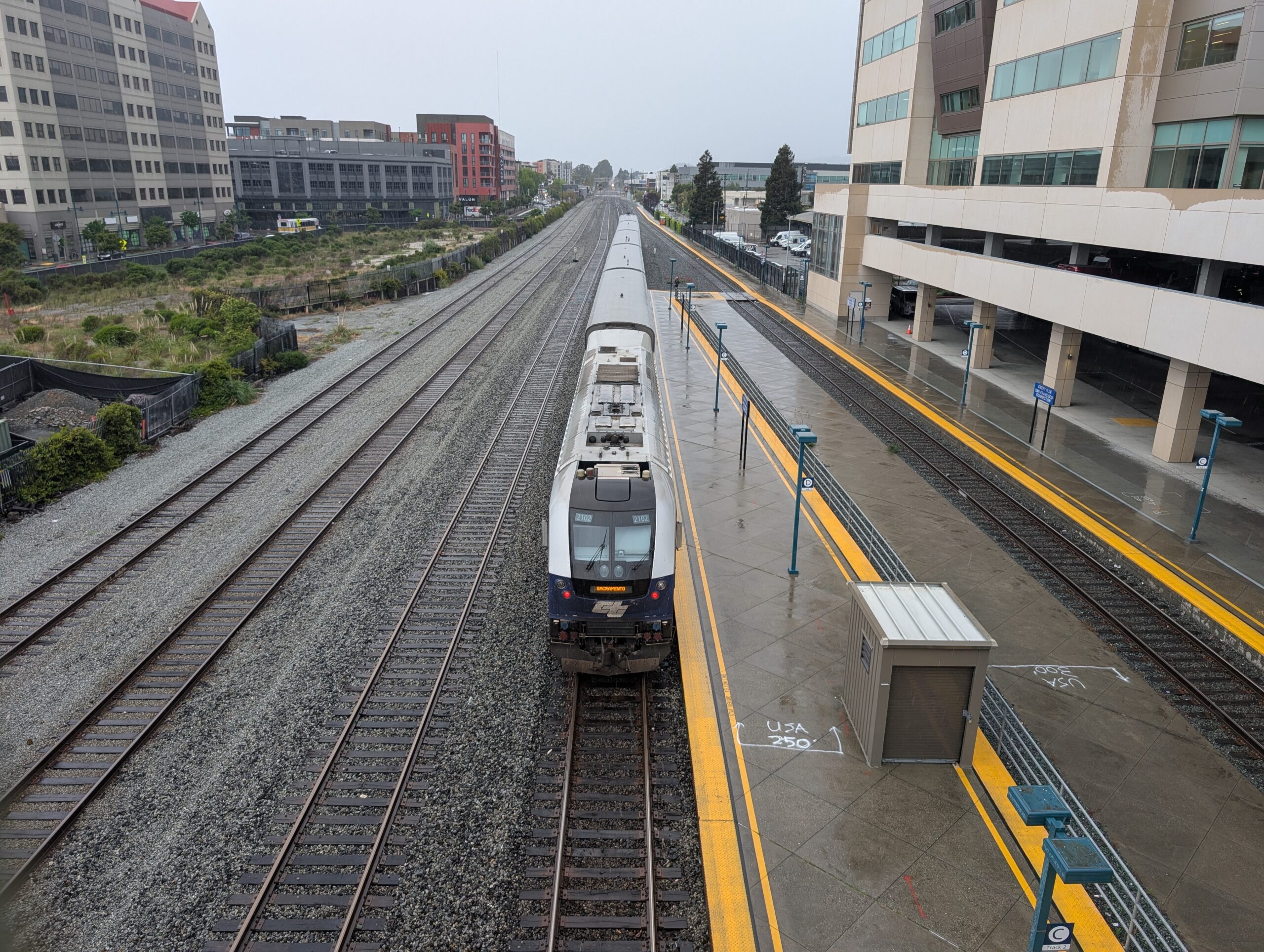
Our Sacramento train viewed from the overpass at Emeryville. The rightmost track is where we would board the California Zephyr the next morning.
Off at Emeryville and over the tracks to the hotel where we met Grandma. For a few dollars more, you can book a Bay View, but I correctly inferred that for a few dollars less, I could book a Train View. And the train view was fantastic: the Capitol Corridor stopped by at a regular cadence, then the Amtrak Coast Starlight, as well as freight trains. Sometimes in the night the horns heard softly on the fifth floor would prompt me to look out through the picture window and smile. The hotel has a restaurant but it was closed, so we walked to the Food Court across the street. Oakland offers no shortage of variety in cuisine, but the vendors were mostly consistent in serving their respective foods in garbage, collected in bins. The burger place flaunted convention, serving Younger Son and I drinks in used glass tumblers, incurring the endless toil of washing.
The hotel’s breakfast buffet was decent and important because breakfast is not served on the train which departs at 8:25 am. We ate our eggs and sausage and cereal and whatnot and schlepped to the pedestrian overpass where we were greeted in the elevator by a man just waking up across from a pool of vomit. Grandma was comfortable enough taking the stairs up if I handled the luggage. We crossed the tracks to the other elevator, to which the man had moved so that he could rest away from vomit. We rode down in the vomit-free second elevator with the man, and ambled over to where the lady was yelling to the assembled throng how boarding would work. Welcome to the glamor of train travel in America!
The train rolled up and we crept our way down the narrow platform to our boarding places, dutifully staying behind the yellow line, except where the platform had been flooded by rain. We found our first-class sleeper car and the attendant re-assigned our two rooms on the spot so we could have adjacent bedrooms. She later obtained the special key to open the partition between them. I appreciated her initiative, because I had previously called Amtrak, waited on hold, and spoke with a nice person who had access to The Slowest Computer which couldn’t help me anyway but rest assured it doesn’t matter if the bedrooms are next to each other. Sure. I figured if there was any improvement to be made to that situation the Train Staff would not be encumbered by computers and they would do what was right by them. Worked out great.
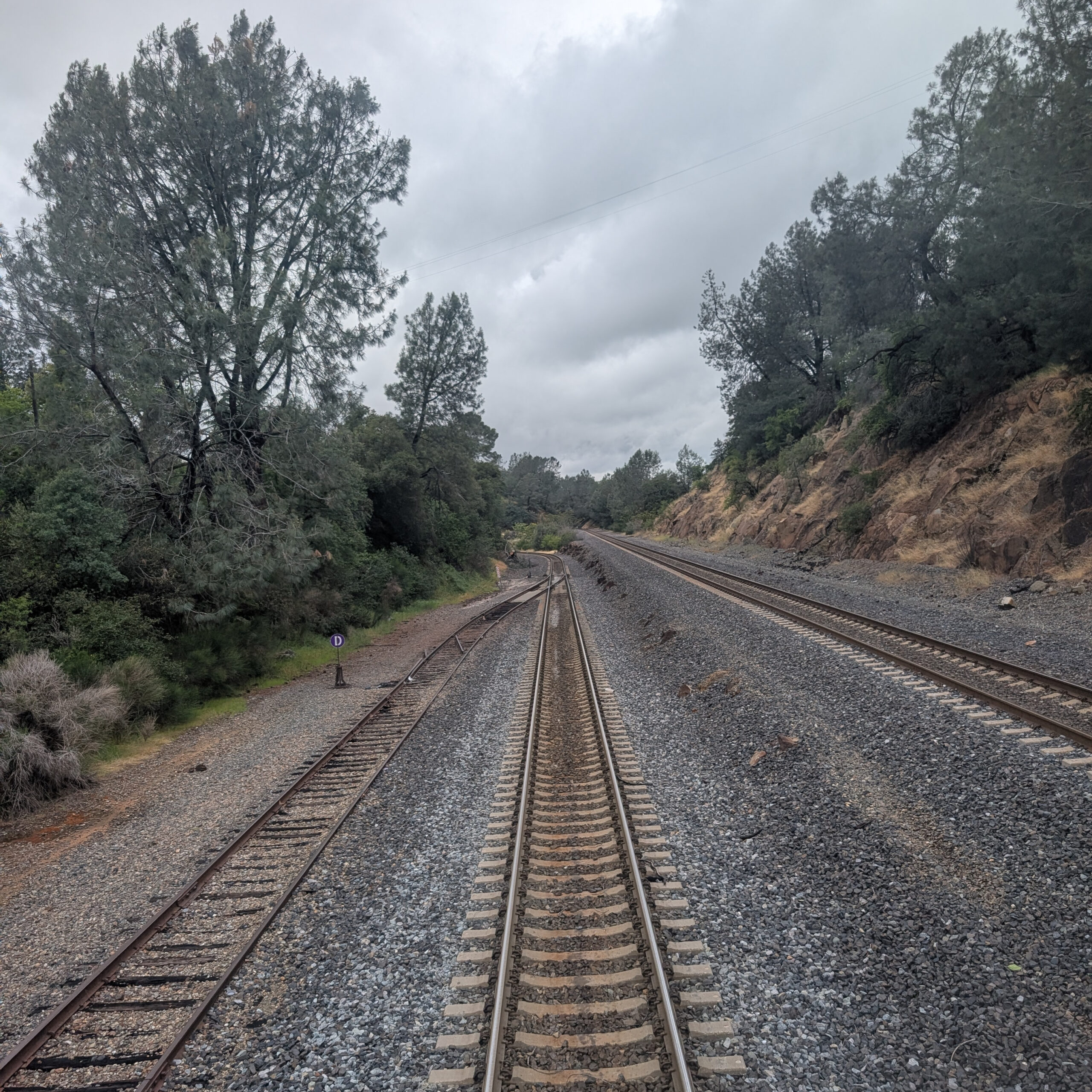
I wandered to the rear end of the train, where you can look out the window. Great view.
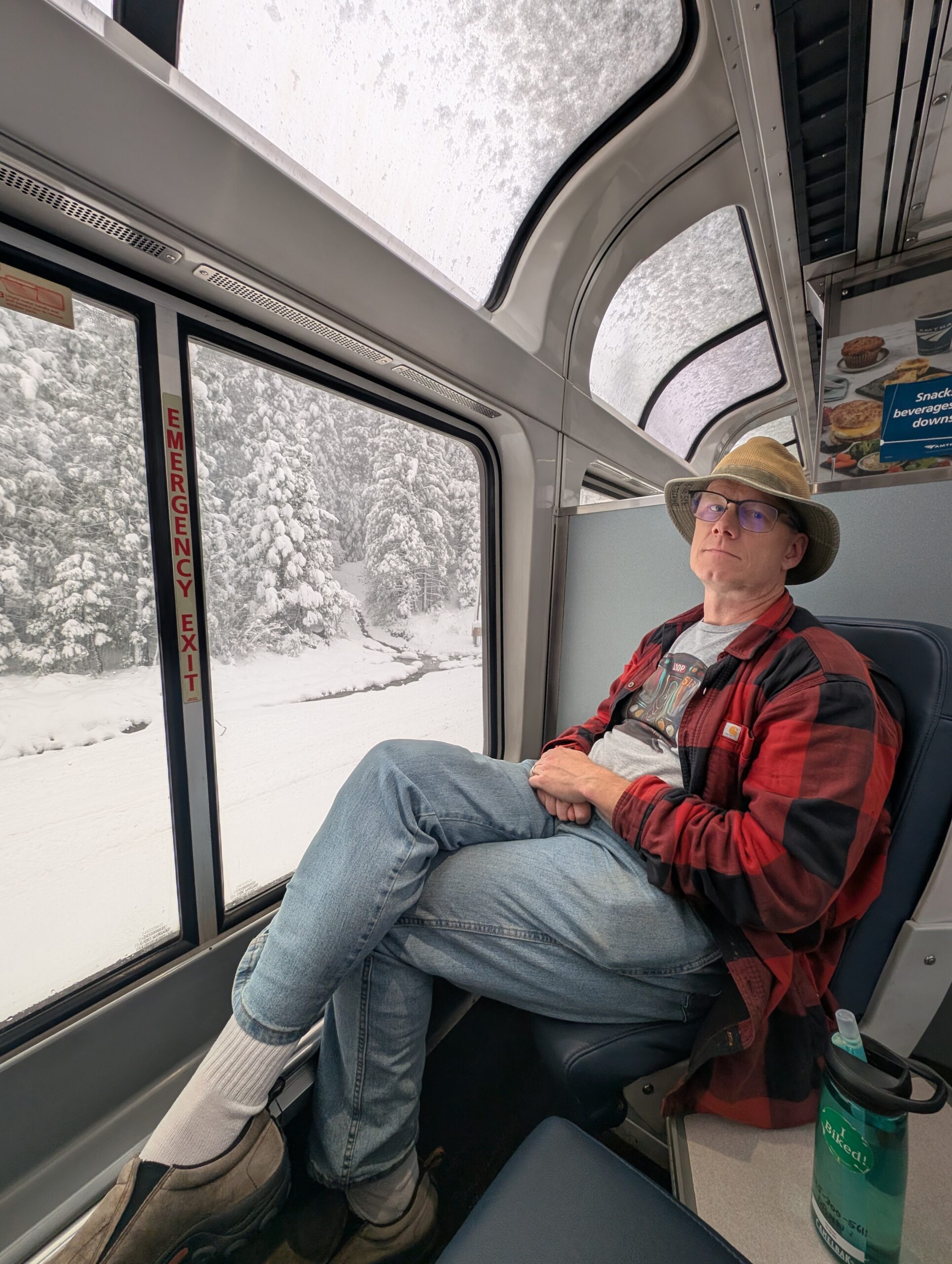
There were a decent number of folks riding to Reno, a favorite gambling spot for some Californians. A lady explained that driving was faster, but if the weather wasn’t looking great, the train was a more relaxing experience. As we climbed into the Sierra Nevada Mountains East of Sacramento, the snow picked up. Mobile phones alerted that there was a snow storm in effect. I watched the adjacent rails as the snow grew deeper, and was covered. Our train was delayed at Truckee around 90 minutes. As we waited, someone from the crew stepped off to make a snowman along the tracks. Slowly, snow accumulated on the top windows of the observation dome. It was a pleasant time, watching the snow cover the trees as we waited. A set of seven Union Pacific locomotives passed us headed downhill, then later the plow train: two diesels and a caboose with a plow beneath. The deal is the plow train ran down the line to a loop where it spun around and plowed back up the line. Before long, the plow train passed us again, heading East. Once the line was clear we were off again through the snow on plowed rails.
Waiting with no urgency for the plow at Truckee.
Reno is a “fresh air stop” where you can get off the train for up to fifteen minutes to smoke a cigarette or let your dog pee “but don’t go upstairs.” From the train platform, Reno looks like a bomb shelter. Atop the concrete canyon you can just make out a few tall hotels.
We spent most of our time in the Observation Lounge. The train staff made regular announcements for new passengers that the lounge was for People Not Luggage. I sighed that I wish they made these announcements on Caltrain, where half the seats are reserved for backpacks. A recent Caltrain encounter: I went to sit at a table, and I wasn’t In The Mood. I lifted a guy’s backpack off my seat to set it across the table.
He calmly caught it and said, “You could just ask.”
I gestured at the mass of baseball fans that had packed the car. “You could read the room.”
“It is important to be polite.”
I smacked my hand on the table in agreement, “Yes! It is important to be polite!”
We were amiable enough after that interaction. But yes, it would be a sweet treat indeed if Caltrain riders had better etiquette.
Anyway, part of the fun of the train is the other passengers, overhearing conversations. An older guy with an old red cap covered in train pins explained to someone the distinctions between Alcos, F units, and E units, and what trains he had ridden as a kid, and how he was headed home to see his folks. At one point he mentioned his love of visiting the Museum of Science and Industry. I leaned over and chirped that was my spot every weekend when I was a kid. We chatted a bit and I mentioned that a new thing nearby is the Obama library, a towering modern structure near the classical architecture of the museum. He said he wasn’t fond of Obama, as the Affordable Care Act had pushed up his health insurance, but his wife had voted for him. Fair enough. Later I noticed that the button on his hat that said “2024” had the word “Trump” just above.
It is important to be polite.
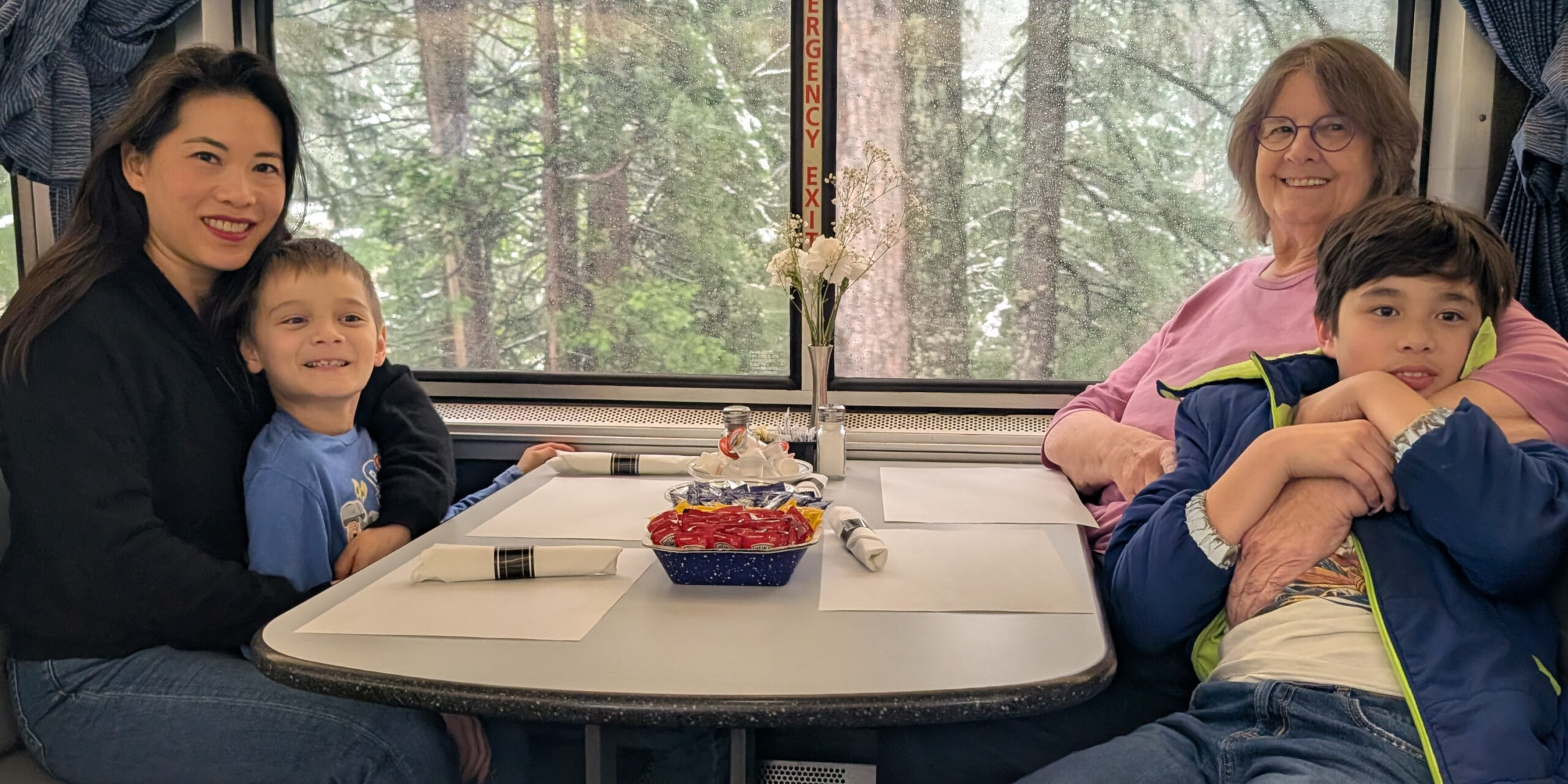
Waiting for lunch in the dining car.
We moved East. Dinner was good. The menu, as far as I know, is the same every day for decades on end, modified only when the Pandemic limited the menu. I had, as usual, steak and potatoes and a glass of wine.
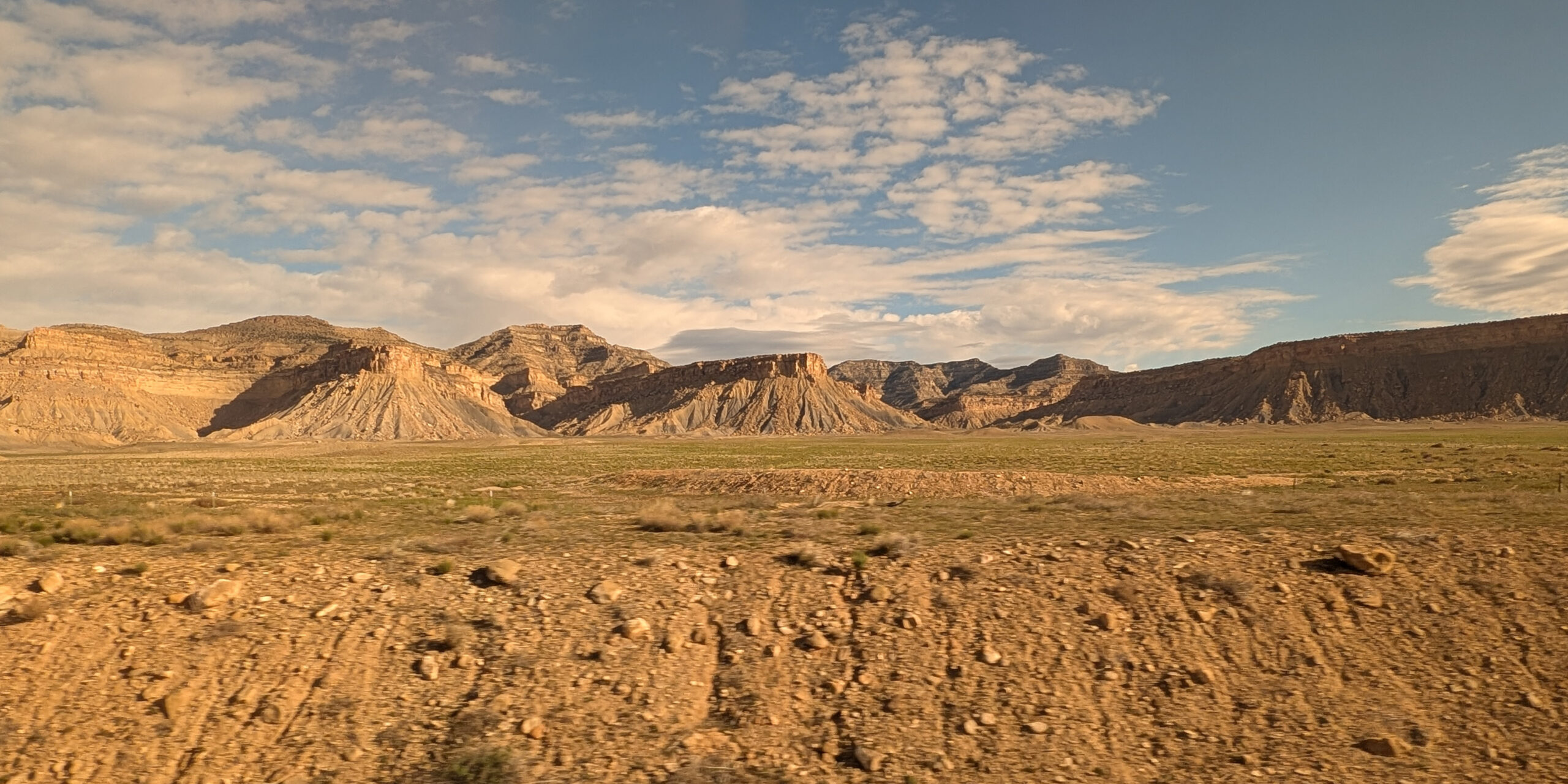
The attendant folded the seats in our cabin into bunks. The First Class Bedrooms shoehorn in a toilet room that also serves as a snug shower stall. When the lower bunk is extended, you enter the room by shuffling past the mattress, which mostly blocks the narrow doorway. Five of us and four bunks, with the bottom bunks I would describe as “twin and a half.” The boys were nervous about the top bunks, but Older Son took the one above Grandma. Mom took the top bunk above the one I shared with Younger Son. The night was comfortable enough. Quiet. Warmer than I like. The train rocked pleasantly. When he woke in the morning, Younger Son looked up out the window at the scrubby hills of Eastern Utah and said it was pretty.
Whizzing out of Utah and into Colorado the next morning.
I tried the narrow shower and it was alright. During breakfast, the attendant folded the beds back into daytime seating and, with our blessing, consolidated our luggage into one bedroom so she could clean the other for passengers boarding at Grand Junction, where we were getting off. We lounged more in the observation car: the train came upon and paralleled the Colorado River, which meandered through the scrubby landscape, offering gentle rapids in spots, alternating with sandy banks. There were groups of folks riding the river in rafts, some camping. It looked to me like a good time. Around the river the scenery was wonderful. In the distance were a few snow-capped peaks.
At Grand Junction I walked a few blocks over to the Enterprise Rent-a-Car. Three adults and two kids: I had put in for a “full-size” car. The lady indicated “a small SUV” – a Chevy Blazer, that did us just fine. Grandma is a tall woman who spent a lot of time in the back seat with the grandkids, and said the legroom was sufficient that her knees did not complain. Electric was not on the menu, and over the next few days in the Colorado backcountry, I counted all of one Rivian, one first-generation Nissan Leaf, two late-model “Sieg Heil” Teslas, and several blue signs indicating where EV chargers were to be found. As a smug EV owner, I assume the gas I bought on the trip was expensive. About $50 per half tank.
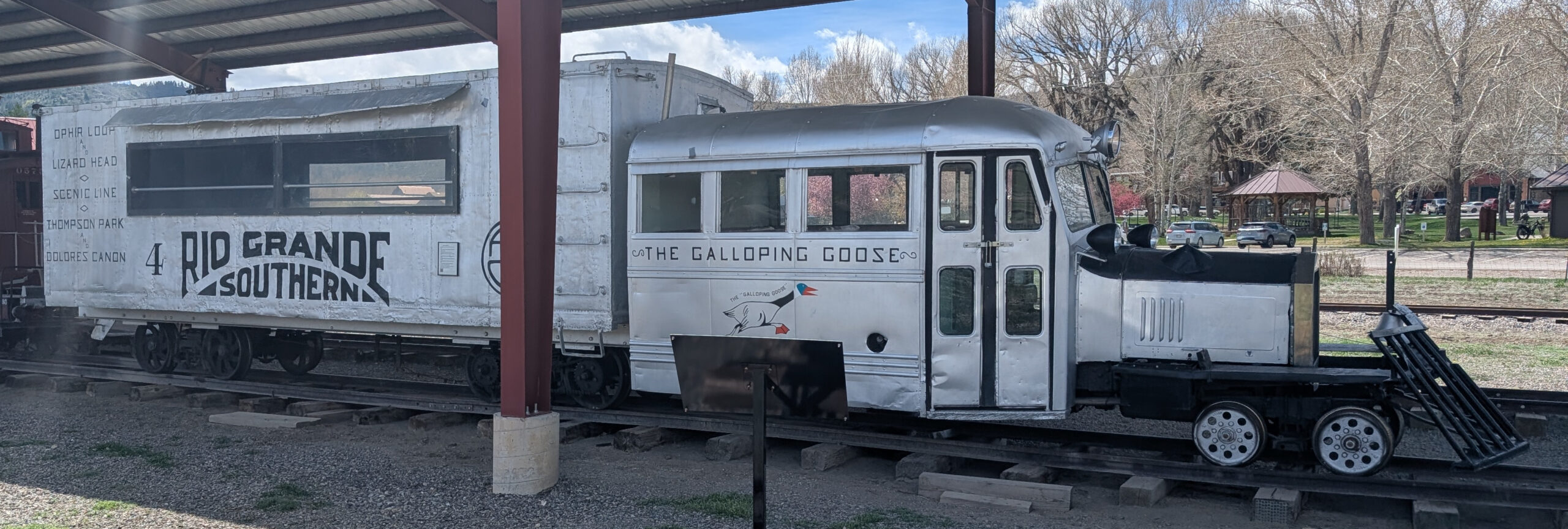
Galloping Goose at Ridgeway
South down US-550 to Ridgeway, where I stopped to admire a Galloping Goose. The story goes that in the 1930s, the Denver and Rio Grande Railroad had fallen on hard times: the mines were closed, but they were still carrying mail. The mail revenue was not enough to operate steam trains profitably, so the folks in the shop tried putting an old bus on rail wheels, to haul mail and a handful of passengers on a low budget. This worked out really well, so they built six more of these improvised railcars. They were painted grey and they “galloped” along the tracks, which were probably not in the best shape at that time. Hence the nickname: “galloping geese.”
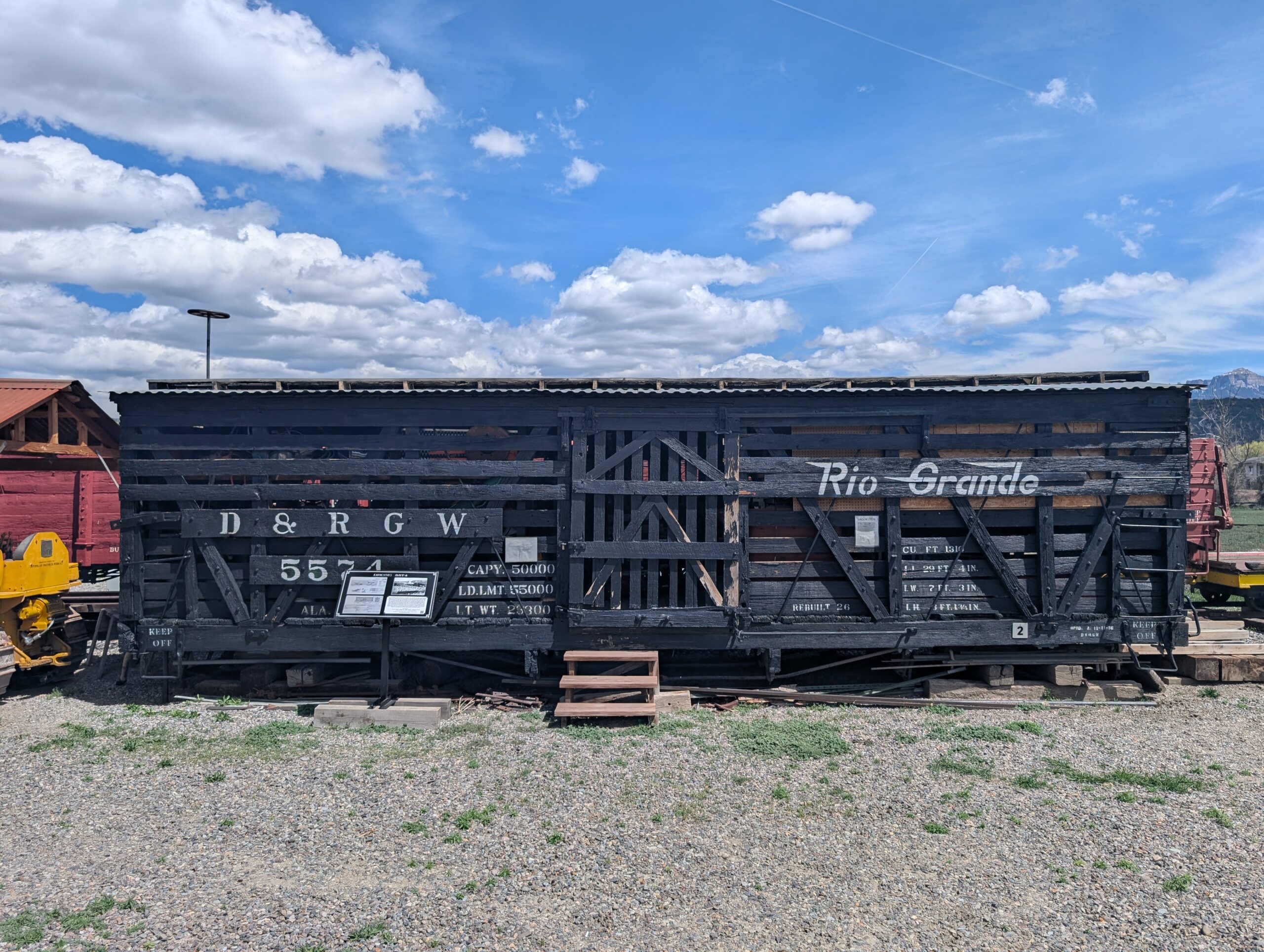
An old Rio Grande stock car basks in the sun at Ridgeway.
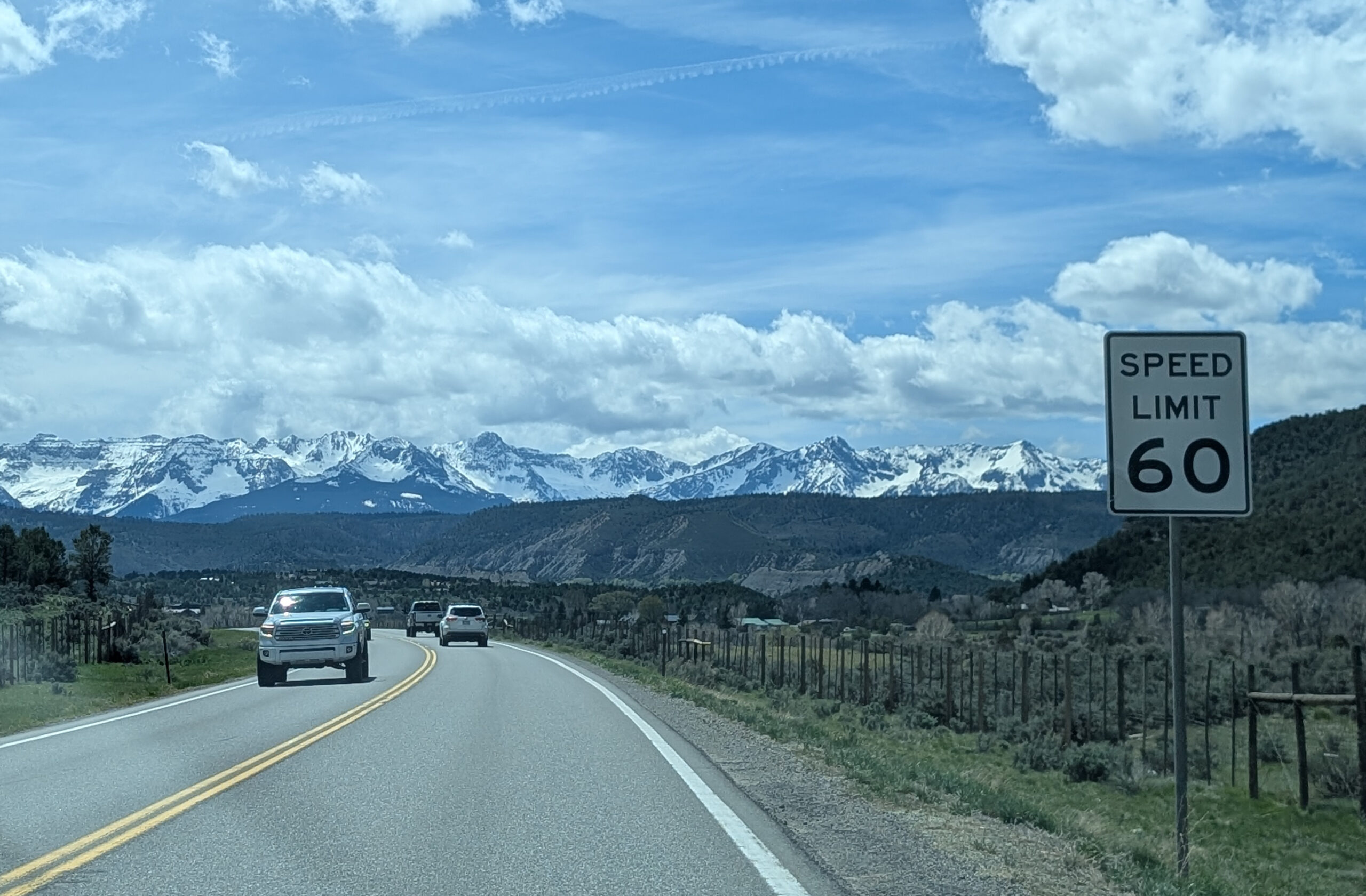
Passenger-side view North of Ridgeway. We drove up to Silverton, somewhere in those distant snow-capped mountains, before descending again into Durango. The speed limit south of Ouray is much lower.
I pushed on and down US-550 South from Ouray, where I calculated I had enough time to make Silverton before dark . . . and I drove up, past signs advising of curvy roads, avalanche zones, and speed limits between 10 and 30 MPH much of the way. Up and up twists and turns and curves and well-plowed snow and ice, and freezing water streaming across the road way. Occasional wild animals and oncoming cars, nobody passed me and I passed nobody. Much of the time it was me, the car, and a blue-gray sky going on twilight. Where the scenery of the afternoon had been beautiful, the scenery of early evening was transcendent. It felt very much as if I had drove clear up into some special realm where we mortals are allowed to tread only in times of fair weather, and with great caution. My experience of the road between Ouray and Silverton was this: sublime.
This time through Silverton, though, I had a car full of dozing family members. The amazing views as the car rocked slowly, slowly, back and forth into the thinning mountain air had knocked them all out. Better them than me. I drove up the main street and back down another, places I had experienced once before, but there was no nostalgia to be had. They woke up at a convenience store at the edge of town. We answered the calls of nature and acquired snacks, and continued the quiet drive back down slow roads to Durango.
The object of my quest was to ride the Durango and Silverton Narrow Gauge Railroad, a train I had missed on a couple of occasions. This trip being the occasion of my fiftieth year on the planet, I splurged for two nights and two rooms at the General Palmer Hotel, next door to the train station. Who is General Palmer? A Civil War veteran who built the Denver and Rio Grande Railroad is who. The original ambition had been to build a line from Denver to Mexico City. Americans know the Rio Grande as the Mexican Border, but it flows to that role from Southern Colorado down through New Mexico. Anyway, he had to battle the Santa Fe railroad. The battles were fought in state and federal courts and with guns in the Royal Gorge and Raton passes. Ultimately, the narrow-gauge Denver and Rio Grande curved not South to Mexico, but West through the Rocky Mountains to tap lucrative mine traffic. They built a branch line to Silverton, where Silver and Gold were mined. (“Silver … mined by the ton!”) The last of the mines closed in 1992, but the first tourist train, “The Silverton,” began running in 1947. Durango sprouted a tourist district near the station in subsequent decades. The Durango and Silverton was spun off in 1980, and when the world isn’t on fire, steam trains run daily from Durango. Though, in the winter, they only run as far as Cascade Canyon.
The General Palmer is a comfortable hotel, ideally located for catching the morning train at 9:15. The gentle toots next door remind you that Train Time approaches, so finish breakfast! There were three options for tickets: First Class 21+, where you get to sit at a table far from any children and drink, I guess; First Class, which is a glass-top observation car built a decade ago; and Coach Class, which is upholstered seating in vintage passenger cars. I wanted to ride a properly old train, and the old coach cars have toilets, so I opted for thrifty seats with handy access to bathrooms.
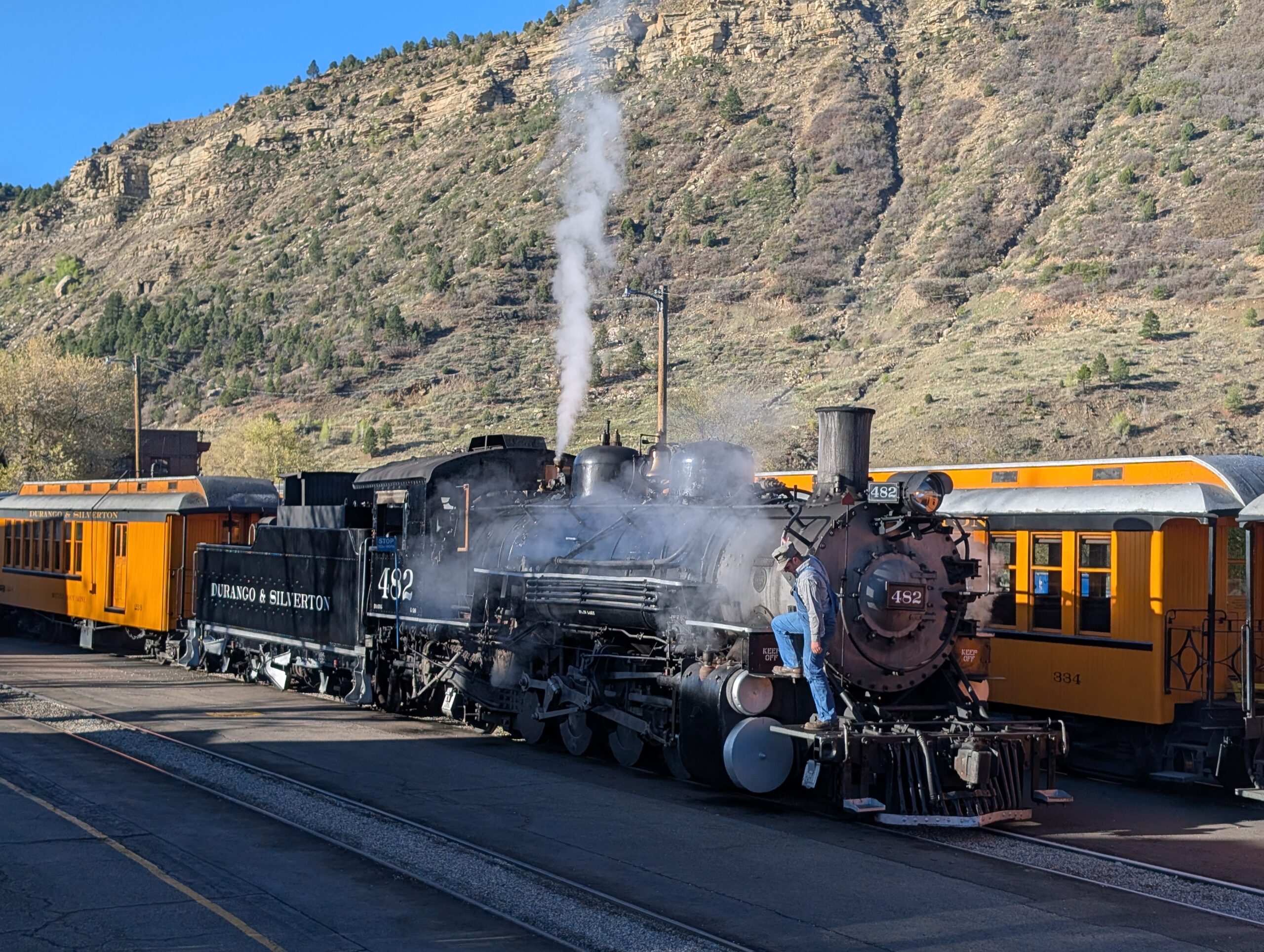
The Engineer inspects D&S steam engine 482 at Durango station.
The desk clerk, himself a father, gave me a list of budget-friendly family activities. First on the list is a hamburger place on the other side of the downtown area that will serve you a burger for $3.50. That sounds swell, but when you’re travelling hamburgers become the stopgap food for when you’re hungry and desperate for something predictable. Our first night in town we dined at a saloon in the other fancy old hotel a block away. We were waited on by “saloon girls” in corsets and fishnets and sensible flat shoes. The ladies were upstaged by a guitar player. At each table there was a two-page menu of songs that he knew, and he knew others as well. We had fun singing along between bites of tasty food. The second night, after our train ride, we went to another restaurant a block away that was the sister of a concert venue. The service was stellar and the delicious food a little more creative than we had hoped. My wife had the prime rib, and I indulged a boozy milkshake for dessert.
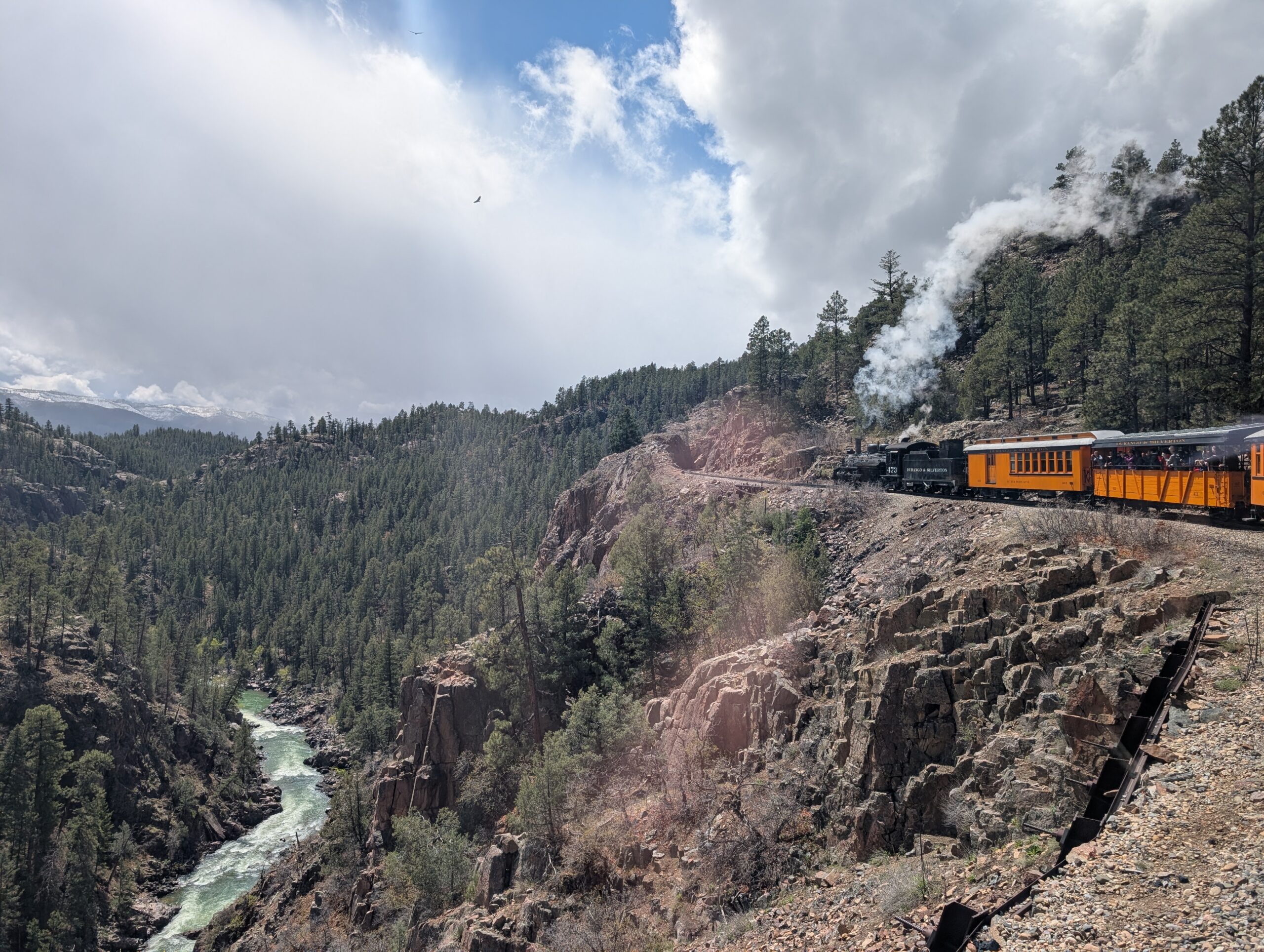
A “postcard view” of the Durango & Silverton chugging up the mountain, the Animas River far below.
Between those dinners we caught The Train, which is the whole point of visiting Durango. General Palmer serves a breakfast buffet next to a gallery looking out at the railroad. Eat your eggs and amble over to the train at 9am. Fifteen minutes later, you start to move and smile at the gusto with which the engineer whistles the train’s way through Durango. Up the river. Higher. Higher. Before very long you’re chugging along cliff faces between a river gorge and rock walls. Trees and rocks and river, and on our journey, snow that grew from a hint of dust to a flurry of floppy wet April flakes as we climbed the mountain. There’s a reason the train only runs halfway to Silverton in April: the mountains of Colorado get extra months of Real Winter.
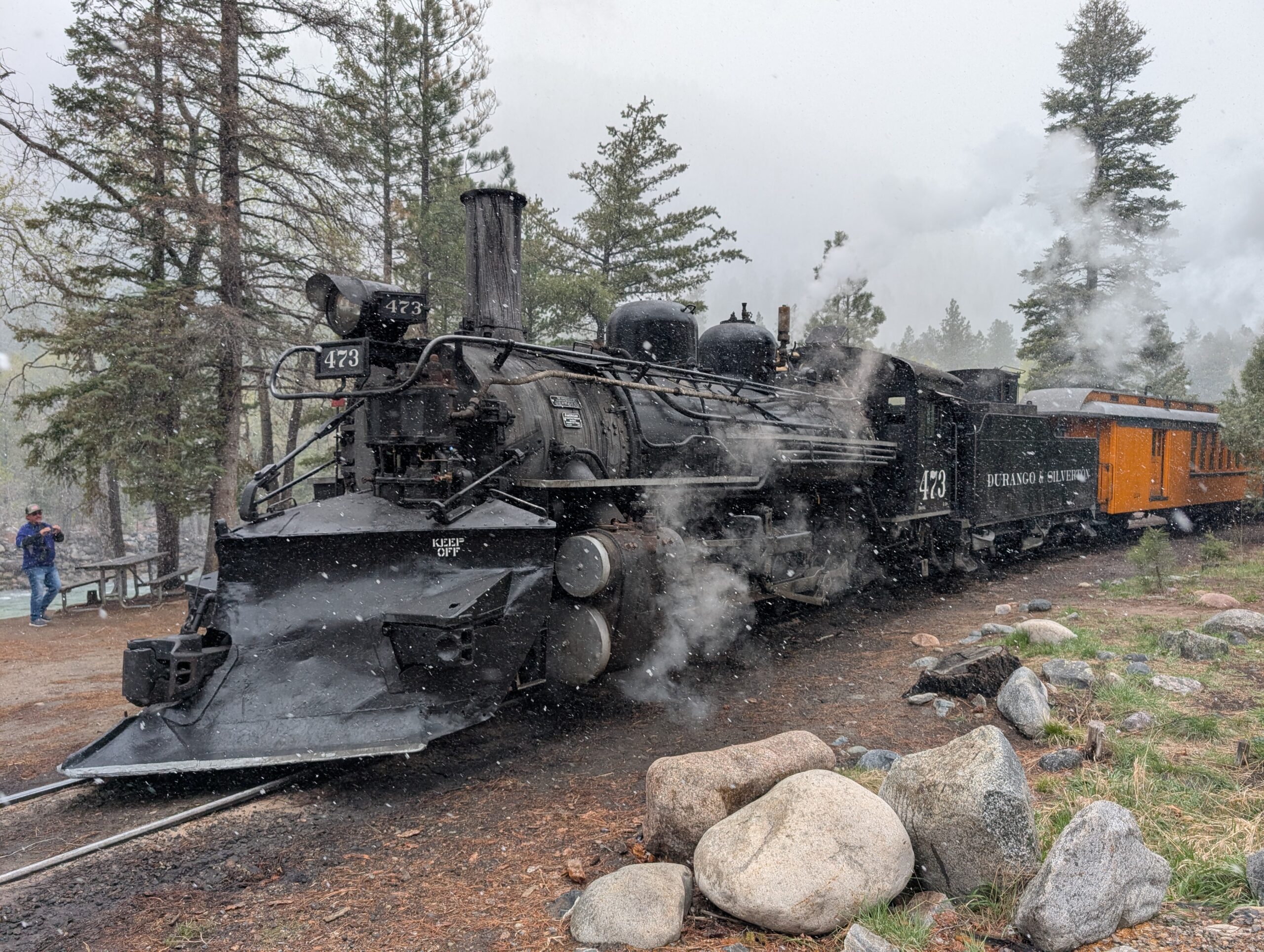
D&S 473 poses for photos on the Wye track at Cascade Canyon, on a wintertime excursion before the return to Durango.
It is a five-hour excursion. The passengers in coach class began to mingle. Our section was older men from the Midwest with familiar relationships to the University of Illinois and Purdue. The chatty great grandpa who used to hang drywall in Florida asked the conductor his age: seventy-eight. Great Grandpa was a mere seventy-six! Folks wandered to the snack car for something to do and we took turns standing in the open-walled observation car, gawking at the scenery and testing our camera skills until numb hands coaxed us back inside. The observation car was two back from the Engine, and as the engine chuffed over a bridge it shot off extra steam on either side. What’s going on? In a moment, we saw the rainbows!
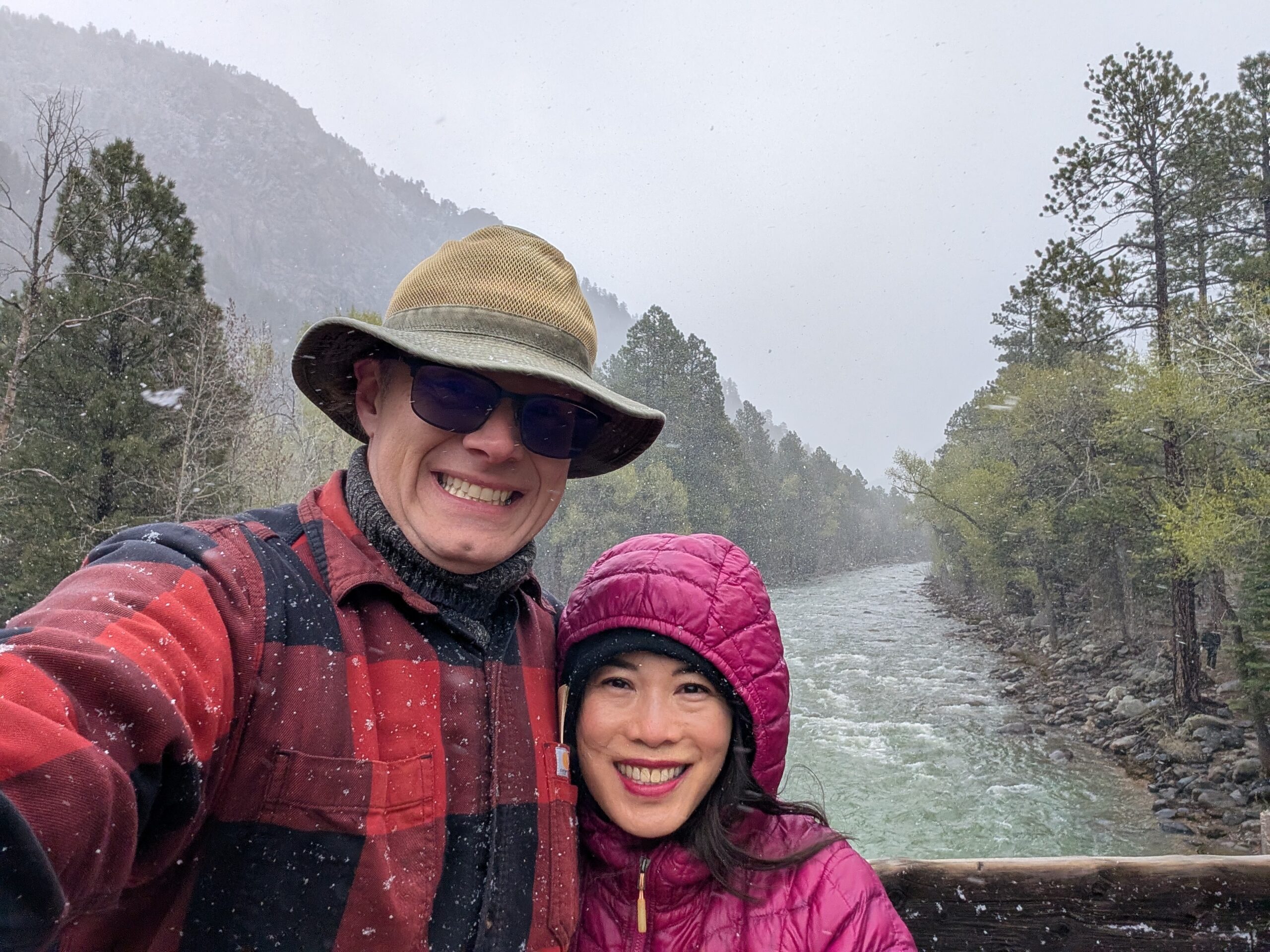
My Sweetheart and I together on a snowy bridge over a river at the end of the world.
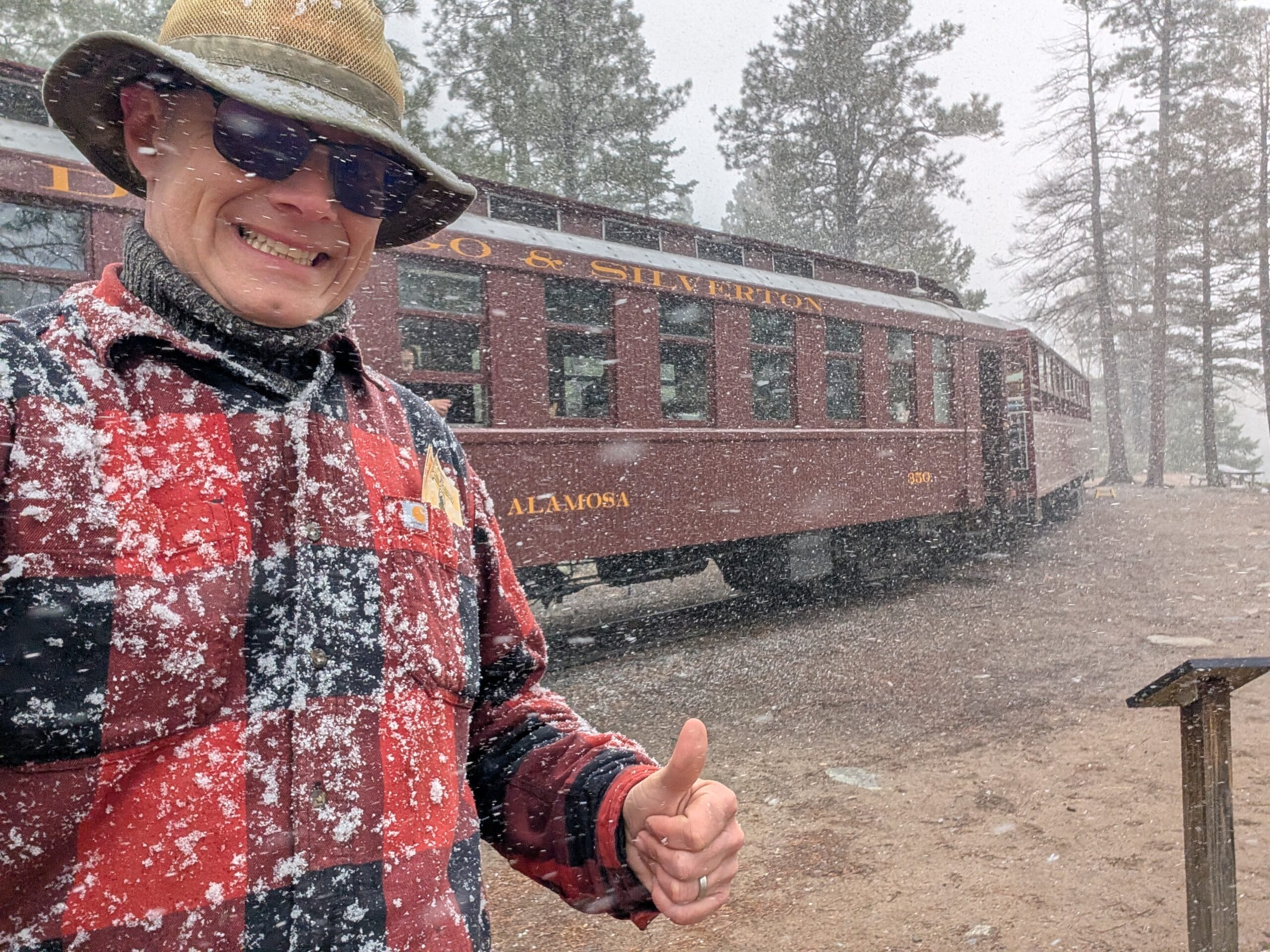
The train backed into a wye track at Cascade Canyon, and we had 45 minutes to frolic. I walked around the train, took selfies with the engine. The snow fell faster. The Earth was quiet. I walked back and found the end of the track, then up a short trail to a bridge over the river, just downstream from where a tributary joined. Most folks by this time had returned to the warmth of the train. My wife and I enjoyed a quiet moment with the snowy river. Back at the train, I lingered alone, enjoying the scene, the quiet, and letting the snow accumulate on my shirt. As the conductor came along, preparing for departure, I climbed back up the stairs, for our return trip to The World.
The next day, we drove East along Highway 160 through the San Juan Mountains. A quiet green river valley in a bowl of pine trees. We lunched at a cafe in Del Norte, which we learned was pronounced “del nort,” then we headed North. There were a few delays for road construction on the two-lane roads, and one delay due to someone flipping a pickup truck. We made Bishop Castle with twenty minutes to spare before it officially closed at 6pm.
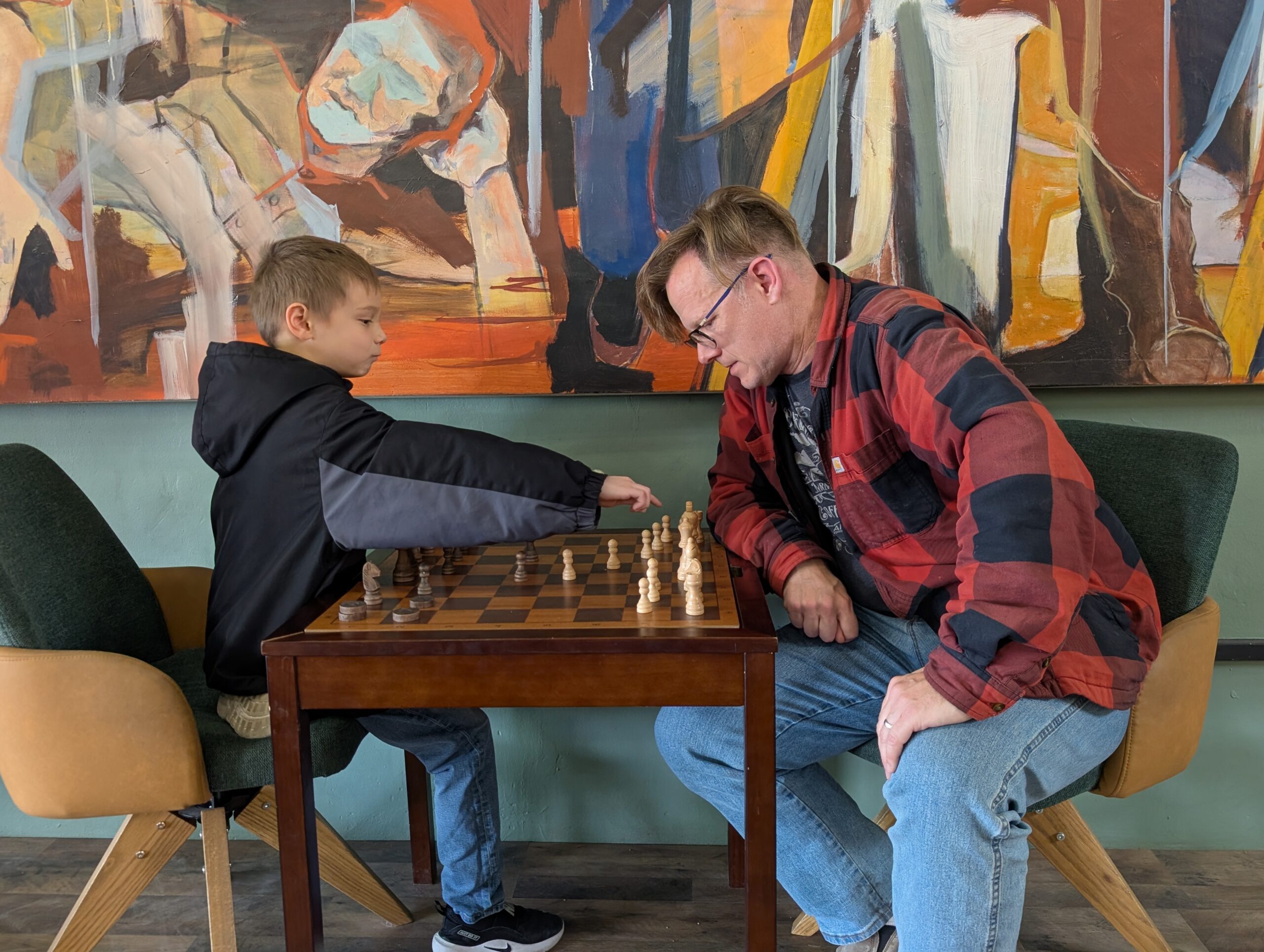
Chess match in Del Norte
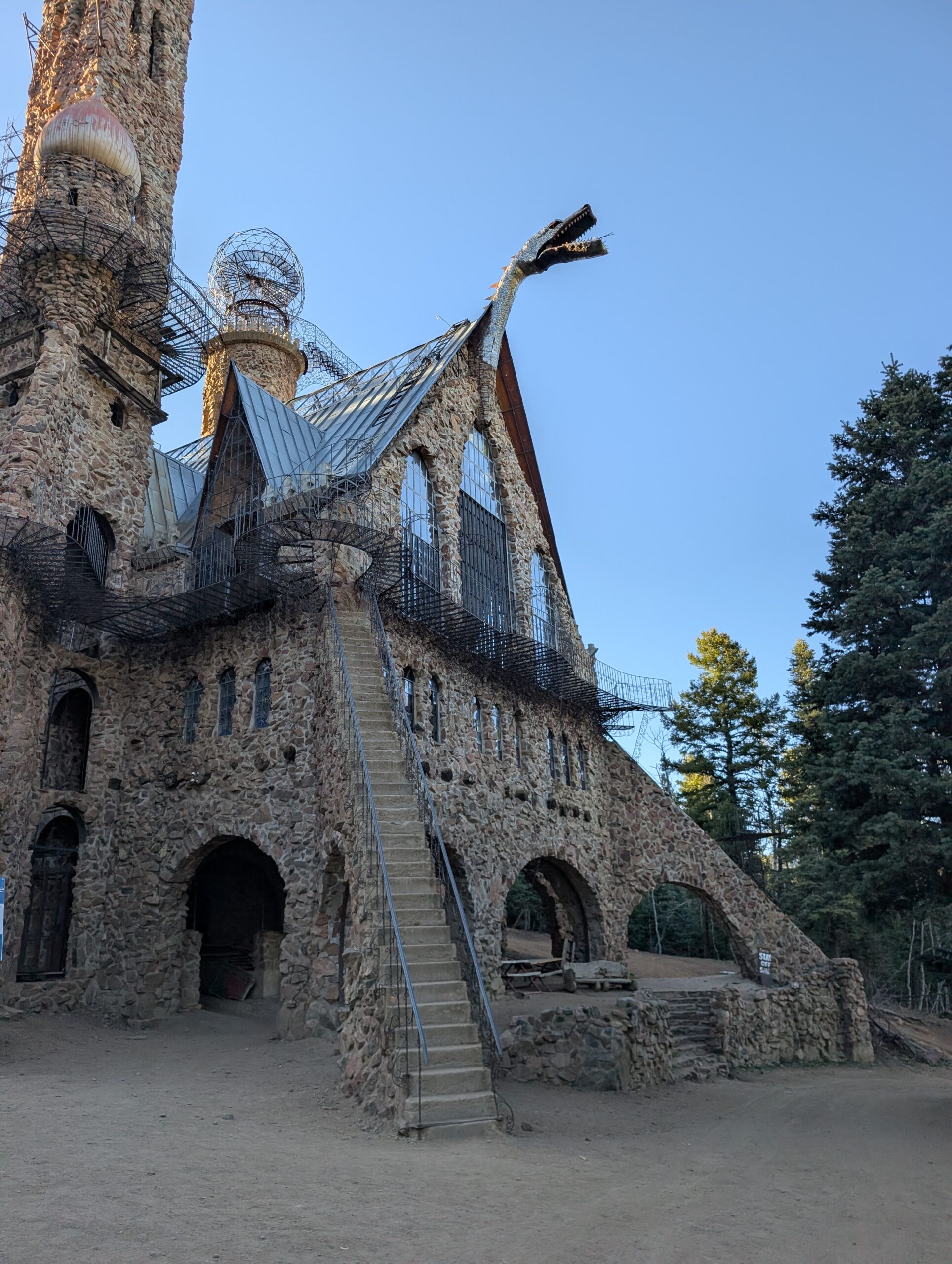
Bishop Castle is built on uneven ground. Grandma waited in the car as we crossed the drawbridge and climbed up the spires to the Great Room of what could pass as a rustic cathedral if there were a congregation around to enjoy it. The place was hand-built in the middle of nowhere in defiance of the government and its pesky permitting and construction safety standards. You visit very explicitly At Your Own Risk.
The dragon is capable of spitting fire.
Younger Brother understood a world-class playground structure, and proceeded up and up and up and up the dubious spiral staircase, trailed by Mom, who had selected the destination. Older Brother and Dad carefully picked our way down and tried to spot our loved ones from six stories below. I left a donation at the gift shop. The place is a work of art: art of course is in the eye of the beholder. To my eyes, the place is a monumental tribute to poor judgment.
Along the way, we had been hoping to meet up with my Uncle John, who was traveling in his van. Unfortunately, the van had broken down in New Mexico, and parts were hard to acquire. He had hoped to meet us at Grand Junction, then Silverton or Durango. But now he had finished repairs at Albuquerque. I had chosen not to structure the day, but figured we might stay in Golden, outside Denver, possibly visit the Colorado Railroad Museum along the way to the airport. With about 90 minutes of sunlight left, we set our sites South of Denver: Cañon City, still in the mountains off of I-25.
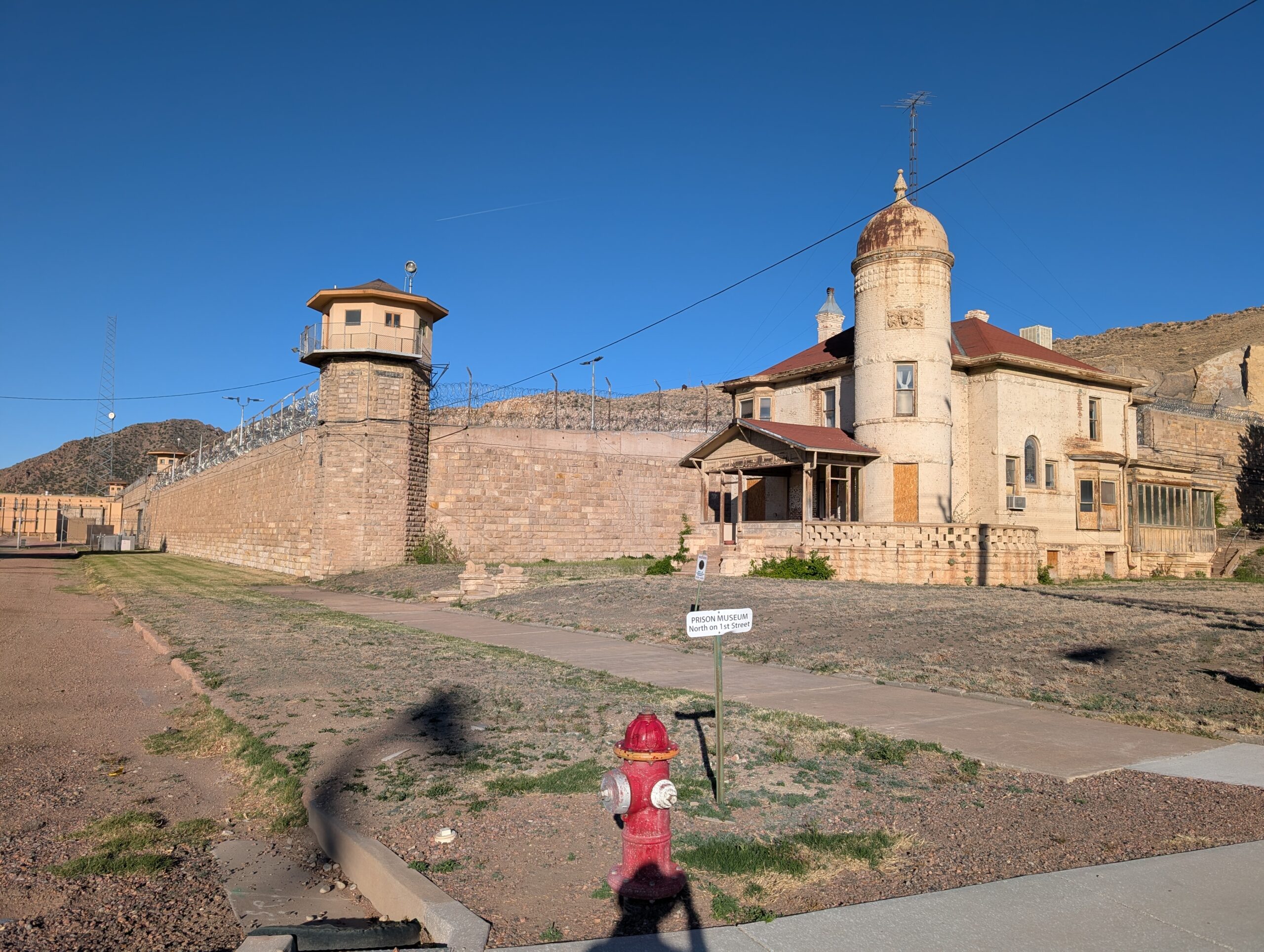
Cañon City’s economy has long relied on the prison industry.
We had a nice dinner downtown. As the meal wound down I rolled over to a budget hotel two blocks away, which boasts a pool and a hot tub and an indifferent clerk, who charged my card and handed me key cards to a pair of rooms which were … adequate. The next morning, waiting for people to stir, I took a nice walk around the old part of Cañon City, taking pictures of dinosaur statues and the historic prison. Uncle John rolled up, and we all brunched in the dining room of the historic hotel three blocks over, and someone asked why we hadn’t stayed there. I had asked myself the same question. However, the budget hotel had a pool and a hot tub, though I don’t think any of us ever confirmed this with our own eyes.
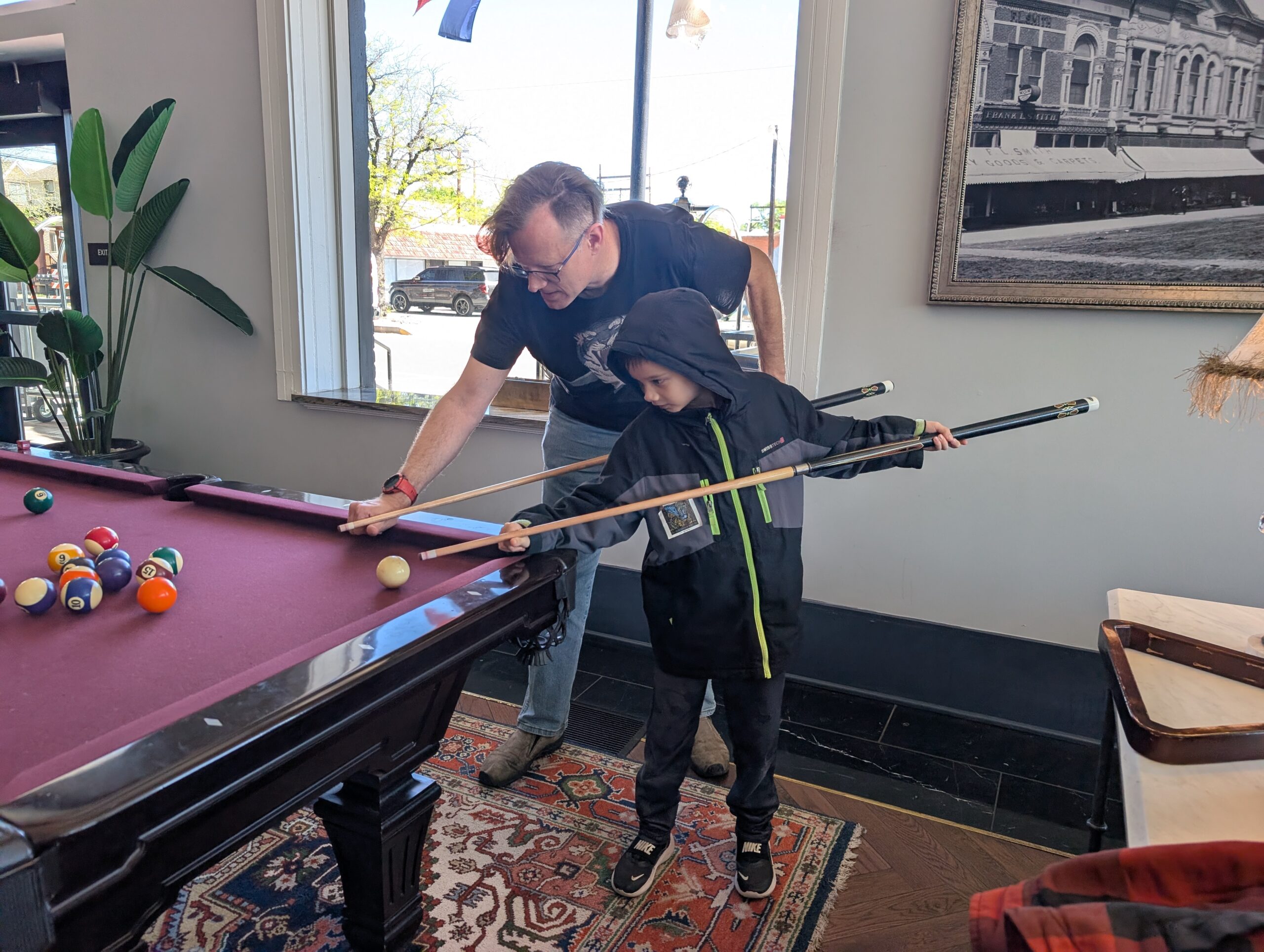
After breakfast at the fancy hotel where we didn’t stay, Younger Son was drawn to their pool … table.
Cañon City has a tourist railroad. It boards just across the street from the budget hotel. I looked into it. The fare was about 50% more than a night at the adjacent budget hotel, and 25% higher than the Durango and Silverton. The trip is half as long. A diesel engine from a freight train. “But the cars have premium butcher block dining tables where you will eat food from our onboard restaurant. And yes, German tourist, you should tip the server.” On the day of my 50th birthday in January I took the family on a “wine train” excursion near Sacramento. It was okay, but what I figured out is that there are two kinds of tourist trains you can ride: one kind is the “historic preservation” railroad where folks who love trains try to fix them up As They Were and fund the work with rides and tours. The other kind is “that old branch line is worth money.” Go find some old rolling stock and a business plan and Capitalism ensues. I gave the Royal Gorge Route Railroad a pass.
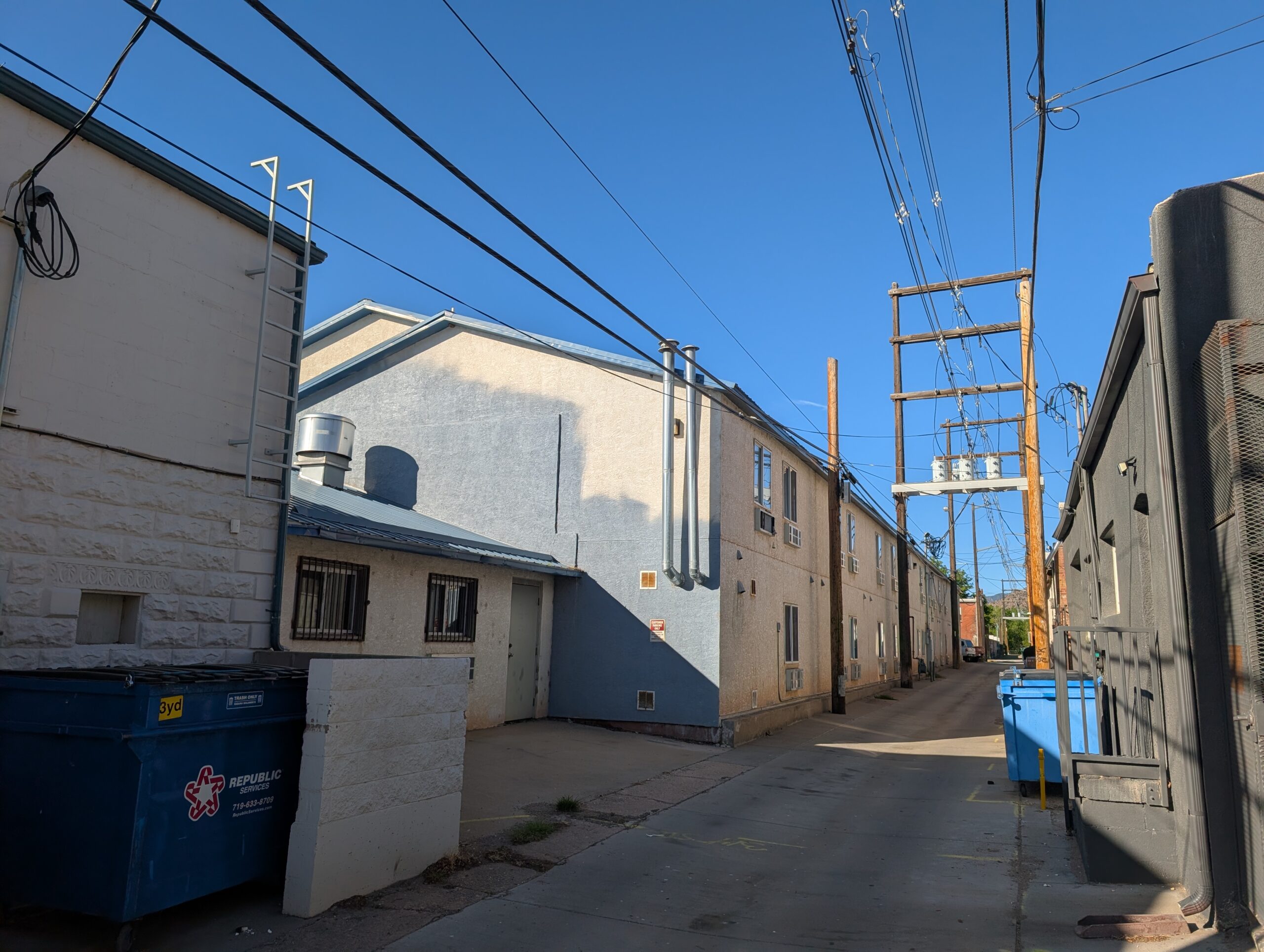
Our Budget Hotel room window opened onto the alley, which was alright. On my walk, I noticed that at some point they apparently lost interest half way through re-painting the exterior.
We had an afternoon flight, and had had a fulfilling week. Our next destination was Denver International. Instead of making a beeline to I-25, we chose to drive Northeast, milking the experience of rural highways for one last hour, until we hit Colorado Springs. There, Grandma and Uncle John kept Northeast in the van, bound for Chicago. I merged onto I-25, commencing our return trip to Civilization.