Our current national information security policy basically amounts to every company hires their own militia to provide collective security against attacks, large and small. The major ISPs will cooperate with each other to filter out attacks when they can, but . . . it is basically “every man for himself”
And our own critical infrastructure, like the power grid and the military, is constantly being hacked by the Chinese, who have a standing Army of highly competitive, over-caffeinated nerds and a shortage of women. Guys who can’t get laid acquire a lot of energy that needs to be directed somewhere.
So, this new initiative, to use a military analogy, amounts to giving the President an especially large white flag which can be deployed at a moment’s notice. “The Internet is under attack!? Quick, turn everything off and hide!!”
I mean, I thought I was all for Socialism and all, but this rapid surrender option isn’t the part of French national policy that I was hoping we would emulate . . .
How about instead of a “kill switch” we invested some time and energy and patriotism in to building a common defense strategy that analysed threats in real time and coordinated with the parties who manage our national networking infrastructure to deploy a rapid response to threats? Too obvious? Maybe oh maybe that is what they’re trying to do, but they have this “kill switch provision” in there that is making the whole effort look more retarded than it is.
I used to believe . . . that growing and growing up are analogous, that both are inevitable and uncontrollable processes. Now it seems to me that growing up is governed by the will, that one can choose to become an adult, but only at given moments. These moments come along fairly infrequently — during crises in relationships, for example, or when one has been given the chance to start afresh somewhere — and one can ignore or seize them.
Nick Hornby
I think that is a fair description. I think that for a long time I chose to be swept along with the current, without taking much responsibility for my destination. In the past few years I have gained a better understanding that the crises are “growing up” opportunities, and that I have successfully “grown up” from some of these experiences. Still, it is easy enough to be swept along and fail to learn lessons, and I have surely missed the opportunity to grow as much as I could have from some of these crises.
I also remember John Chambers, Cisco’s CEO, recounting advice he had received during the dot-com boom, that you really only have a great company after you have survived an existential threat. After you have had to “grow up” and see what hard decisions you make when it comes time to make those hard decisions. John recounted with a grim face the large number of layoffs that Cisco chose to make in order to survive the dot-com crash. Today, Cisco pays well, and hands out bonuses, but although it has billions in the bank, it is also religious about managing expenses, which can be frustrating at times. All the same, I prefer to work for a company that can sometimes feel frustratingly stingy, if it means my job is less likely to be axed in the next recession. I like to think that this “stinginess” is the mark of a “grown up” company which is keen to reduce the risk of future crisis.
There is a well-worn adage that those who set out upon a great enterprise would do well to count the cost. I am not sure that this is always true. I think that some of the very greatest enterprises in the world have been carried out successfully simply because the people who undertook them did not count the cost; I am much of the opinion that . . . the most instructive consideration for us is the cost of doing nothing.
Thomas Henry Huxley
The cost of doing nothing? Global Warming springs to mind. I have talked myself down from a lot of ideas because, for example, I have a better and better understanding of the costs of building a service on robust and scalable architecture. For the most part that is a good thing: great ideas should be able to wrestle down their opponents. But sometimes you just have to charge forward, and in the words of Buckminster Fuller, “dare to be naive.”
I have run in to this a zillion times. You SSH to a Unix server, type your password, and then wait a minute or two before you get the initial shell prompt, after which everything is reasonably zippy.
The short answer is “probably, something is wrong with DNS . . . your server is trying to look up your client but it can not, so it sits there for a couple of minutes until it times out, and then it lets you in.”
Yesterday I was working with an artist who had a hosting account, and when he got in, I said:
sudo vim /etc/resolv.conf
He admitted that he had just copied the DNS configuration from his previous server. How to fix this? Well, he could check what nameservers are provided by his current hosting company . . . . or, I changed his file to read:
“You got a sweethweart? How are they?” Boys are sweethearts, girls are sweethearts, husbands and wives are sweethearts, and maybe your sweetheart is a cat, or a video game, or your spinster sister, or what-have-you.
The only place where I see this maybe falling down is with poly-amorous people who have multiple sweethearts, but in my experience these folks are so busy getting laid that they don’t have much energy to take offense at the most superficial of trivialities. Sweet!
Travelling to Europe? Perhaps you have a guidebook. Perhaps you have a few guidebooks. Considering the expense of travelling in Europe, it doesn’t hurt to have multiple guidebooks at hand. Alas, guidebooks can be bulky.
But you’re not planning to visit everything in each guidebook, are you? Nah! So, make your own guidebooks!
Step 1: remove the bits you are actually interested in:
Step 2: collate those bits into mini-dossiers. Now, both your “Italy” chapters from Fodor’s and Lonely Planet are in one convenient place!
The banjo came from Africa. White people began playing banjo in the 19th century in Minstrel Shows. As white people in black face got better at playing the banjo, black people lost interest.
. . .
Mei was called in to substitute at the hospital. Left without any better ideas of how to spend my day I hopped on the train, transferring to the 7 at Times Square, figuring that I might as well cover the IRT system. Once it hit Queens, a borough I haven’t visited since moving to New York except to fly through the airports, we rode on elevated tracks. At one point the elevated tracks were double-stacked, which thrilled me and I thought “only in New York . . .”
I hopped off at Woodside 61st St to admire the LIRR overpass. I then rode two more stops up to 74th St Broadway thinking I might transfer to the trains running out to Jamaica, then take some complicated set of transfers back, but first I had to explore the neighborhood, which began Indian, everyone offering a $12 lunch buffet, though I wasn’t hungry. A bit further and I saw some stoop sales and a sign advertizing a Flea Market, but what I found were many people milling around a board with lots of spread sheets posted, each spreadsheet headed by “Mesa” and a number. At first I figured this was table assignments for the flea market, or maybe a silent auction. I got closer and saw that the spreadsheets were tallying rows of numbers in the tens of thousands. I am used to wandering in foreign countries where I don’t speak enough to ask intelligent questions so my natural instinct was to wonder to myself and continue my wander.
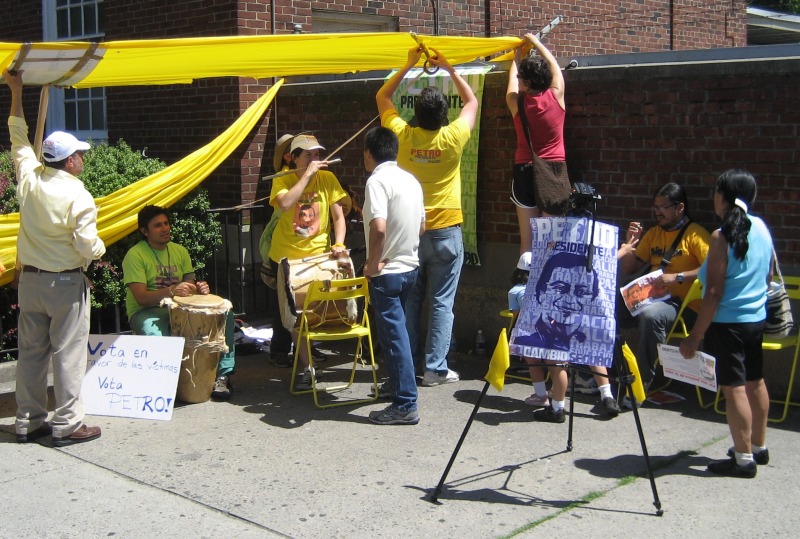
People were standing around filling out forms on clipboards. Others carried red, yellow and blue flags. “Venezuela?” I wondered. No, Venezuela has stars. Finally campaign posters and small groups chanting for their candidate. I caught the name Columbia, and at last understood that people were campaigning for mail-in ballots.
I wandered back around, passing a lady who was selling meat kabobs from a grill set on a grocery cart beneath the elevated tracks. I was tempted, because the last street vendor of this nature I had seen was nearly a decade ago, in Bangkok. I was glad that New York had enough people from developing countries that someone had balls enough to (I assume) flout the authorities and sell some proper street food.
Back at the station I reconsidered my plan: the other trains ran underground, how far I did not now. There were also multiple service advisories: shuttle buses to Jamaica? Nah, I took the 7 to the end of the line: Flushing.
The Flushing station gave very much the impression of a transit outpost: plenty of people ride to the end of the line, and pass past a dozen signs indicating which buses connect nearby, then they go stand in long lines on the street to head, I assume, home. Also, everyone is Chinese. And many signs are posted in Chinese, without translation.
I wandered in the commercial bubble surrounding Flushing Main St, wandering into “malls” of little stalls. I didn’t buy anything, but I recalled that Mei’s parents had declared San Francisco Chinatown superior to the one in Manhattan, which was too cheesy. There was little dairy for sale in Flushing: just Chinese people selling goods and services to Chinese people. There was no self-consciousness of outsiders. I saw a man hold a little boy over a street curb so he could urinate in the gutter, as I thought to myself “there must be a toilet he could use.” In the basement level of one mall I caught sight of an ancient man sitting in a stall impassively watching a porno. The video screen was angled away from me but I could see what was on the screen. I smiled: people were being human and that was all there was to say.
A while back I outfitted my personal workstation with 4GB of RAM. That’s plenty of memory and since disk space was tight I didn’t want to waste any on a swap partition, and I lived happily without swap for a very long time until I began using more virtualization. (I freed up space on my physical desk top by migrating my work environment from a laptop to a virtual machine on my personal workstation.)
I wrote a script to add a “temporary” swap file on demand but what I wanted was a swap file at boot. That actually turns out to be pretty simple. In this case, I just prepare the swap file:
I recently migrated this web site to a virtual server at the Rackspace Cloud. I started with the cheapest, 256M slice, but after hitting some performance issues really quickly, I figured that the extra $10/month to grow the slice to 512M was worthwhile. Even so, I don’t think MySQL and Apache are tuned, out-of-the-box, for such “small” systems.
I am running WordPress, a PHP application, on Apache and MySQL, running on CentOS. I am using Munin to track the system health. Since MySQL performance tuning can be extremely complicated I have focussed my initial efforts on Apache.
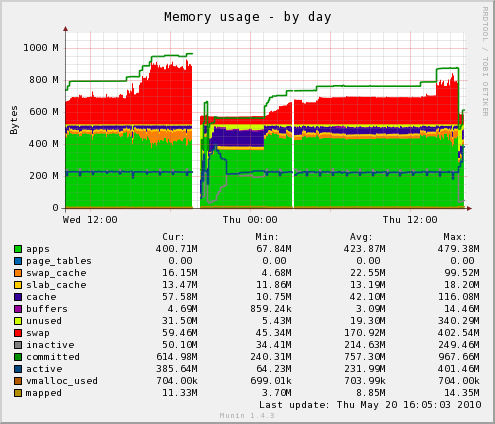
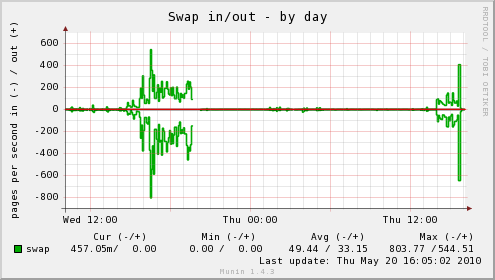
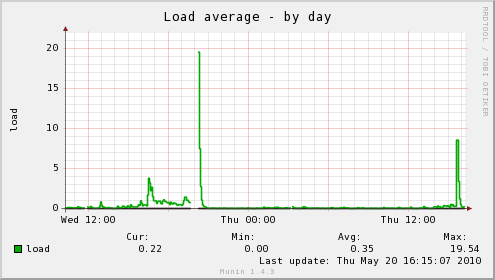
So, the memory graph would ideally top out at 512MB, but in practice, the system and programs allocate excess memory they rarely touch, and that gets paged out to swap. It is when the swap activity gets high that system performance goes to heck. A spike in system load is a good symptom of possible performance issues.
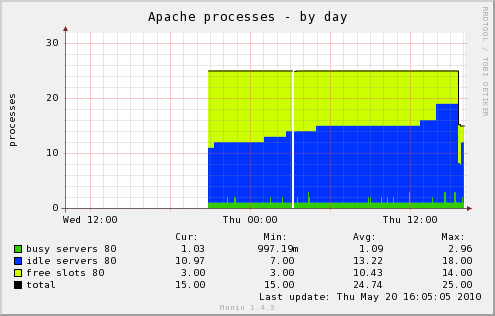
When things went bad on Wednesday, I tuned Apache down somewhat from the defaults and then enabled the Apache status page, and told Munin to go ahead and graph that. I am new to Munin, but Slicehost has some excellent articles on installing and configuring it in my environment.
This morning Munin sent me e-mail that it was having trouble collecting data, so I took a look, and reset performance values for Apache based on the above graph:
Hopefully, this will hold. I would love to audit the system memory use in greater detail to allow Apache some greater flexibility, but in the interests of achieving a stable system quickly, this will hopefully prove to be a good strategy.
So, occasionally someone asks “well, what will we replace Facebook with?” We don’t really need to replace it right away, but there are some NYU kids who figure it would be a fun project to build a distributed social network where you get your own little “seed” site on a server somewhere, and you can connect with your friends, determining what you intend to share with whom. It sounds totally doable, though who knows if they’ll actually manage to execute and gain traction.
They asked the Internet for $10,000 via KickStarter. So far they have been pledged $174,915. $25 of that is mine. I guess they won’t fail for lack of interest or money. Go go underdogs! :)
Oh, and if you’ve been tempted to ditch Facebook, but didn’t want to be the only crazy dweeb out there, you can join just over 6,000 other folks planning to quit on May 31: http://www.quitfacebookday.com/
Yes, I still use mutt. The killer feature it has over Gmail is that I can go through my old messages in forward-chronological order. That and I don’t have to hack my web browsers to display plain text messages in a monospace font. But, in order to use mutt with all the latest and greatest patches, I had to apt-get install mutt-patched.
It is convenient that they maintain a package with all the patches. Unfortunately, when I fired up mutt it had this ugly left-pane, like it wanted to be Outlook or something? So, I did a little research and tracked the sidebar to its source:
Unfortunately, though, mutt lacks an important feature that most email clients do have: a folder list that allows you to see all mail folders you have and how many (new) emails they each contain.
One person’s important feature is another person’s nuisance, but further down the page I found the config to turn the thing off: